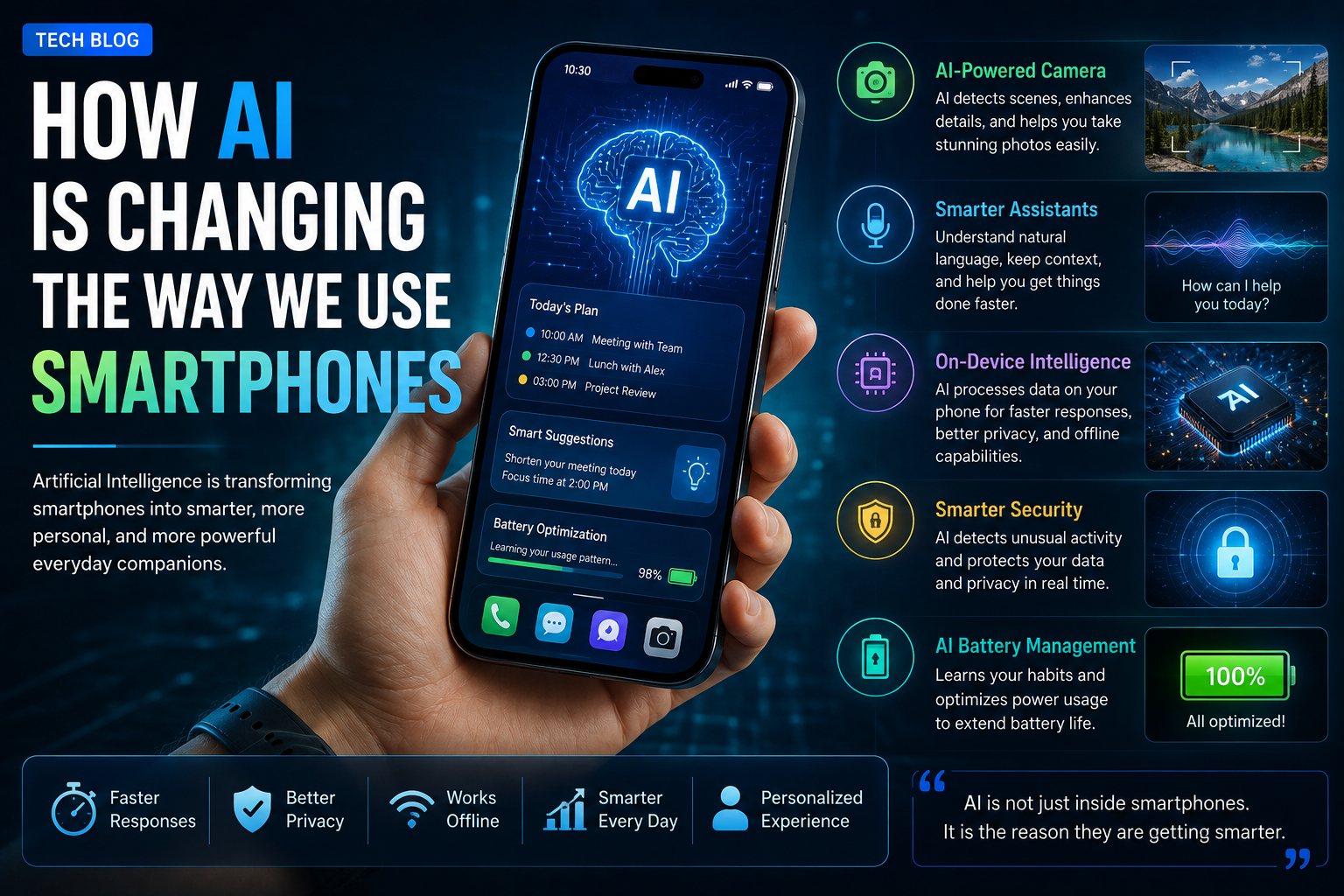
Smartphones have become an essential part of modern life. People use them for communication, entertainment, shopping, banking, education, photography, navigation, and work. But smartphones are now becoming much more than simple mobile devices.
Artificial Intelligence is changing how smartphones operate and how users interact with them. From smarter cameras and voice assistants to personalized recommendations and on-device security, AI is becoming an important part of the modern smartphone experience.
As AI technology continues to improve, future smartphones could become more personalized, intelligent, and capable of completing tasks automatically.
What Is AI Doing Inside Your Smartphone?
Many smartphone features already use AI, even when users may not realize it.
When your phone recognizes your face, improves a photograph automatically, predicts the next word you are going to type, or recommends content based on your interests, AI may be working behind the scenes.
Modern smartphones contain powerful processors designed to handle AI workloads. These chips allow certain AI tasks to happen directly on the device rather than sending every piece of information to a remote server.
This technology is commonly known as on-device AI.
AI Is Making Smartphone Cameras Smarter
One of the most noticeable uses of AI is smartphone photography.
Modern phone cameras can automatically recognize objects, faces, lighting conditions, landscapes, and other elements in a photograph. AI can then adjust settings to produce better results.
For example, computational photography can combine multiple images to improve brightness, reduce noise, and increase detail.
AI can also help smartphones improve portrait photography, night photography, image stabilization, and automatic editing.
This means users can often take high-quality photographs without understanding complicated camera settings.
AI-Powered Personal Assistants
Voice assistants have been available on smartphones for years, but generative AI is making digital assistants more capable.
Traditional assistants were mainly designed to respond to specific commands. Newer AI systems can understand more natural language and maintain context across multiple interactions.
In the future, users may be able to give an assistant a broader instruction such as:
“Plan my trip for next weekend and organize the information.”
Instead of simply answering a question, an AI assistant could potentially perform multiple steps using different applications and services.
This could turn smartphones into much more useful personal productivity tools.
AI and Smartphone Battery Life
AI is not only about adding new features. It can also help smartphones manage their resources more efficiently.
AI-powered systems can learn how users interact with their devices and optimize battery usage accordingly.
For example, a smartphone may identify applications that are rarely used and limit their background activity. It can also predict when certain applications are likely to be needed.
Better AI-powered resource management could help smartphones deliver improved battery performance without requiring significantly larger batteries.
AI and Mobile Security
Security is another important area where AI can improve smartphones.
Facial recognition and bio-metric authentication already use sophisticated algorithms to identify users. AI can also help detect unusual behavior and potentially suspicious activity.
For example, a security system could analyze patterns associated with applications, network connections, or login behavior.
However, AI-powered security must also protect user privacy. Companies need to ensure that sensitive information is handled responsibly and that users understand how their data is being processed.
Generative AI on Smartphones
Generative AI is becoming increasingly important in mobile technology.
Users can already find AI features that help generate text, summarize information, edit photographs, translate languages, and assist with productivity.
For example, someone writing an email on a smartphone may use AI to improve grammar or change the tone of the message.
AI can also help users summarize long documents or quickly understand information without manually reading every part.
As mobile processors become more powerful, more generative AI features may run directly on smartphones.
Why On-Device AI Matters
One of the biggest developments in mobile AI is the ability to process information locally.
Traditional AI services often require data to be sent to cloud servers for processing. On-device AI can perform certain tasks directly on the smartphone.
This can provide several benefits.
Faster Responses
Local processing can reduce the time required to send information to a server and receive a response.
Better Privacy
Some information can remain on the device instead of being sent to an external server.
Offline Features
Certain AI functions may continue working without an internet connection.
Lower Network Usage
Processing information locally can reduce the amount of data that needs to be transferred.
However, smartphones still have limited processing power compared with large data centers, so many advanced AI applications will continue to use a combination of on-device and cloud computing.
AI Could Change Mobile Apps
AI may also change how people use applications.
Today, users usually open an application and manually select different features. In the future, AI assistants could potentially act as a layer connecting multiple applications.
For example, instead of opening a calendar, email application, maps application, and messaging app separately, a user could give an AI assistant a single instruction.
The assistant could coordinate the necessary steps across different services.
This could make smartphones more focused on intent rather than individual applications.
Challenges of AI Smartphones
Despite the benefits, AI-powered smartphones also have challenges.
Privacy is one of the biggest concerns. AI systems can process large amounts of personal information, so companies must protect user data carefully.
Another issue is accuracy. AI systems can sometimes generate incorrect information or misunderstand user requests.
There is also the question of cost. Advanced AI hardware and features may increase smartphone prices, making the latest technology less accessible to some users.
Finally, greater AI automation could make users more dependent on intelligent systems. Maintaining human control and understanding how AI makes decisions will remain important.
What Will AI Smartphones Look Like in the Future?
The smartphone of the future may feel very different from today’s devices.
Instead of simply waiting for users to open applications, AI could continuously understand context and help users complete tasks.
A smartphone might know when someone is traveling, preparing for a meeting, studying, or working and automatically provide useful information.
Future devices may also offer more advanced real-time translation, personalized education, intelligent health and fitness features, automated productivity tools, and improved accessibility.
The goal is likely to move from smartphones that simply run applications to devices that can actively assist users.
Conclusion
Artificial Intelligence is transforming smartphones from traditional communication devices into increasingly intelligent digital assistants.
AI is improving cameras, security, battery management, voice assistants, productivity tools, and mobile applications. The growth of on-device AI is also making mobile technology faster and potentially more private.
There are still challenges involving privacy, accuracy, cost, and responsible AI development. However, the direction is clear: AI will play an increasingly important role in the future of mobile technology.
The smartphone may not disappear anytime soon. Instead, it is becoming smarter—and AI is at the center of that transformation.


Leave a Reply