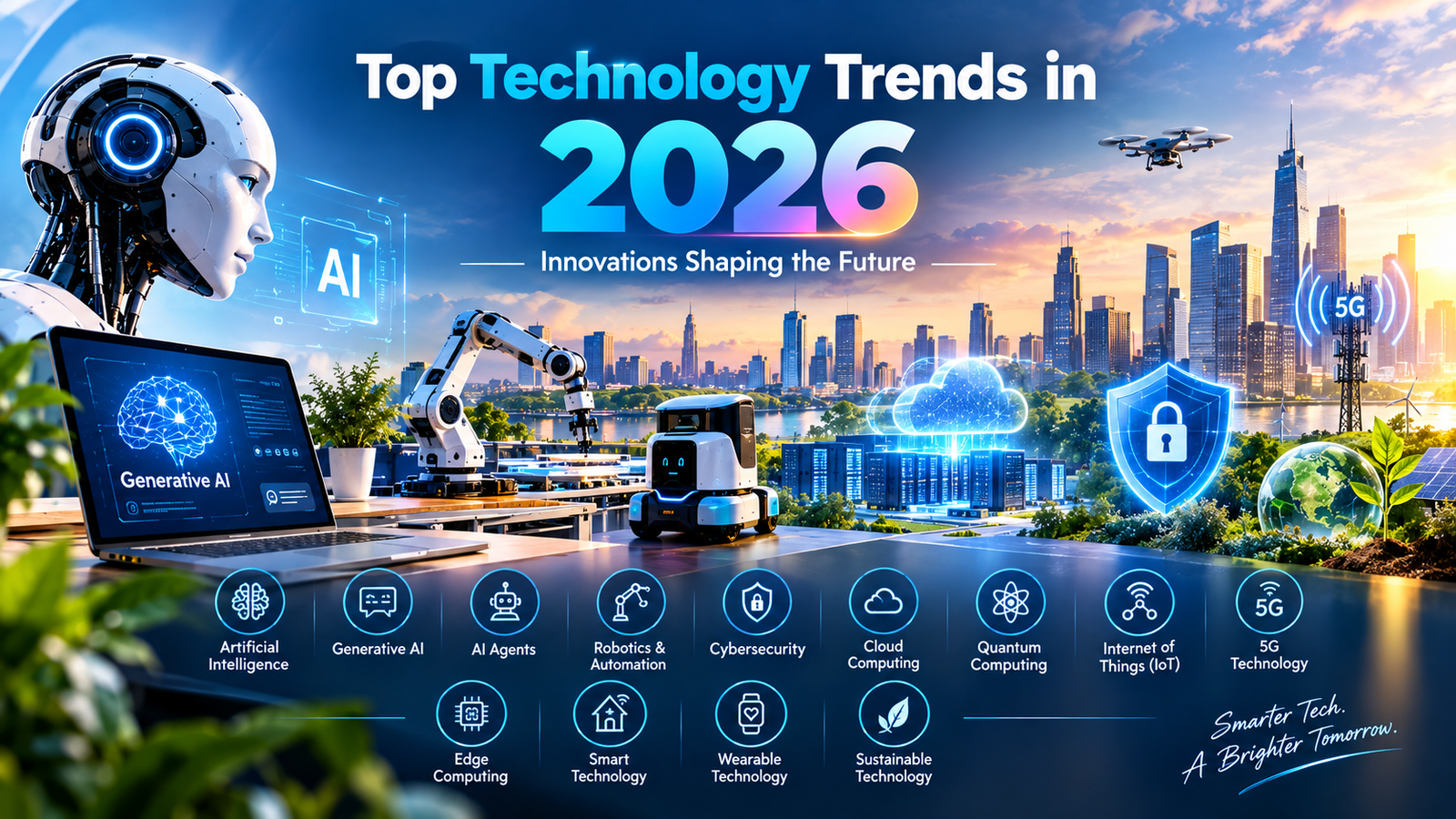
Technology is entering a new phase in 2026. Artificial intelligence is no longer limited to chat-bots and image generators, while robotics, cloud computing, cybersecurity, advanced connectivity, and smart devices are becoming increasingly interconnected. Businesses, governments, researchers, and consumers in the United States are adapting to a landscape in which software and physical systems increasingly work together.
The most important technology trends in 2026 are not isolated developments. Instead, generative AI is influencing software development, AI agents are beginning to perform multi-step tasks, robotics is becoming more intelligent, edge computing is bringing processing closer to users, and cybersecurity is adapting to new AI-driven threats. At the same time, quantum computing continues to advance, 5G networks support increasingly connected environments, and Internet of Things (IoT) devices generate vast amounts of real-world data.
This evolution is also creating new questions. For example, how should businesses secure autonomous AI systems? How can companies manage the growing energy demands of data centers? What role will robots play in manufacturing? How will smart technology affect everyday life? Which emerging technologies are likely to become more practical over the next few years?
Several major technology organizations already identify these areas as key parts of the next stage of digital transformation. Gartner’s 2026 strategic technology trends include AI-native development platforms, AI super-computing, multi-agent systems, physical AI, preemptive cybersecurity, and AI security platforms.
This article explores the major technology trends in 2026, with particular attention to how they affect U.S. consumers, companies, and technology professionals.
1. Artificial Intelligence Continues to Lead Technology Innovation
Artificial intelligence remains one of the most influential forces in the technology industry in 2026. However, the AI conversation is changing. Earlier waves of AI adoption focused heavily on conversational assistants, recommendation systems, and generative content. Now, the next stage is increasingly about AI systems that can reason over information, use tools, interact with software, and perform tasks.
Gartner’s 2026 technology outlook places AI-native development, AI super-computing, multi-agent systems, domain-specific language models and physical AI among its strategic trends. This illustrates how AI is spreading beyond a single application category into software engineering, infrastructure, and physical machines.
For U.S. businesses, this can mean integrating AI into customer support, marketing, software development, analytics, supply chains, and internal operations. Instead of treating AI as a separate tool, organizations are increasingly building it into existing workflows.
Artificial intelligence is also influencing scientific research. The World Economic Forum’s 2026 emerging technology report describes a broader shift toward using AI to help researchers model biological processes, identify potential drug candidates, and explore complex scientific problems.
This shift is changing how technology is developed. In this sense, AI is becoming part of the infrastructure used to create other technologies.
Why Artificial Intelligence Matters in 2026
AI’s growing importance comes from its ability to process enormous amounts of information and assist with tasks that previously required significant human time. AI can summarize documents, analyze data, generate software code, recognize patterns, and support decision-making.
However, AI also introduces challenges involving privacy, security, reliability, copyright, workforce changes, and responsible deployment. Companies therefore need more than powerful models. They need governance, monitoring, human oversight, and cybersecurity controls.
In 2026, the discussion is increasingly moving from “What can AI generate?” to “How can AI be safely integrated into real systems?” That shift leads naturally to generative AI, which expands the conversation further.
2. Generative AI Is Moving Beyond Text
Generative AI remains a major technology trend in 2026, but the technology is expanding beyond simple text generation. More broadly, modern generative systems can work across different formats, including text, images, audio, video, and software code.
Modern generative systems can work across different formats, including text, images, audio, video, and software code. This makes generative AI relevant to marketing teams, designers, software developers, educators, media companies and businesses of all sizes.
For example, a marketing team can use generative AI to develop an initial campaign concept, create product descriptions and produce variations of advertising content. Developers can use AI-assisted tools to explain code, generate functions, test ideas and accelerate software development.
The technology is also becoming increasingly connected to enterprise systems. Rather than simply responding to a prompt, AI applications can retrieve information from company databases, analyze documents, or interact with business software.
This creates significant opportunities, but it also increases the importance of verification. Consequently, generated information can contain errors, so organizations must establish processes to review AI-generated content before using it in high-impact situations.
Gartner expects domain-specific language models to become increasingly important because specialized models can provide better context for particular industries and business functions. Gartner projects that more than half of enterprise generative AI models could be domain-specific by 2028.
That suggests the future of generative AI may be less about one universal model and more about combinations of general and specialized AI systems. In other words, specialization may matter as much as scale.
3. AI Agents and the Rise of Autonomous Software
One of the most important developments in 2026 is the growth of AI agents. More specifically, these systems are moving autonomy into everyday software tasks.
Traditional AI assistants generally wait for a user instruction and produce an answer. AI agents are designed to perform more complex tasks by planning actions, using tools, accessing information, and interacting with software systems.
An AI agent might, for example, receive a business objective and then break it into multiple steps. It could gather information, organize the results, create a report, and send the completed work through an approved application.
This concept is closely associated with agentic AI and multi-agent systems. In Gartner’s view, multi-agent systems are a major strategic technology trend for 2026, describing systems in which multiple specialized agents can work together on complex tasks.
The rise of the AI agent builder is making this technology more accessible. As a result, businesses can increasingly use agent-building platforms to configure AI systems for specific workflows instead of developing every component from scratch.
Possible applications include:
- Customer-service automation
- Research and information gathering
- Software-development assistance
- Scheduling and administrative work
- Data analysis
- Enterprise workflow automation
- Sales support
- Document processing
But autonomous software brings new risks. An agent with access to email, company databases, or financial systems can potentially cause greater damage if its permissions, identity, or actions are not properly controlled.
NIST’s 2026 research on AI agent security highlights concerns surrounding the unique security risks of autonomous agents. Responses to NIST’s request for information emphasized that traditional cybersecurity principles remain useful but may need adaptation for agentic systems.
NIST has also launched an AI Agent Standards Initiative focused on secure adoption, interoperability, and standards for systems capable of autonomous action.
This makes AI agents both a major innovation opportunity and an important cybersecurity issue in 2026. With that in mind, physical AI and intelligent robotics are the next major development.
4. Physical AI and Intelligent Robotics
Robotics is entering a more intelligent phase as artificial intelligence becomes increasingly integrated with physical machines. In this next stage, systems are moving from fixed instructions toward AI-enabled perception, planning, navigation, and adaptation.
Traditional robots generally operate according to predefined instructions. By contrast, newer systems can use AI for perception, planning, navigation, and adaptation. This is sometimes described as physical AI because it connects artificial intelligence directly to machines that interact with the physical world.
The International Federation of Robotics identifies AI and autonomy as a major global robotics trend for 2026. It notes that analytical AI can help robots process data, identify patterns, anticipate failures, and improve planning, while generative AI can support a shift away from strictly rule-based automation.
This trend is visible in manufacturing, warehouses, logistics, healthcare, and other sectors.
The U.S. robotics market provides a useful example. According to preliminary International Federation of Robotics data, U.S. industrial robot installations increased 11% year over year to about 38,000 units in 2025. During that period, the food industry grew particularly strongly, while automotive remained the largest adopter.
This trend extends beyond factories. Mobile robots, autonomous warehouse systems, medical robots, and emerging humanoid machines are also expanding the definition of automation.
AI Robotics News and the Changing Robot Industry
Search interest in AI robotics news increasingly focuses on how AI models connect to robots rather than on robotics hardware alone.
The important question is no longer simply how accurately a robot can repeat a movement. It is whether the machine can understand its environment, respond to changes, and perform useful tasks with less manual programming.
This is especially relevant to warehouses and manufacturing environments where robots can work alongside software systems, sensors, and human employees.
Top Robotics Companies and Industry Development
The robotics industry includes long-established industrial manufacturers and companies developing warehouse, medical, mobile, and humanoid robots. Companies such as FANUC, ABB, Yaskawa, KUKA and Universal Robots have significant positions in industrial automation, while companies such as Intuitive Surgical and Boston Dynamics operate in specialized robotics markets.
There is no single definition of a “top” robotics company because the industry covers very different sectors. A manufacturing robot manufacturer, surgical robotics company, and humanoid robotics developer serve different purposes.
For businesses evaluating robotics in 2026, factors such as reliability, integration, safety certification, service support, software compatibility, and the specific application often matter more than brand popularity.
5. Automation Becomes More Intelligent
Automation has existed for decades, but AI is changing what it can automate.
Traditional automation works best when processes are predictable. AI-powered automation can potentially handle more variable situations because machine-learning models can recognize patterns and interpret unstructured information.
For example, a traditional workflow might automatically move a document from one folder to another. An AI-enabled workflow could classify the document, extract information, identify missing fields, and route it to the appropriate department.
This creates a convergence between automation, generative AI, and AI agents.
In the future, organizations may operate workflows where humans establish business rules while AI systems handle routine decisions and execution within predefined limits.
However, automation should not automatically mean removing human involvement. In areas involving financial decisions, medical information, legal processes, security, or sensitive personal data, human review may remain essential.
6. Cybersecurity Enters the AI Era
As organizations adopt more AI systems, cybersecurity is becoming more complex.
AI can help defenders analyze huge quantities of security information, identify unusual activity, and prioritize potential threats. At the same time, attackers can use AI to create convincing phishing messages, automate reconnaissance, and develop new attack strategies.
This creates a rapidly changing security environment.
Gartner lists preemptive cybersecurity and AI security platforms among its strategic technology trends for 2026. Its outlook emphasizes moving toward proactive protection while establishing security controls specifically for AI systems.
NIST is also developing guidance in this area. In August 2026, NIST released a draft guide showing how AI could analyze, plan, implement, and monitor Cybersecurity Framework 2.0 outcomes.
Security Challenges Created by AI Agents
AI agents create additional concerns because they can interact with external applications.
An ordinary chat-bot may provide information. An agent could potentially use that information to take actions. As a result, identity, authentication, permissions, and monitoring become especially important.
NIST’s work on agent identity and authorization emphasizes the need to understand the risks created when agents receive access to different datasets, applications and tools.
Businesses adopting AI in 2026 therefore need to consider not only model accuracy but also access control, data protection, logging, identity management and incident response.
7. Cloud Computing Gets More AI-Centric
Cloud computing remains a foundation for modern digital services, but the cloud environment is changing as AI workloads grow.
AI systems require significant computing resources for training, inference, storage, and data processing. This is increasing demand for specialized infrastructure, high-performance networking, and AI-optimized data centers.
Gartner’s 2026 trends include AI super-computing platforms, reflecting the growing importance of infrastructure that can handle demanding AI workloads.
Cloud platforms are also becoming more important for businesses that do not want to purchase and operate all their own specialized infrastructure.
Companies can use cloud services for machine learning, databases, analytics, software development, cybersecurity, and AI applications.
At the same time, organizations are becoming more cost-conscious. Running large AI workloads continuously can be expensive, so businesses may increasingly combine cloud systems with smaller models, specialized hardware, and edge processing.
The future therefore is not simply “everything moves to the cloud.” Instead, computing is becoming more distributed.
8. Edge Computing Brings Intelligence Closer to Users
Edge computing processes data closer to where it is generated, rather than sending every piece of information to a distant cloud data center.
This approach matters for applications that require rapid responses.
Consider an industrial robot monitoring a manufacturing line. Waiting for every sensor event to reach a remote server and return an answer may add unnecessary latency. Processing critical data locally can make the system more responsive.
Deloitte identifies edge AI as an important technology signal, noting that AI processing is increasingly moving toward devices such as smartphones, smartwatches, security cameras, and industrial robots. It highlights latency, privacy, cost, and internet dependence as key drivers of this shift.
Edge computing can work alongside cloud computing rather than replace it.
A device might process urgent information locally while sending selected data to the cloud for long-term analysis.
This hybrid model is particularly useful for smart factories, connected vehicles, healthcare devices, retail systems, and large IoT networks.
9. Quantum Computing Moves Closer to Practical Applications
Quantum computing remains an emerging technology, but 2026 is a key year for research and commercialization.
Unlike classical computers, quantum computers use quantum mechanical phenomena to process information in fundamentally different ways. They are not expected to replace ordinary computers for everyday computing—instead, their potential lies in solving specific categories of complex problems.
Possible applications include materials science, drug discovery, financial optimization, chemistry, and advanced simulation.
IBM has identified 2026 as a potential milestone year for demonstrating quantum advantage, referring to cases in which a quantum computer could solve a problem more effectively than classical methods. This is IBM’s stated outlook rather than an independently established conclusion, and practical quantum advantage remains dependent on the specific task and technology involved.
The World Economic Forum’s 2026 emerging technology report also includes quantum-related developments among technologies approaching broader real-world impact.
For the average consumer, quantum computing may not produce an immediately visible change in 2026. Its significance is more likely to appear through research breakthroughs and specialized applications.
10. Internet of Things Connects the Physical World
The Internet of Things (IoT) continues to expand as more physical objects become connected to networks and software.
IoT devices can include industrial sensors, home appliances, medical equipment, vehicles, security cameras, and environmental monitoring systems.
The value of IoT doesn’t come simply from connecting devices. It comes from collecting information and using that information to make better decisions.
For example, sensors inside a factory can monitor temperature, vibration, and machine performance. Data analysis can then identify unusual patterns before equipment fails.
Combining IoT with artificial intelligence creates what is often described as AIoT—AI combined with connected devices.
This combination can make systems more responsive because sensors continuously produce data while AI models analyze that information.
IoT will also remain important in smart cities, logistics, and connected infrastructure.
However, more connected devices also mean a larger cybersecurity attack surface. Organizations need secure device authentication, software updates, network segmentation, and careful data management.
11. 5G Technology Supports Connected Experiences
5G technology continues to evolve from being primarily a faster mobile connection into an infrastructure layer for connected devices, industrial applications and private networks.
High-performance wireless connectivity can support applications involving robotics, IoT, augmented and extended reality, connected vehicles and industrial automation.
Private 5G networks are particularly interesting for businesses that require control over connectivity within a specific location. GSMA describes private 5G architectures that can support automation, robotics, extended reality, and large-scale IoT environments.
For U.S. businesses, the practical value of 5G will depend on the application. A consumer may primarily notice improved connectivity, while a manufacturer could use private wireless networking to connect machines, sensors and mobile robots.
The combination of 5G, IoT and edge computing could become particularly significant because these technologies complement one another:
5G provides connectivity.
IoT generates data.
Edge computing processes data close to the source.
AI analyzes the information and supports decisions.
Together, these technologies form a foundation for highly connected digital environments.
12. Smart Technology Becomes More Personalized
Smart technology is becoming increasingly integrated into everyday environments.
Smart homes can combine connected lighting, security systems, appliances, thermostats, and entertainment devices. Smart offices can use sensors to understand occupancy and energy consumption. Retailers can use connected technologies to manage inventory and improve customer experiences.
Artificial intelligence adds another layer by enabling more personalized, context-aware behavior.
Instead of simply responding to manual commands, future smart systems can increasingly use data to anticipate common needs while still requiring appropriate privacy and security controls.
The challenge is finding the right balance between convenience and data protection.
Consumers may value personalized services, but they also need to understand what information is being collected, where it is stored, and how it is used.
13. Wearable Technology Becomes More Intelligent
Wearable technology continues to move beyond conventional fitness tracking.
Smartwatches, smart rings, earbuds, and other wearable devices can increasingly collect information from the user’s environment and body.
As sensors improve and on-device AI becomes more capable, wearable devices can potentially provide more personalized insights while reducing the need to send every piece of data to cloud services.
Deloitte’s technology analysis points to growing interest in edge AI, where processing can occur directly on devices such as smartwatches and other connected hardware.
Wearable s are also becoming part of broader digital ecosystems. A smartwatch can connect to a smartphone, cloud service, smart home, and other applications.
The major development, therefore, is not simply better wearable hardware. It is the connection between devices, AI, and personalized computing.
14. Sustainable Technology and the Energy Challenge
Technology innovation also brings environmental challenges.
AI systems require computing infrastructure, and data centers consume significant amounts of electricity. The rapid expansion of AI therefore increases the importance of efficient chips, cooling technologies, renewable power, and improved data center design.
The International Energy Agency reports that global data center electricity consumption increased by 17% in 2025, while electricity use from AI-focused data centers grew even faster. The IEA projects that global data center electricity consumption could approximately double from 485 TWh in 2025 to around 950 TWh by 2030.
The United States is especially important in this discussion. The IEA projects U.S. electricity demand to grow by nearly 2% annually through 2030, with approximately half of the increase driven by expanding data center demand.
This means sustainable technology is becoming more closely connected to AI infrastructure.
Companies are exploring ways to reduce energy use through more efficient processors, better cooling, workload optimization, renewable energy, and improved data center management.
The sustainability discussion also extends to electronic waste, device life-cycles, semiconductor manufacturing, and the environmental costs associated with producing connected technologies.
15. AI Infrastructure Becomes a Technology Trend of Its Own
AI applications receive most of the public attention, but the infrastructure supporting them may be equally important.
Modern AI requires processors, memory, networking, data storage, cooling systems, and large-scale data centers.
Gartner describes AI super-computing platforms as systems combining Cups, GPUs, AI accelerators and other computing architectures to handle intensive workloads.
This infrastructure is also influencing physical data center design.
The IEA reports that AI server power density increased substantially between 2020 and 2025 and expects further increases in the coming years, creating additional pressure on electricity infrastructure and data center engineering.
For consumers, this trend may be invisible. But behind every major AI application is a physical infrastructure layer that determines its speed, cost, and environmental footprint.
16. Confidential Computing and Data Protection Gain Importance
As businesses process sensitive information in cloud and AI environments, protecting data while it is being processed is becoming increasingly important.
Confidential computing protects data during processing using hardware-based security mechanisms.
Gartner includes confidential computing among its strategic technology trends for 2026, highlighting it as part of the foundational architecture needed for secure digital transformation.
This is particularly relevant to industries that handle sensitive information, including finance, healthcare, government, and enterprise services.
The broader direction is clear: organizations are seeking ways to make advanced computing useful without unnecessarily exposing sensitive information.
17. Digital Provenance Becomes More Important in an AI World
As AI-generated content becomes common, determining where digital information came from can become increasingly difficult.
Digital provenance refers to the ability to establish the origin, ownership, or integrity of digital assets.
Gartner lists digital provenance among its strategic technology trends for 2026 and connects it with issues such as third-party software, open-source code, and AI-generated content.
For businesses, provenance can help answer important questions:
Did AI generate this image?
Where did this dataset come from?
Has this software component been modified?
Who created this document?
Can the origin of a digital asset be verified?
These questions matter more as organizations rely on large amounts of digital information.
18. AI and Robotics Are Converging
One of the most important themes in 2026 technology trends is convergence.
AI is not developing separately from robotics, IoT, cloud systems, or edge computing. Instead, these technologies are becoming parts of the same ecosystem.
Imagine a warehouse where sensors collect information, edge computers process local data, AI software plans tasks, and mobile robots move products. The cloud stores broader operational data while cybersecurity systems monitor the entire environment.
This is not a single technology. It is a technology stack.
The robotics industry is already experiencing this convergence. IFR’s 2026 robotics outlook highlights AI and autonomy, while its U.S. data shows continued industrial robot adoption.
The same pattern is appearing in smart factories, autonomous vehicles, healthcare systems, and connected infrastructure.
19. The Future of Work Will Become More Technology-Driven
The expansion of AI, automation and robotics will influence how people work.
Some repetitive tasks may increasingly be handled by software or machines, while human workers may spend more time on problem-solving, communication, creativity, supervision and decision-making.
This does not necessarily mean every job will disappear. Technology adoption is often more complicated than replacing an entire occupation. A system may automate selected tasks while increasing the productivity of the worker performing the remaining tasks.
AI agents could handle administrative workflows. Generative AI could help employees produce initial drafts. Robotics could automate physically repetitive operations. Analytics systems could help managers identify patterns.
This makes digital skills increasingly valuable.
Professionals entering technology-related fields may benefit from understanding AI, cybersecurity, data analysis, cloud infrastructure, automation, and system integration.
20. Technology Trends in 2026 Point Toward Convergence
The most significant lesson from 2026 is that the future of technology will not be defined by one innovation.
Artificial intelligence provides intelligence.
Generative AI creates content and assists with knowledge work.
AI agents perform multi-step tasks.
Robotics brings intelligence into the physical world.
IoT connects sensors and devices.
5G provides high-performance connectivity.
Edge computing processes information close to where it is generated.
Cloud computing provides scalable infrastructure.
Quantum computing explores new forms of computation.
Cybersecurity protects increasingly complex systems.
Sustainable technology addresses the energy and environmental consequences of this expansion.
These technologies are increasingly interconnected.
For example, an intelligent robot may use AI for decision-making, IoT sensors for environmental information, edge computing for rapid processing, 5G for communication, and cloud computing for larger-scale analysis. Cybersecurity protects the entire system, while efficient infrastructure helps manage energy consumption.
This convergence is likely to define the next phase of digital transformation.
What Technology Trends in 2026 Mean for U.S. Businesses
For U.S. businesses, the major challenge is not simply identifying new technologies. The challenge is determining where each technology can create practical value.
A small business may benefit from generative AI, cloud software and automated customer support without investing in advanced robotics or quantum computing.
A manufacturer may focus on industrial robots, edge computing, IoT sensors, private 5G and predictive maintenance.
A financial company may place greater emphasis on cybersecurity, AI governance, cloud infrastructure and confidential computing.
A technology company may invest heavily in AI agents, specialized models and AI infrastructure.
The right technology strategy therefore depends on business needs, not hype.
Organizations should evaluate potential investments by considering cost, security, integration requirements, employee skills, regulatory obligations, measurable benefits and long-term scalability.
Challenges That Could Shape Technology Adoption
Despite rapid innovation, technology adoption still faces challenges.
The first is security. AI agents, connected devices, and cloud systems create new attack surfaces.
The second is cost. AI infrastructure and data center expansion can require significant capital and energy.
The third is skills. Businesses need people who understand both emerging technologies and how to implement them.
The fourth is trust. Customers and employees need confidence that AI systems will handle their data responsibly.
The fifth is reliability. A technology demonstration may work in a controlled environment but still require significant development before becoming reliable at commercial scale.
These challenges are why responsible implementation is becoming just as important as technical innovation.
Frequently Asked Questions About Technology Trends in 2026
What is the biggest technology trend in 2026?
Artificial intelligence is one of the central technology trends in 2026, but the broader trend is the convergence of AI with robotics, cloud computing, cybersecurity, IoT, edge computing, and advanced infrastructure. Gartner’s 2026 strategic technology trends place AI-related technologies across foundational computing, intelligent orchestration, and security.
What are AI agents?
AI agents are software systems designed to perform tasks with some autonomy. They can use information, tools, and applications to complete multi-step objectives. NIST is actively developing security and standards work for AI agents because autonomous actions create new identity, authorization, and cybersecurity considerations.
Why is generative AI important in 2026?
Generative AI can produce text, images, audio, video, and code, making it useful across many business and consumer applications. Its next stage increasingly involves integration with specialized models, enterprise data, and AI agents rather than simple standalone content generation.
Is robotics becoming more important?
Yes. Robotics adoption continues across manufacturing and other industries, while AI is increasing the autonomy and adaptability of physical machines. The IFR reported that U.S. industrial robot installations increased 11% in 2025 to approximately 38,000 units.
Will quantum computing replace normal computers?
Quantum computers are not expected to replace ordinary computers for general everyday tasks—their potential lies in specialized problems where quantum approaches may outperform classical computing.
How are 5G and IoT connected?
5G can provide wireless connectivity for large numbers of connected devices and demanding applications. IoT systems generate data, while edge and cloud computing process it. Private 5G networks can also support enterprise applications such as robotics, automation, and IoT.
Why is sustainable technology becoming important?
Technology infrastructure requires physical resources and energy. The rapid growth of AI data centers is increasing electricity demand, making energy efficiency, renewable power, cooling systems, and responsible infrastructure design increasingly important.
Conclusion
The technology trends in 2026 show the industry moving from isolated digital tools to highly connected intelligent systems.
Artificial intelligence and generative AI remain major drivers, but the next stage of innovation is broader. AI agents are beginning to perform multi-step workflows, robotics is becoming more autonomous, cloud infrastructure is evolving around AI workloads, and edge computing is bringing intelligence closer to users and machines.
At the same time, cybersecurity is becoming more important as organizations deploy autonomous systems and connected devices. Quantum computing continues to progress toward specialized applications, while IoT, 5G and smart technology create increasingly connected environments.
Sustainability will also remain a major part of the technology conversation. As AI infrastructure expands, businesses and data center operators will need to pay closer attention to electricity consumption, cooling, hardware efficiency, and environmental impact.
For the United States, these developments represent both opportunities and practical challenges. Businesses that adopt technology effectively will need more than access to the latest tools. They will need strong infrastructure, security, skilled workers, responsible governance and a clear understanding of where technology creates measurable value.
The future of technology is therefore not one single machine, application or breakthrough. It is an interconnected ecosystem in which AI, automation, robotics, cloud computing, cybersecurity, connectivity and smart devices increasingly work together.
That convergence is what makes 2026 an important year in the continuing evolution of the digital world.





Leave a Reply