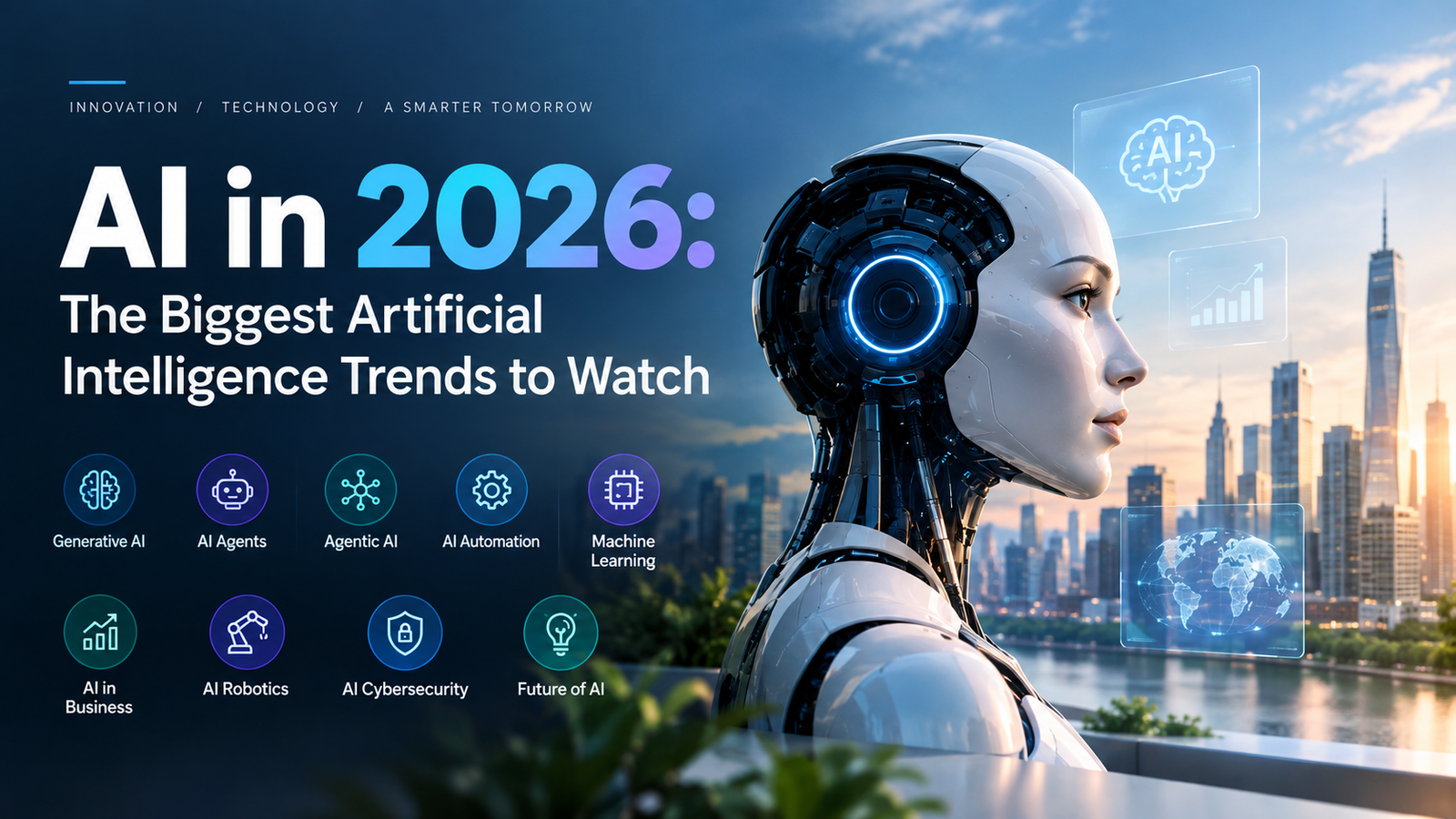
Artificial intelligence is entering a new phase in 2026, moving beyond chat-bots, image generation, and simple automation into everyday business operations, software development, cybersecurity, scientific research, education, and robotics.
The most important AI trends in 2026 are not simply about larger language models. The industry is shifting toward AI systems that can reason through complex problems, work with multiple types of information, use external tools, complete multi-step tasks, and interact with real-world environments.
According to Stanford HAI’s 2026 AI Index, organizational AI adoption reached 88%, while generative AI reached an estimated 53% population adoption within three years globally. AI capabilities also continue to improve rapidly across reasoning, coding, multi-modal understanding, robotics, and agentic systems.
For people and businesses in the United States, these developments are especially significant. The U.S. remains a major center of AI investment, infrastructure, and model development. Stanford reports that the United States hosted 5,427 data centers and attracted $285.9 billion in private AI investment in 2025, reinforcing its AI capacity.
So, what should we expect from artificial intelligence in 2026?
Generative AI, AI agents, agentic AI, machine learning, automation, robotics, cybersecurity, and the broader future of AI are shaping the technology landscape in 2026.
What Are the AI Trends 2026?
The phrase AI trends 2026 refers to the major technological developments, applications, business strategies, and research directions influencing artificial intelligence during 2026.
Some of the most important developments include:
- More capable generative AI systems
- AI agents that can complete multi-step tasks
- Growth of agentic AI and autonomous workflows
- Greater use of AI automation in companies
- Multi-modal AI combining text, images, audio, and video
- AI-powered software development
- AI robotics and physical AI
- AI cybersecurity and AI-assisted cyber defense
- More specialized and efficient machine learning models
- Increased use of AI in science, medicine, and education
- Greater emphasis on AI governance, evaluation, privacy, and security
These developments are connected. Generative AI provides content and reasoning capabilities, machine learning provides much of the underlying technology, AI agents add the ability to take actions, and automation connects AI capabilities to real business processes in 2026.
1. Generative AI Is Becoming More Capable and More Useful
One defining artificial intelligence trend in 2026 is the continued development of generative AI.
Generative AI refers to systems that can produce new content such as text, images, video, audio, software code, summaries, designs, and other forms of digital output. Earlier generations of these systems often focused on responding to a prompt. In 2026, the focus is increasingly shifting toward systems that can understand context, reason over information, work across different media, and complete longer tasks.
The technology is also becoming more deeply integrated into existing software, making it easier to use in daily workflows.
Instead of opening a separate AI website, a user may encounter AI directly inside a document editor, email client, customer relationship platform, coding environment, design application, search engine, or enterprise system, bringing AI into routine tasks.
This makes generative AI less of a standalone novelty and more of an underlying computing capability that affects how people work.
Stanford’s 2026 AI Index reports rapid progress across multi-modal reasoning, coding, mathematics, language, image and video understanding, although it also emphasizes that AI performance remains uneven and benchmark results can sometimes hide important weaknesses, which affects reliability in use.
For businesses, the practical question is therefore changing because adoption now depends on workflow impact.
It is no longer simply:
“Can generative AI create something?”
The more important question is:
“Can generative AI reliably complete part of a real workflow?”
That distinction will shape adoption throughout 2026, because it determines where AI adds real value.
How Generative AI Is Being Used
Businesses are applying generative AI to marketing drafts, customer support, documentation, internal search, software development, research, data analysis, sales assistance, training materials, and creative production, improving speed and productivity in these areas.
Consumers are using it for learning, writing, planning, brainstorming, programming, image creation, and personal productivity, helping them complete tasks more efficiently.
The next stage will likely involve deeper integration between generated content and organizational data in 2026.
For example, instead of asking an AI model a general question about sales, an employee could ask it to analyze company sales information, identify unusual changes, prepare a summary, and create a report for a meeting, saving time on analysis.
That moves generative AI closer to an operational assistant rather than merely a content generator, increasing its practical value.
2. AI Agents Are Moving From Conversation to Action
Another major AI trend for 2026 is the growth of AI agents.
A traditional chat-bot usually waits for a user request and responds. An AI agent is designed to perform a sequence of actions toward a goal.
For example, an agent may be asked to research several suppliers, compare prices, prepare a report, organize the findings, and recommend next steps. The system may use search tools, databases, APIs, browsers, spreadsheets, or software applications as it works through the task.
That difference is important.
AI agents are about doing, not only answering, which changes how tasks get completed.
Stanford’s 2026 AI Index reports that agent performance on OSWorld, a benchmark for computer-use tasks, increased from roughly 12% to 66.3%, although agents still fail a significant portion of structured tasks, limiting full autonomy.
This suggests meaningful progress while also showing why human oversight remains important for reliable results.
AI Agents in the Workplace
Companies are particularly interested in agents for repetitive digital workflows where automation can save time.
Examples include:
- Processing customer requests
- Reviewing documents
- Scheduling activities
- Generating reports
- Supporting sales operations
- Monitoring internal systems
- Writing and testing software
- Researching information
- Managing routine administrative tasks
McKinsey’s 2026 global survey found that 40% of respondents from large organizations reported scaling AI agents, up from 27% in the prior year. The figure was lower among smaller organizations, where 22% reported scaling agents, showing uneven adoption across company sizes.
This difference illustrates an important point about the future of AI: adoption is not occurring at the same speed everywhere, which affects how quickly benefits spread.
Large organizations often have more data, technical staff, budgets, and established digital infrastructure. Smaller companies may still need to determine where agents provide measurable value before investing heavily, slowing their adoption.
3. Agentic AI Could Change How Software Works
Agentic AI takes the AI-agent concept further by focusing on systems that can plan, use tools, make decisions within defined boundaries, and work toward objectives across multiple steps, expanding what software can do.
The basic idea is relatively simple.
A traditional software application follows predefined logic.
A chat-bot receives a question and returns a response.
An agentic system can receive a goal and determine the sequence of actions needed to pursue it.
For example, an online retailer could use an agentic system to monitor inventory, identify products approaching stock-out levels, analyze sales patterns, prepare purchase recommendations, and send the relevant information to a human manager for approval, improving oversight and response time.
The agent does not necessarily replace the employee. Instead, it shifts the employee’s role from performing every task to supervising a process, changing daily work.
Agentic AI and Software Development
Software development is already becoming an important area for agentic AI, changing how teams build products.
McKinsey’s 2026 research found that about two in ten surveyed organizations were scaling software coding agents, while 32% reported that their organizations had decided not to purchase at least one software product or feature because they could build the functionality internally using agentic coding tools.
That could change the economics of software creation by shifting costs and build choices.
Instead of manually implementing every component, developers may increasingly describe requirements, review AI-generated code, test results, identify problems, and guide multiple AI systems through development tasks, speeding up parts of the process.
The human role remains important because software must still be tested for security, reliability, maintainability, and compatibility to protect product quality.
The likely direction is not simply “AI replaces programmers.” A more realistic model is human engineers working with increasingly capable AI development tools, changing how they collaborate.
4. AI Automation Is Becoming More Intelligent
Automation has existed for decades, but AI automation differs from traditional rule-based automation because it can handle more complex work.
Traditional automation generally follows explicit instructions:
If condition A happens, act B.
AI-powered automation can work with less structured information. It can interpret language, classify documents, extract relevant information, identify patterns, and make decisions within predefined limits, reducing manual review.
For example, an insurance workflow could receive a customer document, extract relevant information, categorize the request, identify missing information, prepare a response, and send the case to a human reviewer when confidence is low, improving speed and consistency.
This combination of machine learning, generative AI, and workflow software is creating a broader category of intelligent automation that changes operations.
Why AI Automation Matters
Automation is often most valuable when tasks are repetitive, measurable, and relatively well defined.
Stanford’s 2026 AI Index reports productivity gains in several structured areas, including customer support, software development, and marketing, while also noting that benefits can be smaller for tasks requiring deeper reasoning.
This is an important distinction.
AI automation isn’t automatically valuable just because it involves AI. Companies still need to identify the processes where automation reduces costs, improves speed, increases quality, or creates a better customer experience.
In 2026, businesses are increasingly moving from experimental AI projects toward this practical question of measurable value.
5. AI in Business Is Moving From Experimentation to Workflow Integration
The phrase AI in business now covers much more than chat-bots.
Organizations are using AI across customer service, marketing, finance, software development, operations, human resources, research, sales, and knowledge management.
McKinsey’s 2026 survey illustrates the scale of adoption. Chat-bots were the most widely scaled AI tool in the survey, with 47% of respondents reporting enterprise-wide scaling. At the same time, AI agents and coding agents were increasingly entering operational workflows.
The next stage of business adoption is therefore likely to focus on integration.
Consider a modern customer-service process.
A customer sends a request. An AI system can understand the message, retrieve information from a company knowledge base, identify the appropriate policy, draft a response, update a CRM record, and escalate complicated cases to an employee.
The result is not simply an AI chat-bot. It is an AI-enabled business workflow.
AI for Small Businesses
AI is also lowering the barrier to sophisticated digital capabilities for smaller companies.
A small business may use AI to create marketing content, analyze customer feedback, generate product descriptions, summarize financial information, support customers, automate administrative processes, or build internal software.
However, smaller businesses still need to consider data privacy, vendor dependence, accuracy, security, and the total cost of operating AI systems.
The best use of AI may not always be the most advanced model. A smaller, more specialized system could be faster, cheaper, and easier to control for a specific task.
6. Multi-modal AI Will Make AI More Natural to Use
Another major AI trend for 2026 is multi-modal AI.
Human communication is naturally multi-modal. We use language, images, sounds, gestures, video, and physical context simultaneously.
AI systems are increasingly moving in the same direction.
Instead of working only with text, modern models can combine multiple inputs and outputs.
Imagine taking a photograph of a machine problem and asking an AI system to explain what it sees—or uploading a long video and asking for a summary of specific events, or speaking naturally to an AI assistant while showing it a document.
These interactions make AI more accessible because users do not need to translate every problem into a perfectly structured text prompt.
Multi-modal AI is also important for robotics.
A robot needs to understand visual information, interpret instructions, reason about objects, and translate decisions into physical actions. That requires more than language generation.
Stanford’s 2026 AI Index tracks progress across image, video, language, speech, reasoning, robotics, and agentic systems, reflecting this broader movement toward systems that can operate across different kinds of information.
7. AI Robotics and Physical AI Are Expanding
For many years, AI was mostly associated with the digital world.
That is changing.
AI robotics combines artificial intelligence with machines that can interact with the physical environment. This includes industrial robots, autonomous vehicles, warehouse systems, humanoid robots, medical robotics, and other intelligent machines.
The challenge is much harder than generating text.
A physical robot must interpret the environment, understand spatial relationships, predict consequences, move safely, and react to unexpected situations.
Stanford’s 2026 AI Index found that robots succeeded on only about 12% of real household tasks in the evaluated benchmark, demonstrating the continued gap between controlled demonstrations and unpredictable physical environments.
Nevertheless, important progress is occurring.
In July 2026, Google DeepMind introduced Gemini Robotics 2 and Gemini Robotics ER 2, describing systems designed to provide robots with capabilities such as visual understanding, spatial reasoning, multi-step planning, dexterity, and coordination between robots.
These developments illustrate a wider industry direction sometimes called physical AI or embodied AI.
Where AI Robotics Could Have an Impact
Manufacturing is one obvious area because environments can be structured and repetitive.
Other potential uses include warehouses, agriculture, logistics, healthcare assistance, inspection, construction, and autonomous transportation.
However, physical AI introduces safety considerations that do not exist to the same extent in purely digital systems.
An incorrect chat-bot answer might waste time.
An incorrect robotic action could damage equipment or injure someone.
As a result, safety engineering, testing, monitoring, and human supervision will be essential.
8. AI Cybersecurity Is Becoming a Two-Sided Race
One of the more important AI trends in 2026 involves cybersecurity.
AI can help defenders analyze large volumes of security information, identify anomalies, summarize alerts, detect suspicious activity, and automate portions of incident response.
At the same time, attackers can also use AI to improve phishing, automate reconnaissance, generate malicious content, and scale cyber operations.
This creates a two-sided technology race.
Organizations therefore need to think about both:
Using AI to defend systems and securing the AI systems themselves.
NIST is actively developing guidance in this area. Its Cybersecurity Framework Profile for AI addresses cybersecurity risks associated with AI while also considering opportunities for AI to strengthen cybersecurity capabilities. NIST’s 2026 work includes further workshops and development around an AI-focused cybersecurity profile.
Securing AI Systems
AI systems introduce their own attack surfaces.
Organizations need to consider threats such as prompt injection, malicious inputs, data exposure, insecure tool use, model manipulation, unauthorized access, and unreliable outputs.
This becomes especially important when an AI agent has access to company systems.
A chat-bot that can only answer questions presents one level of risk.
An agent that can access email, databases, financial systems, customer records, or internal applications presents a much larger security challenge.
As AI becomes more autonomous, permission management and monitoring will become increasingly important.
9. Machine Learning Is Becoming More Specialized and Efficient
Although generative AI receives most of the attention, machine learning remains the foundation of countless AI applications.
Machine learning powers recommendation systems, fraud detection, forecasting, search, computer vision, medical applications, industrial systems, and many other tasks.
One important direction is specialization.
A giant general-purpose AI model is not always necessary.
For a specific scientific, industrial, or healthcare task, a smaller specialized model may perform better while requiring less computing power.
Stanford’s 2026 AI Index provides examples from medicine and biology in which smaller specialized models have outperformed larger systems on particular benchmarks. For example, it reports that a 111-million-parameter protein model outperformed previous leading methods on one benchmark, while a 200-million-parameter genomics model outperformed a much larger 40-billion-parameter model on another.
This suggests that the future of AI will not be defined only by model size.
Efficiency, training data quality, specialization, inference cost, latency, and reliability will matter, too.
Smaller AI Models and Local Processing
Another related trend is running AI closer to the user.
Instead of sending every task to a remote cloud service, some workloads can be processed locally on smartphones, computers, edge devices, and specialized hardware.
Local AI can offer advantages such as lower latency, greater privacy for some workloads, offline functionality, and reduced dependence on network connectivity.
This is particularly relevant to consumer devices, industrial systems, vehicles, and robotics.
10. Reasoning AI Is Moving Beyond Simple Answers
AI systems are increasingly designed to spend more effort on difficult tasks rather than immediately generating the first plausible answer.
This is part of the broader movement toward reasoning-oriented AI.
Reasoning capabilities matter for programming, mathematics, science, research, planning, legal analysis, data interpretation, and other tasks that require the system to work through several steps.
Stanford’s 2026 AI Index reports substantial gains on challenging evaluations and notes that some frontier models now perform at or above human baselines in several demanding areas. At the same time, the report emphasizes “jagged” performance, meaning models can excel at difficult tasks while still making surprising mistakes on seemingly simple ones.
That has practical implications.
Users should not assume that a high-performing AI system is equally reliable across every task.
For important decisions, outputs still need appropriate verification.
11. AI Is Becoming a Scientific Research Partner
The future of AI extends beyond consumer apps and business software.
AI is increasingly being used in scientific discovery.
Researchers are applying AI to biology, chemistry, physics, astronomy, climate modeling, drug discovery, protein analysis, and other areas.
Stanford’s 2026 AI Index reports approximately 80,150 AI-related publications in the natural sciences in 2025, up 26% from 2024. It also describes AI systems being used for increasingly complex scientific tasks, although fully autonomous research remains far from solved.
This is an important distinction.
AI can help scientists search huge datasets, generate hypotheses, model complex systems, analyze images, identify patterns, and propose experiments.
But scientific discoveries still require validation.
A model can produce a promising hypothesis without proving it is correct.
The combination of AI-generated ideas and human experimental validation may therefore become one of the decade’s defining research workflows.
12. AI in Healthcare Is Becoming More Practical
Healthcare is another major area where AI capabilities are moving from research toward practical applications.
AI can support medical documentation, patient communication, imaging analysis, research, administrative workflows, and clinical decision support.
Stanford’s 2026 AI Index reports broad adoption of AI-generated clinical notes in several hospital systems. It also reports that the U.S. Food and Drug Administration authorized 258 AI medical devices in 2025. However, the report notes important limitations in the evidence and evaluation processes surrounding many of these products.
The opportunity is substantial, but healthcare also demonstrates why accuracy, privacy, validation, and professional oversight matter.
AI should not be treated as automatically correct merely because it sounds confident.
In sensitive areas such as medicine, human professionals and established clinical processes remain central.
13. AI Is Changing Education and Professional Skills
AI is also reshaping education.
Students can use AI for brainstorming, research assistance, explanations, language practice, coding, and editing.
Teachers can use AI to create instructional materials, generate examples, analyze classroom data, and support administrative tasks.
Stanford reports that more than 80% of U.S. high school and college students now use AI for school-related tasks, but school policies have not always kept pace.
This creates a new challenge.
Education cannot focus only on whether students use AI.
It also needs to teach students how to use AI responsibly, evaluate outputs, verify information, protect private data, and maintain genuine understanding.
AI Skills for the Workforce
The same principle applies to employment.
Workers may increasingly need a combination of traditional domain expertise and AI literacy.
A marketer who knows how to use AI tools effectively may combine creative judgment with automated research and content production.
A software developer may combine programming skills with AI-assisted coding.
A data analyst may use AI to accelerate exploration while still understanding statistics, data quality, and business context.
AI literacy therefore appears likely to become a general workplace skill rather than a niche capability limited to AI engineers.
14. AI Governance, Safety, and Trust Will Matter More
As AI systems become more powerful, governance becomes harder to ignore.
AI governance includes policies and practices covering privacy, security, accountability, evaluation, transparency, bias management, data handling, and human oversight.
NIST’s AI Risk Management Framework provides a voluntary framework intended to help organizations manage AI risks and incorporate trustworthiness considerations throughout the AI life-cycle. In April 2026, NIST also released a concept note for a specialized profile addressing trustworthy AI in critical infrastructure.
This shows that AI governance is increasingly becoming an operational issue rather than an abstract discussion.
For businesses, responsible AI may involve establishing internal policies such as:
What information can employees provide to AI tools?
Which AI applications require security review?
When must a human approve an AI-generated decision?
How should organizations test models before deployment?
Who is responsible when an AI system produces an incorrect result?
How should AI-generated content be identified or documented?
As agents become more capable, these questions become more important because AI systems can move from generating information to taking actions.
15. AI Evaluation Will Become More Important
Another trend that may receive less public attention but will become increasingly important is AI evaluation.
As AI systems become more capable, measuring performance becomes harder.
A model that performs well on a benchmark may still fail in real-world conditions.
Stanford’s 2026 AI Index notes that benchmarks are becoming saturated more quickly and that some widely used evaluations have reliability and validity problems. It reports error rates as high as 42% on certain commonly used evaluations after review.
This means businesses should not select AI systems based solely on headline benchmark scores.
Real-world evaluation should include:
Accuracy on the company’s actual tasks.
Reliability across repeated use.
Security under adversarial conditions.
Performance with unusual or incomplete inputs.
Cost and latency.
Human review requirements.
Failure recovery.
The companies that evaluate AI properly may be better positioned to use it safely and effectively.
16. AI Infrastructure and Computing Will Remain Critical
Behind every advanced AI application is a substantial infrastructure layer.
This includes data centers, processors, networking systems, cloud infrastructure, data pipelines, storage, and specialized AI hardware.
Stanford reports that the United States hosts more AI data centers than any other country, with 5,427 facilities in total, according to the 2026 AI Index. The report also highlights the concentration of leading-edge AI chip manufacturing in the global supply chain.
This infrastructure race affects AI cost and availability.
As models become more capable, organizations need enough computing power to train, fine-tune, and operate them.
At the same time, businesses are becoming more sensitive to inference costs.
This is creating a push toward smaller models, better optimization, specialized chips, efficient architectures, and systems that use the right model for each task.
The future of AI will therefore be shaped not only by algorithms but also by computing economics.
17. Open and Closed AI Ecosystems Will Continue to Compete
Another development to watch is the balance between open and closed AI models.
Closed systems can offer tightly managed infrastructure, integrated products, and centralized updates.
Open models can encourage experimentation, customization, local deployment, and broader developer participation.
Stanford’s 2026 AI Index reports that the performance gap between leading closed and open models changed over time and that, as of March 2026, the top closed model led the top open model by 3.3% on the measured evaluation.
The debate is therefore not simply about which approach is better.
Businesses may select different approaches based on privacy, cost, customization, security, performance, or regulatory requirements.
Developers may use open models for experimentation while relying on commercial services for other applications.
This competition can also accelerate progress across the ecosystem.
18. AI and Human Collaboration Will Define Many Workflows
A common misunderstanding about the future of AI is that every AI trend must lead directly to human replacement.
In practice, many of the most useful applications involve collaboration.
A human defines the objective.
AI handles repetitive analysis.
The human reviews the output.
AI performs additional actions.
The human makes the final judgment.
This workflow can be especially valuable in areas that require both speed and expertise.
The key change is that work may increasingly be divided between humans and machines according to their respective strengths.
AI systems can process large amounts of information quickly and generate multiple possibilities.
Humans provide context, responsibility, judgment, communication, and accountability.
The goal for many organizations may therefore be to redesign workflows around human-AI collaboration rather than simply inserting an AI tool into an old process.
19. What These AI Trends 2026 Mean for U.S. Businesses
For companies in the United States, the 2026 AI landscape creates both opportunities and practical challenges.
Businesses can use AI to improve customer experiences, automate repetitive processes, accelerate software development, analyze information, support employees, and create new products.
But successful adoption requires more than buying an AI subscription.
Companies first need to understand their workflows.
A useful AI strategy might begin with a simple question:
Which business process is slow, repetitive, expensive, or difficult to scale?
From there, an organization can determine whether AI is actually appropriate.
Companies should also consider data quality.
An AI system cannot produce reliable business intelligence if the underlying information is incomplete, inaccurate, outdated, or poorly organized.
Security is equally important.
An organization should understand what data it shares with an AI provider, what permissions an AI agent has, how it monitors outputs, and what happens when the system makes an error.
The organizations gaining practical value from AI may therefore be the ones that combine technology adoption with workflow redesign and responsible governance.
McKinsey’s 2026 research reinforces this point: organizations are increasingly moving beyond simple experimentation, but scaling AI requires attention to economics, workflows, and measurable value.
20. What the Future of AI Could Look Like
Looking beyond 2026, several themes are likely to remain important.
AI systems will probably become more multi-modal.
Agents will likely handle longer and more complicated workflows.
Robotics will continue connecting digital intelligence to the physical world.
Smaller specialized models will coexist with large general-purpose models.
AI will become increasingly embedded in existing software rather than appearing only as separate applications.
Cybersecurity will become more closely connected with AI development.
And organizations will face growing pressure to evaluate AI systems for reliability, privacy, safety, and business value.
However, the future of AI is not completely predictable.
Stanford’s 2026 AI Index shows how quickly capabilities are advancing while also demonstrating that important limitations remain. Agents can perform impressive computer tasks but still fail frequently. Robots can succeed in controlled environments while struggling in everyday homes. Frontier models can achieve exceptional results in specialized evaluations while making basic mistakes in other settings.
That combination of progress and unpredictability is one of the most important things to understand about modern AI.
How Consumers Can Prepare for AI in 2026
People do not need to become AI researchers to benefit from these changes.
The most useful starting point is learning how to work with AI responsibly.
Understand what AI can and cannot do.
Learn how to provide clear instructions.
Check important information instead of assuming the output is correct.
Avoid sharing sensitive information with services that are not approved for that data.
Learn the AI features already available in the tools you use.
For professionals, developing AI literacy alongside existing career skills can be particularly valuable.
A financial professional does not necessarily need to become a machine-learning engineer.
A marketer does not necessarily need to build a neural network.
A programmer does not necessarily need to abandon conventional software engineering.
Instead, professionals can learn how AI changes the workflows inside their existing fields.
AI Trends 2026: What Businesses Should Watch Closely
The most significant developments in 2026 are interconnected.
Generative AI is improving machines’ ability to create and understand content.
AI agents are enabling systems to perform multi-step tasks.
Agentic AI is moving toward goal-oriented workflows.
AI automation is connecting intelligence with business processes.
Machine learning continues to improve specialized applications.
AI robotics is bringing artificial intelligence into the physical world.
AI cybersecurity is developing as both attackers and defenders use intelligent tools.
And AI governance is becoming more important as organizations deploy increasingly powerful systems.
At the same time, the industry is becoming more focused on the economics of AI.
A model that is powerful but extremely expensive to operate may not be practical for every business.
A smaller model that is faster and sufficiently accurate may deliver greater real-world value.
This is why 2026 should not be viewed only as a race toward the largest possible AI model.
It is also a race toward useful, reliable, efficient, secure, and controllable AI.
Conclusion
The biggest AI trends of 2026 reveal a technology industry moving from experimentation toward deeper integration.
Generative AI is becoming more capable. AI agents are beginning to perform longer tasks. Agentic AI is changing ideas about software and automation. Businesses are redesigning workflows around AI. Robotics is connecting artificial intelligence with the physical world. Cybersecurity is adapting to AI-enabled threats and defenses. Specialized machine learning models are creating more efficient solutions. At the same time, evaluation, governance, privacy, and human oversight are becoming increasingly important.
For the United States, the opportunity is particularly significant because the country remains a major center of AI investment, infrastructure, research, and commercial development. Stanford’s 2026 AI Index shows both the scale of this position and the rapid pace of global competition.
The most interesting part of AI’s future may therefore not be a single breakthrough.
It may be the gradual transformation of how people work, how companies operate, how software is built, how robots interact with the physical world, and how information is created and used.
In 2026, artificial intelligence is becoming less like a standalone tool and more like an underlying layer of modern technology.
That shift is likely to influence the rest of the decade.
Frequently Asked Questions About AI Trends 2026
What are the biggest AI trends in 2026?
Key AI trends 2026 include generative AI, AI agents, agentic AI, AI automation, multi-modal AI, AI robotics, AI cybersecurity, specialized machine learning, AI in business, and stronger AI governance and evaluation.
What is generative AI?
Generative AI is artificial intelligence that can produce content such as text, images, audio, video, software code, and other outputs. In 2026, generative AI is increasingly being integrated into productivity software, business workflows, development platforms, and consumer applications.
What are AI agents?
AI agents are AI systems designed to perform tasks rather than simply provide a single response. Depending on the system, an agent can plan steps, use tools, retrieve information, interact with software, and complete a multi-stage workflow.
What is agentic AI?
Agentic AI generally describes AI systems designed to pursue goals through multiple steps, including planning, tool use, decision-making, and execution within defined limits. It is becoming particularly relevant to software development and business automation.
How is AI changing business in 2026?
AI is being integrated into customer service, marketing, software development, research, operations, data analysis, sales, and internal knowledge management. Companies are increasingly focusing on integrating AI into complete workflows rather than using it only for isolated experiments.
Will AI replace jobs?
The effect of AI on employment is uneven and varies by occupation, industry, task, and level of AI exposure. Stanford’s 2026 AI Index reports that labor-market effects are appearing disproportionately in some hiring pipelines and among younger workers in exposed occupations, while broad economy-wide job losses have not appeared in the same way.
Why is AI cybersecurity becoming important?
AI can help organizations detect threats, analyze security data, and automate parts of cyber defense. At the same time, attackers can use AI to increase the speed and scale of some malicious activities. Organizations therefore need to secure both their traditional systems and their AI-enabled systems. NIST is developing specific guidance for this growing area.
What is the future of AI?
The future of AI is likely to involve more capable multi-modal systems, longer-running agents, greater automation, specialized models, physical AI and robotics, AI-assisted scientific research, and deeper integration into everyday software. At the same time, reliability, security, governance, and human oversight will remain important.
Should businesses invest in AI in 2026?
Businesses should evaluate AI according to their specific goals, workflows, data environment, security requirements, and expected value. Current research indicates that large organizations are increasingly scaling AI agents and other AI tools, but adoption and results vary significantly by organization and use case.





Leave a Reply