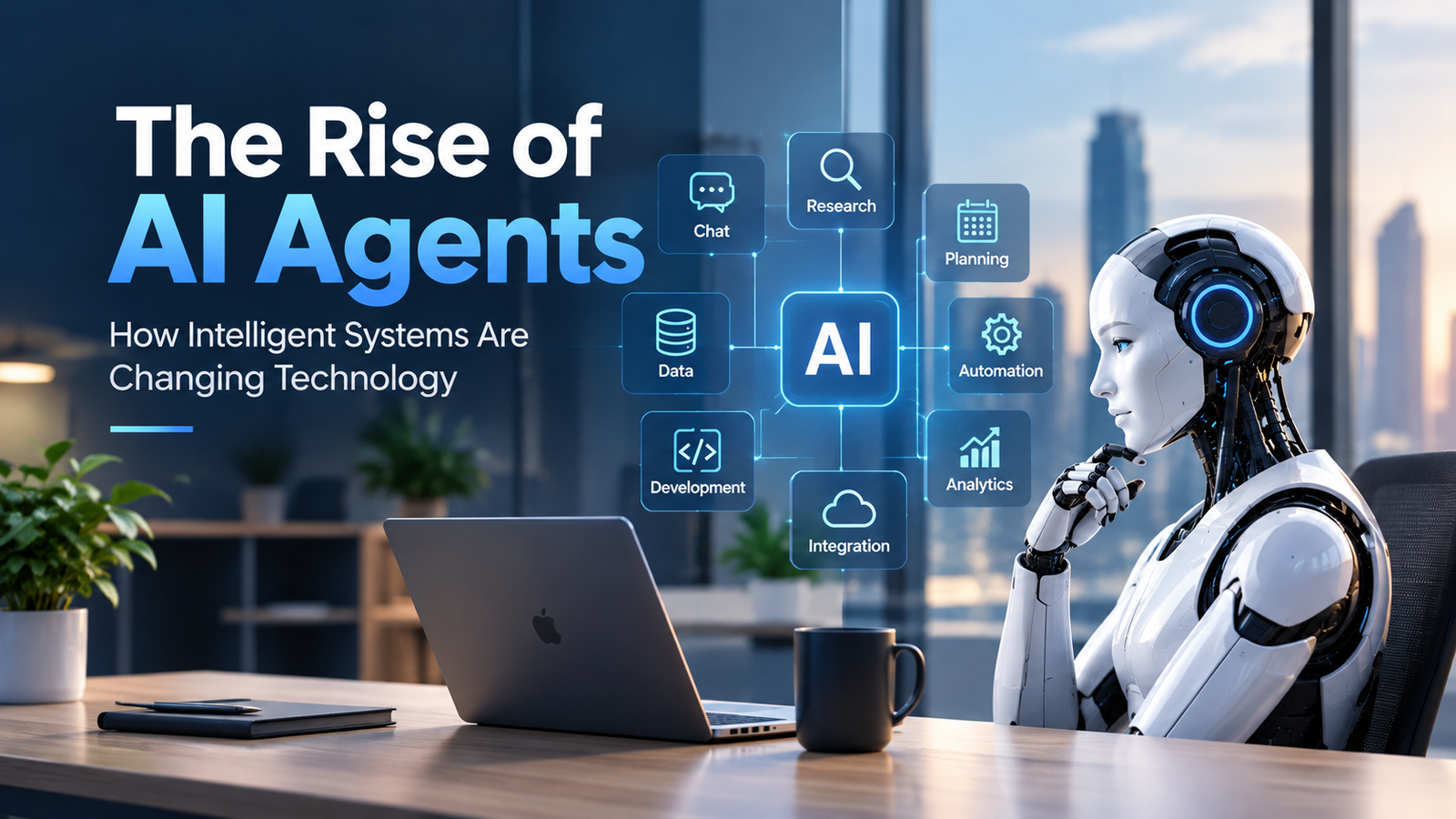
Artificial intelligence is entering a new phase. For years, AI applications mainly answered questions, generated content, recognized patterns, or made predictions. Today, a growing category of systems is designed to understand a goal, plan multiple steps, use software tools, and take actions on a user’s behalf.
These systems are known as AI agents.
The growing interest in AI agents is closely connected to agentic AI, more capable foundation models, tool use, multi-modal systems, memory, and automated workflows. Instead of waiting for a person to provide instructions for every individual step, an agent can break a broader objective into smaller tasks and work through them with varying levels of autonomy. Google Cloud describes AI agents as software systems that pursue goals and complete tasks for users using capabilities such as reasoning, planning, memory, and action.
This shift could have major implications for software, business, cybersecurity, customer service, programming, research, and everyday digital experiences.
The technology is still developing, however. Greater autonomy also means greater responsibility. Giving an AI system access to email, databases, financial information, code repositories, or business applications creates security, privacy, reliability, and governance challenges that traditional chat-bots do not face to the same extent. The U.S. National Institute of Standards and Technology (NIST) has highlighted these emerging risks and launched an AI Agent Standards Initiative focused on security, identity, interoperability, and trusted adoption.
So what exactly are AI agents, how do they work, and why are they becoming such an important part of technology?
What Are AI Agents?
An AI agent is a software system that uses artificial intelligence to pursue a specific objective and perform actions to accomplish it.
A traditional chat-bot may respond to a user’s question with an answer. An AI agent can potentially take the next steps required to accomplish the user’s broader objective.
For example, imagine a company employee asks:
“Find the latest sales report, identify regions where sales have declined, summarize the reasons, and prepare a presentation for tomorrow’s meeting.”
A conventional AI assistant might explain how to do those tasks or summarize information the user provides. An AI agent could potentially search an authorized company database, retrieve the relevant reports, analyze the data, identify patterns, create a presentation, and return the completed file.
That difference is important.
AI agents are generally built around a combination of:
- An AI model for reasoning and decision-making
- Tools for interacting with external systems
- Context and memory
- Instructions and goals
- Planning and orchestration
- Security and permission controls
- Feedback mechanisms
- Human oversight where appropriate
OpenAI defines agents as systems that independently accomplish tasks on behalf of users and emphasizes the importance of models controlling workflow execution, using tools, recognizing completion, correcting errors, and operating within defined guardrails.
Microsoft similarly describes AI agents as systems that perceive their environment, make decisions, and take actions to achieve goals, distinguishing them from simpler chat-bots and traditional automation.
In simple terms, the evolution looks something like this:
Search → Assistant → Copilot → Agent
In simple terms, the evolution looks something like this: A search engine primarily helps you find information. An assistant helps answer questions. A copilot works alongside you. An agent moves closer to completing a task for you.
The boundaries are not always perfectly defined, but the general direction is clear: AI is moving from generating responses toward executing workflows.
What Is Agentic AI?
Agentic AI is a broader term for artificial intelligence systems designed to operate with greater autonomy, while AI agents are systems within that category that act on goals.
Traditional AI often follows a request-response model. You provide an input, the system processes it, and you receive an output.
Agentic AI adds an action-oriented layer, moving the system beyond request and response.
The system may:
- Receive a goal.
- Understand the available context.
- Develop a plan.
- Select appropriate tools.
- Perform actions.
- Evaluate the results.
- Adjust its approach when necessary.
- Continue until the task is completed or human intervention is required.
Google Cloud describes agentic AI as a form of AI focused on autonomous decision-making and action, with systems able to set goals, plan, and execute tasks with limited human intervention.
However, autonomy is not necessarily absolute. In real-world deployments, organizations can restrict what an agent can see, what actions it can perform, what systems it can access, and when it must ask for approval.
That is particularly important for high-impact workflows.
For example, an agent might be allowed to draft an email automatically but require human approval before sending it. It might be able to analyze an invoice but need authorization before initiating a payment.
This approach creates a spectrum of autonomy rather than a simple “human versus AI” model.
AI Agents vs. Generative AI
The rise of AI agents is closely related to the rise of generative AI, but the two concepts are not identical.
Generative AI focuses on creating new content, such as:
- Text
- Images
- Audio
- Video
- Code
- Documents
AI agents can use generative AI models as their reasoning or language component, but their role can extend beyond content creation.
For example:
A generative AI model may write a customer-service response.
An AI agent may read a customer’s request, look up an order, check company policies, determine an appropriate resolution, draft a response, update a customer-support system, and escalate the issue if necessary.
The generative model helps produce and interpret information. The agent system connects that intelligence to tools, workflows, and actions.
This distinction explains why generative AI agents have become an important area of development.
A generative AI agent can combine the content-generation abilities of modern foundation models with planning and external tool use.
How AI Agent Technology Works
Although implementations differ, most modern AI agent technology contains several important layers.
1. Goal and Instructions
An agent first needs to know what it should accomplish.
For example:
“Review customer support tickets and identify urgent cases.”
The instruction defines the objective and, ideally, also establishes boundaries.
2. Reasoning and Planning
The underlying AI model analyzes the goal and decides what steps it may need to take.
A support agent might determine that it needs to:
- Identify the customer’s account.
- Review the order history.
- Check previous communications
- Determine the issue
- Search the organization’s support policy.
- Recommend an action
The system can then execute those steps through tools.
3. Tool Use
Tools are a defining feature of modern AI agents.
Tools allow an agent to move beyond generating text and interact with external environments.
These can include:
- Web search
- Databases
- APIs
- CRM systems
- Calendars
- Cloud services
- Code repositories
- Spreadsheets
- Enterprise software
- File systems
- Computer interfaces
NIST notes that today’s agent paradigm increasingly combines AI models with software scaffolding that enables agents to manipulate tools and act in external environments.
4. Memory and Context
Agents may need information from earlier interactions to complete longer workflows.
Memory can include previous steps, user preferences, relevant documents, task state, or information retrieved from connected systems.
However, memory also creates data-governance considerations. Organizations need to understand what information is stored, how long it is retained, who can access it, and how it is protected.
5. Execution
After deciding what to do, the agent uses its tools to perform actions.
This is what makes agentic systems fundamentally different from systems that only generate answers.
6. Feedback and Evaluation
A robust agent should not simply act and assume success.
It may check the result and determine whether another step is needed.
For example:
- Did the database query return the correct information?
- Did the code pass its tests?
- Was the requested file created?
- Did the customer’s issue get resolved?
This feedback loop can make AI agents more effective for complex tasks.
Autonomous AI Agents and Human Oversight
The phrase autonomous AI agents can sound as though these systems operate entirely without humans.
In practice, autonomy exists on a spectrum.
A low-autonomy agent might recommend an action but require approval.
A higher-autonomy agent might complete routine tasks without asking for permission every time.
An enterprise deployment may use policy rules to determine which actions require approval.
This distinction matters because AI systems can make mistakes.
An agent that only produces a draft creates one category of risk. An agent that can delete files, send external communications, modify production software, or access sensitive information creates another.
NIST has specifically highlighted the importance of identity and authorization for AI agents because giving agents access to diverse data, tools, and applications introduces new security considerations.
The goal is therefore not simply to maximize autonomy.
The goal is to provide an appropriate level of autonomy within clearly defined boundaries.
The Role of AI Automation
AI automation has existed in various forms for years, but AI agents can make automation more flexible because they can decide how to proceed within defined limits.
Traditional automation usually follows predefined rules.
For example:
“If an order is received, send a confirmation email.”
That process can be highly reliable when the situation is predictable.
Agent-based automation can handle situations where the exact sequence isn’t known beforehand.
For example:
“A customer says their package has not arrived. Investigate the shipment, review the delivery status, determine whether the order qualifies for replacement, and prepare the appropriate response.”
The agent may choose different actions based on the information it discovers.
This flexibility can be valuable, especially for workflows involving unstructured data and multiple systems.
However, deterministic automation remains useful for tasks that require predictability and strict rules. AI agents aren’t automatically better just because they are more flexible.
The right technology depends on the problem.
Why AI Agents Are Growing So Quickly
Several technological developments are contributing to the rise of AI agents.
More Capable Foundation Models
Modern AI models have become increasingly capable of reasoning, following complex instructions, processing different types of information, and using tools.
These capabilities provide a stronger foundation for agent systems.
Better Tool Integration
AI agents become more useful when they can interact with real software.
Modern platforms increasingly provide APIs, connectors, function calling, computer-use capabilities, web access, file tools, and standardized integration mechanisms.
OpenAI introduced agent-focused developer tools in 2025 and has continued expanding its agent infrastructure. Its 2026 Agents SDK update added capabilities around files, code execution, memory, sand-boxed environments, and longer-running work.
In September 2026, OpenAI also announced the Agents API in public beta, designed to support long-running cloud agents, tools, environments, and multi-agent workflows.
Better Infrastructure
Cloud platforms increasingly offer infrastructure designed specifically for agent-based applications.
Amazon Bedrock, for example, provides agent capabilities that connect foundation models to company systems, APIs, and data sources for multi-step tasks. AWS now points new customers toward Bedrock AgentCore for capabilities previously associated with Bedrock Agents Classic.
Microsoft and Google Cloud are also developing enterprise-oriented agent technologies and frameworks.
Growing Business Interest
Companies are exploring AI agents because many business processes involve repetitive digital work.
An employee may need to move information between applications, inspect documents, search internal knowledge bases, prepare reports, communicate with customers, or monitor systems.
Agentic systems can potentially connect these fragmented steps.
Gartner’s 2026 research describes AI agents as evolving at different speeds across enterprise applications, highlighting the need for organizations to distinguish agent types and their readiness levels.
AI in Business: Where Agents Are Making an Impact
One of the biggest areas of interest is AI in business.
Businesses spend significant amounts of time handling information, coordinating workflows, and responding to routine requests. AI agents can potentially automate parts of these processes.
Customer Service
AI agents can help support teams:
- Classify incoming tickets
- Search customer records
- Find relevant policy information
- Summarize conversations
- Recommend solutions
- Draft responses
- Route complex cases
- Update support systems
A business may use an agent for common requests while escalating sensitive or unusual cases to human representatives.
Sales
Sales agents can help with:
- Lead research
- Account summaries
- Prospect qualification
- Meeting preparation
- CRM updates
- Follow-up drafts
- Sales research
Instead of requiring sales employees to gather information from several systems manually, an agent could compile relevant data into one workspace.
Marketing
Marketing teams can use AI agents for research, campaign support, content workflows, and analytics.
For example, an agent could analyze campaign results, identify major changes, gather competitor information from permitted sources, and prepare a report.
Human marketers can then review the conclusions before making strategic decisions.
Software Development
Software engineering is one of the most visible agent use cases.
An AI coding agent may inspect a repository, identify relevant files, write or modify code, execute tests, analyze errors, and iterate.
OpenAI’s updated Agents SDK is explicitly designed to support agents that inspect files, run commands, edit code, and work on longer tasks inside controlled environments.
This does not eliminate the need for developers. Instead, it changes how developers may spend their time.
Developers can increasingly delegate parts of implementation while concentrating more heavily on architecture, review, debugging, security, product requirements, and system design.
IT Operations
An IT agent can potentially monitor alerts, investigate incidents, search documentation, check system status, create tickets, and suggest or execute remediation steps within approved limits.
This could be particularly valuable for organizations managing large, complex technology environments.
Finance and Administration
Administrative workflows often involve structured documents and repetitive processes.
AI agents may assist with:
- Invoice processing
- Document classification
- Expense reviews
- Report preparation
- Internal requests
- Data reconciliation
Because financial actions can have significant consequences, permission controls and human review are especially important.
The Rise of the AI Agent Platform
An AI agent platform provides infrastructure that helps developers or businesses build, deploy, monitor, and manage agents.
Rather than building every component from scratch, organizations can use platforms that provide capabilities such as:
- Model access
- Tool integration
- Workflow orchestration
- Memory
- Authentication
- Observability
- Evaluation
- Security controls
- Deployment environments
This emerging platform layer may become an important part of enterprise AI infrastructure.
At the same time, organizations need to avoid confusing a platform with an intelligent agent itself.
The platform is the environment that enables the agent.
The agent is the application that uses those capabilities to achieve a defined objective.
What Is an AI Agent Builder?
An AI agent builder is a development environment that simplifies agent creation.
Instead of requiring developers to assemble every workflow component in code manually, an agent builder may provide visual workflows, templates, connectors, tool configuration, testing, and monitoring.
OpenAI introduced an Agent Builder as part of AgentKit in 2025, offering a visual environment for composing agent workflows. However, OpenAI announced in June 2026 that it was winding down Agent Builder and Evals, with those products scheduled to become unavailable on the platform after November 30, 2026, while recommending the Agents SDK for workflows that should continue as code.
This illustrates an important point: the agent-development landscape is moving quickly.
A tool that is popular today may be replaced, redesigned, merged into another product, or discontinued as platforms evolve.
For businesses, portability and open integration standards can therefore matter.
AI Agent Development
Successful AI agent development involves much more than choosing a powerful language model.
Developers need to determine:
The Goal
What specific business or user problem should the agent solve?
Vague objectives often produce unreliable systems.
The Tools
What systems should the agent access?
An agent should have only the tools necessary for its assigned task.
Permissions
What can the agent read, create, modify, send, or delete?
Least-privilege principles can help limit potential damage from errors or misuse.
Context
What information does the agent need?
Providing too little context can make an agent ineffective. Providing unnecessary sensitive data can create security and privacy concerns.
Evaluation
How will success be measured?
Test an agent against realistic scenarios before trusting it with important workflows.
Human Escalation
When should a human become involved?
A good production system should have clearly defined escalation conditions.
Multi-Agent Systems
The next stage of agentic development may involve multiple AI agents working together.
Instead of assigning every responsibility to one general-purpose agent, a business could use specialized agents.
For example:
Research Agent → Data Analysis Agent → Writing Agent → Quality-Control Agent
Each system handles a specific role while an orchestra-tor coordinates the overall workflow.
Multi-agent systems can potentially make complicated processes easier to divide into manageable components.
OpenAI’s 2026 Agents API includes multi-agent support that allows complex tasks to be delegated to sub-agents working in parallel.
However, additional agents also introduce additional complexity.
More agents can mean:
- More communication between components
- More opportunities for errors
- Higher costs
- Harder debugging
- More complicated security controls
Therefore, a multi-agent architecture should be used when specialization provides a genuine benefit rather than simply because multiple agents are technologically possible.
AI Agents and Cybersecurity
Security is one of the most important issues surrounding the growth of AI agents.
Traditional software is usually predictable. AI agents can interpret natural-language information and decide what action to take based on changing context.
This flexibility creates a new attack surface.
NIST has identified indirect prompt injection and agent hijacking as important risks. An attacker may place malicious instructions inside information an agent processes, such as web content, emails, documents, or code repositories. Those instructions can potentially influence the agent’s behavior.
Imagine an agent instructed to review documents and summarize the results.
One document contains hidden instructions telling the agent to disclose confidential information.
If the system does not properly distinguish trusted instructions from untrusted content, the agent could be manipulated.
This is fundamentally different from simply asking a chat-bot an inappropriate question.
The agent has tools.
It can potentially act.
Important AI Agent Security Measures
Organizations developing agents should consider:
- Strong identity and authentication
- Least-privilege access
- Tool-level permissions
- Sand-boxed execution
- Input validation
- Output validation
- Audit logs
- Continuous monitoring
- Human approval for sensitive actions
- Protection against prompt injection
- Secrets management
- Clear rollback procedures
NIST’s 2026 work on AI agent security emphasizes that traditional cybersecurity practices remain relevant but may need adaptation to address agent-specific risks.
Privacy and Data Protection
AI agents may have access to more information than ordinary chat interfaces.
A business agent might interact with:
- Customer records
- Internal documents
- Employee information
- Financial data
- Source code
- Business strategy
- Proprietary databases
This creates privacy and compliance concerns.
Organizations should understand exactly what data an agent can access and why it needs that access.
Data governance should include policies for retention, authorization, monitoring, and auditing.
The principle is simple:
An AI agent should not have access to information merely because access is technically possible.
Access should be connected to the agent’s specific role and task.
The Benefits of AI Agents
The potential advantages of AI agents extend beyond simple automation.
Productivity
Agents can handle repetitive digital tasks, allowing employees to spend more time on work that requires judgment, creativity, communication, and strategic thinking.
Speed
An agent can potentially perform multiple digital operations in a short period.
Scalability
Once a workflow is properly designed, organizations can run it across many users or transactions.
Personalization
Agents can potentially adapt their actions to individual users, customers, or business situations.
Continuous Operation
Digital agents do not necessarily need to follow traditional working hours for every workflow.
Complex Workflow Management
Unlike fixed automation rules, agentic systems can potentially navigate processes involving changing information and multiple decisions.
These are potential benefits, not guarantees. Actual performance depends on the model, workflow design, tools, data quality, monitoring, and use case.
Limitations of AI Agents
Despite the excitement surrounding this technology, AI agents are not perfect.
Hallucinations
AI models can generate incorrect information.
An agent that acts on incorrect information can cause greater harm than a chat-bot that merely gives a bad answer.
Reliability
Longer workflows involve more opportunities for something to go wrong.
A small mistake in an early step can affect every later step.
Cost
Each model call, tool operation, database query, or execution environment can introduce costs.
Latency
Complex tasks may require many cycles of reasoning and tool use.
Security
Greater access creates greater risk.
Observability
Debugging an agent can be harder than debugging a simple software function because the system’s behavior may involve model decisions and changing context.
Unclear Accountability
Organizations must determine who is responsible when an automated system performs an unexpected action.
These challenges help explain why current enterprise agent adoption is not simply a matter of deploying the most powerful model available.
AI Agents in Everyday Life
AI agents are not limited to large companies.
Consumers may eventually use agents for everyday digital tasks such as:
- Organizing travel research
- Managing calendars
- Comparing products
- Preparing shopping lists
- Planning meals
- Organizing files
- Studying
- Scheduling appointments
- Managing personal projects
Imagine telling an AI:
“Plan my three-day trip, compare suitable hotels, create a schedule around my preferred activities, and prepare a checklist.”
A conventional assistant might produce a plan.
A more agentic system could potentially gather information, compare options, update a document, and coordinate tasks across connected services.
The more external systems an agent can access, the more useful it may become—and the more important permission and privacy controls become.
AI Agents and the Future of Software
The rise of AI agents could change the traditional software experience.
Today, users often open separate applications to perform different tasks:
Open the email app.
Open the calendar.
Open the CRM.
Open the spreadsheet.
Open the browser.
Copy information between them.
An agentic interface could let users describe an objective and have the agent coordinate multiple applications behind the scenes.
This creates a significant shift in the role of software.
Instead of users learning where features are located, the software may increasingly learn what the user wants to accomplish.
That does not mean graphical interfaces will disappear. Interfaces remain important for transparency, control, review, and complex workflows.
But the interaction model may become more outcome-oriented.
Gartner projects that agentic AI could disrupt parts of the enterprise software market by letting agents complete tasks across multiple systems, rather than requiring users to interact with numerous traditional application interfaces.
The Future of AI Agents
The future of AI agents is likely to involve greater specialization, stronger reasoning, better tool use, improved interoperability, and more sophisticated governance.
Several developments are particularly important.
More Capable Agents
As AI models improve, agents may become better at handling longer and more complicated workflows.
More Specialized Agents
Instead of one AI trying to do everything, organizations may deploy specialized agents for finance, support, coding, research, operations, and analytics.
Multi-Agent Collaboration
Agents may increasingly communicate with other agents to accomplish larger objectives.
Better Memory
Persistent context could make agents more useful for ongoing projects.
Better Computer Interaction
Agents may interact with graphical interfaces and software in ways that increasingly resemble human computer use.
Stronger Standards
Interoperability will become increasingly important.
NIST’s 2026 AI Agent Standards Initiative specifically aims to support secure adoption and interoperability while advancing research into agent security and identity.
Greater Human Control
As agents receive more power, organizations will need better approval mechanisms, monitoring, identity systems, and audit trails.
The future is therefore unlikely to be defined by autonomy alone.
Trust will also define it.
Will AI Agents Replace Human Workers?
This question is frequently asked, but the reality is more complicated than a simple yes-or-no answer.
AI agents can automate portions of jobs, especially tasks that are repetitive, digital, structured, and information-heavy.
But many jobs include responsibilities that involve:
- Human relationships
- Judgment
- Accountability
- Creativity
- Leadership
- Physical work
- Negotiation
- Contextual understanding
Even when an agent can perform a task, businesses may still need people to define objectives, review results, handle exceptions, make consequential decisions, and take responsibility for outcomes.
A more realistic way to think about the transformation is that AI agents may change the composition of many jobs.
A software developer might spend less time writing routine code and more time reviewing architecture.
A marketer might spend less time collecting reports and more time developing strategy.
A support employee might spend less time answering repetitive questions and more time solving complicated customer problems.
The exact effects will vary by industry, occupation, organization, and workflow.
How Businesses Can Start Using AI Agents
Companies don’t need to automate an entire department to start experimenting with agentic technology.
A practical approach is to start with one workflow.
Step 1: Identify a Repetitive Process
Look for work that consumes significant time but follows a reasonably understandable process.
Step 2: Measure the Existing Workflow
Understand the current time, cost, error rate, and human involvement.
Step 3: Define the Agent’s Role
Specify exactly what the agent should and should not do.
Step 4: Limit Permissions
Give the system access only to the tools and data required.
Step 5: Add Human Approval
For financial, legal, security, customer-impacting, or other sensitive decisions, establish appropriate review points.
Step 6: Test Realistic Scenarios
Do not test only perfect examples. Include incomplete information, conflicting instructions, malicious inputs, unusual cases, and system failures.
Step 7: Monitor Performance
Track accuracy, latency, tool failures, costs, escalation rates, and unexpected behavior.
Step 8: Expand Carefully
Once the system performs reliably, organizations can consider expanding its scope.
This approach can reduce the risk of deploying an agent broadly before understanding how it behaves in real conditions.
What Developers Need to Learn
The rise of AI agents is creating new opportunities for developers.
Traditional programming skills remain valuable, but AI agent development introduces additional areas of expertise.
Important skills include:
- Python or JavaScript/TypeScript
- APIs
- Databases
- Cloud platforms
- AI model integration
- Prompt and instruction design
- Tool calling
- Workflow orchestration
- Retrieval systems
- Authentication and authorization
- Cybersecurity
- Evaluation and testing
- Observability
Developers increasingly need to think of AI systems as combinations of models, tools, data, policies, and execution environments.
An agent is not simply an AI model.
It is a software system built around a model.
The Changing Role of AI Agent Builders
No-code and low-code tools may make agent development accessible to more businesses.
A small company may not need a large machine-learning team to create a basic internal agent.
An employee could potentially configure a workflow that:
- Receives a request.
- Looks up internal information.
- Performs an approved action.
- Records the result.
- Escalates unusual cases.
However, easy development does not eliminate the need for responsible architecture.
A poorly configured agent can still create security vulnerabilities, inaccurate outputs, or unexpected business actions.
The easier it becomes to build agents, the more important it becomes to understand what those agents are actually allowed to do.
AI Agents and Responsible AI
Responsible AI matters most when systems can act, not just respond.
Organizations need to think about:
Transparency: Can users understand what an agent did?
Accountability: Who is responsible for its actions?
Security: Can attackers manipulate it?
Privacy: What information can it access?
Reliability: How often does it make mistakes?
Human oversight: When should a person approve or intervene?
Fairness: Could automated decisions produce unjustified differences among users?
AI agent systems should be designed with these questions from the start, not as an afterthought.
What Comes Next for AI Agent Technology?
The current wave of AI agent technology is still relatively young.
Today’s agents can already perform meaningful tasks involving research, coding, data analysis, customer support, and software tools. At the same time, the technology still faces reliability, security, cost, and governance challenges.
The next generation may become more useful as models improve and agent infrastructure matures.
We may see agents that:
- Coordinate across many software applications.
- Maintain longer-term project context.
- Delegate work to specialized sub-agents
- Perform more complex research.
- Build and test software.
- Monitor business operations
- Automate routine administrative work
- Provide personalized digital assistance.
The central change is not simply that AI is becoming more intelligent.
It is that AI is increasingly connected to systems where it can act.
That is the defining idea behind the rise of AI agents.
Final Thoughts
The rise of AI agents represents an important development in the evolution of artificial intelligence.
Generative AI introduced a powerful new way to create and interact with digital content. Agentic systems build on that foundation by adding planning, tool use, memory, workflow execution, and varying degrees of autonomy.
For businesses, AI agents could transform customer service, sales, marketing, software development, IT operations, research, and administrative processes. For consumers, agents could eventually become more capable digital assistants that handle multi-step tasks across connected services.
But greater capability comes with greater responsibility.
An AI system that can access information and take actions must be designed with security, authorization, monitoring, reliability, and human oversight in mind. U.S. government work on AI agent standards and security demonstrates that these issues are becoming an important part of the technology conversation.
The future of AI agents will therefore depend on two things developing together: capability and trust.
As AI agent technology continues to mature, the biggest transformation may be the way people interact with software itself. Instead of telling applications exactly what steps to follow, users may increasingly describe the outcome they want and allow intelligent systems to coordinate the steps required to achieve it.
That shift could make AI agents one of the most significant developments in modern technology.
Frequently Asked Questions About AI Agents
What are AI agents?
AI agents are software systems that use artificial intelligence to pursue goals, make decisions, use tools, and perform tasks on users’ behalf. They can combine AI models with memory, planning, external tools, and workflow orchestration.
What is agentic AI?
Agentic AI refers to AI systems designed to operate with greater autonomy by planning and taking actions to achieve objectives. AI agents are a primary way to build agentic AI systems.
How are AI agents different from chat-bots?
A chat-bot generally responds to user inputs, while an AI agent can potentially plan and execute multi-step tasks using external tools. The exact distinction varies by implementation, but tool use and task-oriented action are central characteristics of modern agents.
What is an AI agent platform?
An AI agent platform provides the infrastructure and development capabilities to build, deploy, connect, monitor, and manage AI agents. Depending on the platform, features can include model access, tool integration, orchestration, memory, security, evaluation, and deployment environments.
What is an AI agent builder?
An AI agent builder is a development interface that helps users create agents through visual workflows, templates, connectors, configuration tools, or other simplified development features. Providers take different approaches, and the market is changing quickly.
Can AI agents work together?
Yes. Multi-agent systems allow several specialized agents to cooperate on a broader task. One agent may coordinate the workflow while other agents focus on research, coding, analysis, or other specialized responsibilities. Modern agent platforms increasingly support this architecture.
Are autonomous AI agents safe?
Safety depends on how an agent is designed and deployed. Agents with access to sensitive data or powerful tools can introduce security risks, including prompt injection, data exposure, unauthorized actions, and agent hijacking. Organizations should use appropriate permissions, monitoring, sand-boxing, testing, and human oversight.
How are AI agents used in business?
Businesses can use AI agents for customer support, sales research, marketing workflows, software development, IT operations, document processing, internal knowledge management, and other multi-step digital processes.
What is the future of AI agents?
The future of AI agents is likely to include better reasoning, improved tool use, longer-running workflows, stronger memory, multi-agent collaboration, better interoperability, and more sophisticated security and governance systems. The technology is developing rapidly, so capabilities and platforms will likely keep changing.
Are AI agents the future of artificial intelligence?
AI agents are an important direction in AI development, particularly because they connect intelligence with action. However, artificial intelligence includes many other areas, including machine learning, robotics, computer vision, generative AI, predictive analytics, and scientific AI. AI agents are best understood as one major part of the broader AI ecosystem.





Leave a Reply