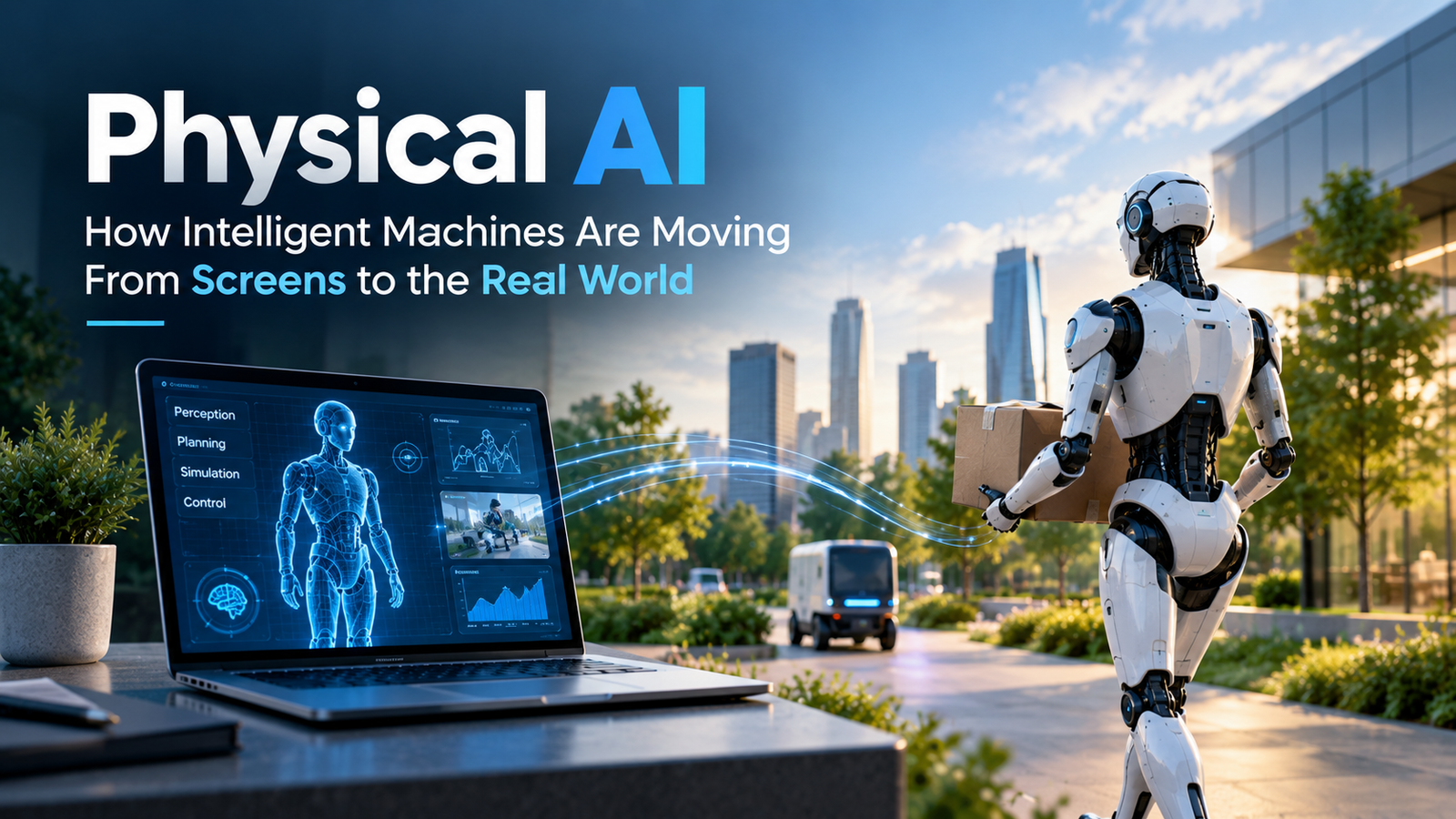
Artificial intelligence has spent much of the past decade living inside screens. Chat-bots can write text, image generators can create visuals, recommendation systems can predict what people may want to watch, and AI assistants can help users complete digital tasks.
The next stage of AI is increasingly focused on something much more physical: understanding and interacting with the real world. That is where physical AI comes in.
This emerging field is commonly called physical AI. Instead of limiting intelligence to software, physical AI connects AI models with machines, sensors, cameras, motors, robotic hands, vehicles, and other systems that can observe and act in physical environments.
That shift matters because the real world is far more complicated than a webpage or a database. For example, a robot operating in a warehouse has to understand where people are standing, recognize objects, avoid obstacles, maintain balance, make decisions under uncertainty, and physically complete a task. Likewise, an autonomous vehicle has to interpret roads, vehicles, pedestrians, traffic signals, weather, and constantly changing surroundings.
In other words, physical AI gives machines a practical connection between perception, reasoning, and action. That connection helps explain why it matters in physical environments.
NVIDIA defines physical AI as technology that enables autonomous systems such as robots and self-driving vehicles to perceive, understand, reason, and perform or coordinate complex actions in the physical world. IBM similarly describes physical AI as AI systems that interact with physical environments through combinations of models, sensors, actuators, and control systems.
As of 2026, researchers and technology companies are developing increasingly capable systems that combine multimodal AI, robotics, simulation, reinforcement learning, and vision-language-action models. For example, Google DeepMind has introduced Gemini Robotics models designed to convert visual and language information into robotic actions. At the same time, NVIDIA has developed platforms such as Cosmos and Isaac GR00T for physical AI and robotics development.
So, what is physical AI, how does it work, where is it being used, and what could it mean for the future? These are the questions worth exploring next.
Let’s explore the topic in detail, starting with the basics.
What Is Physical AI?
Physical AI is a form of artificial intelligence designed to perceive, reason about, and act within the physical world.
Traditional AI often works with digital information. It may analyze documents, recognize patterns in images, generate text, recommend products, or answer questions. Physical AI goes a step further by connecting intelligence to a physical system that can interact with its surroundings.
A physical AI system may include:
- Cameras and computer vision
- Microphones and other sensors
- LiDAR or depth sensors
- AI models
- Motion and control systems
- Robotic arms and hands
- Motors and actuators
- Mapping and navigation software
- Simulation environments
- Safety systems
- Communication and computing hardware
Together, these components allow a machine to observe its environment, understand what is happening, decide what to do, act, and use new information to adjust its behaviour. Step by step, this moves the system from input to response.
For example, imagine an AI-powered warehouse robot instructed to move a box to another area.
A conventional automated machine might follow a predefined route. In contrast, a more advanced physical AI system could identify the box with its camera, estimate its position, understand the surrounding space, detect nearby workers, plan a route, move toward the object, grasp it, and change its behaviour if an obstacle appears.
That ability to deal with changing physical conditions is one of the most important characteristics of physical artificial intelligence. It matters especially when a task does not unfold as expected.
NVIDIA describes physical AI as bringing intelligence “out of the screen and into the real world,” with systems that can perceive, reason, learn, and act in dynamic environments.
Physical AI vs Traditional AI
The easiest way to understand physical AI is to compare it with software-centred AI.
Traditional AI can receive information and produce a digital result. Physical AI must produce or coordinate a physical action.
For example:
| Traditional AI | Physical AI |
| Generates text | Moves a robotic arm |
| Answers a question | Performs a physical task |
| Classifies an image | Uses an image to manipulate an object |
| Recommends a route | Drives or navigates through an environment |
| Predicts data patterns | Adjusts machine behavior in real time |
| Works mainly with digital information | Connects digital intelligence with physical systems |
The distinction is not always absolute. Physical AI still depends heavily on software and digital computation, but its intelligence is connected to a machine or environment where decisions can have physical consequences.
That is why physical AI often overlaps with robotics, autonomous vehicles, smart manufacturing, drones, industrial automation, and other forms of intelligent machinery.
Physical AI, Embodied AI, and Physical Intelligence
Several terms are used in this field, and they are closely related but not identical. It helps to distinguish them clearly.
Physical AI
Physical AI generally refers to AI models and systems designed to operate in the physical world. In industry, the term often describes robotics, autonomous machines, world models, simulation, and AI-based control.
Embodied AI
Embodied AI emphasizes intelligence connected to a physical body or environment, which helps distinguish it from broader software-only AI.
NVIDIA describes embodied AI as integrating AI into physical systems such as robots, autonomous vehicles, factories, and other environments, allowing machines to perceive, reason, and act.
The term is also widely used in academic and research communities.
Physical Intelligence
Physical intelligence is a broader concept describing a machine’s ability to understand physical environments and make useful decisions through interaction rather than simply recognizing information.
For example, recognizing that a glass object is fragile and therefore needs to be grasped differently from a metal tool goes beyond object recognition. It involves understanding how an action could affect the physical world.
These concepts overlap significantly, and companies, researchers, and publications may use them differently. For a general audience, physical AI is the broader practical movement toward AI systems that can perceive and act in physical environments.
How Does Physical AI Work?
Understanding how physical AI works requires looking at several connected layers, each building on the last. To see that clearly, start with the basic workflow.
A basic physical AI workflow can be thought of as:
Sense → Understand → Plan → Act → Observe → Adapt. Here is how each stage works.
A physical AI system needs information about its surroundings before it can do anything useful.
Sensors may include cameras, depth cameras, LiDAR, microphones, force sensors, inertial measurement units, GPS, touch sensors, and other hardware.
A robot’s camera might detect a table, while its depth sensor estimates how far away the table is. Force sensors can help a robotic gripper understand whether it is holding an object securely.
Without reliable sensing, an intelligent robot cannot accurately understand its environment.
2. Perception
The system then processes incoming sensor data to identify relevant objects, people, surfaces, movements, and environmental conditions. From there, it can begin to interpret the scene and move toward action.
Computer vision is particularly important here.
A robot might need to answer questions such as:
- What objects are nearby?
- Which object is the target?
- Where is a person located?
- Is the path clear?
- Is the object moving?
- What part of the object should be grasped?
Modern multimodal AI can combine information from different sources rather than relying on a single input type, which helps connect perception to reasoning.
3. Reasoning and Understanding
After perceiving the environment, the AI needs to determine what the information means before it can act. This is the point where understanding turns into decision-making.
Suppose a person tells a robot:
“Put the bottle on the kitchen table.”
The machine needs more than speech recognition.
It must understand what a bottle is, identify the relevant bottle, identify the table, estimate where both are located, determine whether the bottle can be safely grasped, and decide how to move.
This is where foundation models and embodied reasoning systems are becoming increasingly important, because they help move from interpretation to action.
For example, Google DeepMind’s robotics research separates higher-level embodied reasoning from vision-language-action control. Its models are designed to understand the physical environment, plan multi-step tasks, and translate visual and language information into motor actions.
4. Planning
Physical tasks often require multiple steps, so planning becomes essential. From there, the system can break the task into a sequence it can carry out.
A robot cannot simply recognize an object and move randomly toward it. It may need to calculate a path, consider obstacles, decide how to approach the object, and determine the movements required to complete the task.
Planning can happen at several levels, and each level helps move the task forward.
A high-level system may decide:
Find the package → pick it up → move to shelf → place package.
A lower-level controller may determine the exact movements each joint, wheel, gripper, or actuator needs, translating the plan into motion.
5. Acting in the Real World
The next stage is physical action, where the plan becomes movement.
Actuators, motors, robotic joints, wheels, grippers, legs, and other mechanisms convert AI decisions into movement.
This creates a critical difference between physical AI and purely digital AI, since the result is not only a prediction but a physical outcome.
A language model can produce an incorrect sentence without physically moving anything. A robot that misunderstands its environment could drop an object, collide with something, or create a safety risk.
Physical action therefore requires much tighter integration between AI, control systems, hardware, and safety mechanisms.
6. Feedback and Adaptation
The robot observes the result of its action and updates its behaviour, closing the loop.
Suppose a robot tries to pick up a soft package and the package slips. In that moment, it has to adjust.
A capable physical AI system can use sensor feedback to detect the failure and potentially adjust its grip, position, or movement.
This feedback loop is central to intelligent physical behaviour.
The Role of Simulation in Physical AI
Training robots in the real world can be expensive, slow, and potentially dangerous.
Imagine training a robot to balance by allowing it to fall repeatedly. The robot could damage itself thousands of times before learning the desired behaviour.
Simulation provides an alternative.
A virtual robot can practice in a simulated factory, warehouse, street, laboratory, or home. Developers can change the environment, generate many scenarios, test policies, and collect training data without damaging physical equipment.
NVIDIA’s Cosmos platform, for example, supports physical AI development through world foundation models, simulation, and synthetic data. NVIDIA says these models can help developers generate or predict physics-aware environments for robotics and autonomous vehicle development.
IBM also describes a workflow in which robots can be trained in simulated environments containing changing objects, weather, terrain, lighting, and obstacles before being progressively tested in real-world conditions.
This process is sometimes described as sim-to-real: learning or testing in simulation and transferring the resulting behaviour to physical machines.
World Models and Physical AI
One of the most interesting developments in physical AI is the use of world models.
A world model attempts to represent how an environment behaves.
For physical AI, that can involve understanding spatial relationships, motion, objects, interactions, and physical consequences.
Consider a robot looking at a ball near the edge of a table. A useful world model should help it reason about what may happen if it pushes the ball.
World models can potentially help AI systems answer questions such as:
- What is likely to happen next?
- How will an object move?
- What happens if the robot takes a particular action?
- Is a planned movement physically possible?
- How should the system respond to a changing environment?
NVIDIA’s Cosmos research specifically frames world foundation models as tools for developing customized world models for physical AI systems.
This is important because physical environments cannot be represented effectively through text alone. Robots need information about three-dimensional space, motion, contact, force, and physical relationships.
Vision-Language-Action Models
A major development in AI robotics is the emergence of vision-language-action, or VLA, models.
These models connect three important capabilities:
Vision: Understanding what the robot sees.
Language: Understanding instructions or goals.
Action: Producing or guiding physical movements.
Google DeepMind’s Gemini Robotics models exemplify this approach. Gemini Robotics was introduced as a vision-language-action model that converts visual information and instructions into motor commands for robots. Later versions expanded capabilities involving whole-body control, dexterity, planning, and multi-robot collaboration.
This architecture is significant because it moves robotics toward more general-purpose behaviour.
Instead of programming an individual robot for every possible situation, developers can build models that learn broader relationships between instructions, observations, and actions.
Physical AI Examples
Physical AI is not limited to humanoid robots.
Many potential and existing physical AI examples span industries.
Humanoid Robots
Humanoid robots are one of the most visible examples.
Their human-like structure lets them navigate environments designed for people, use human-oriented tools, and interact with objects at familiar heights.
Current research is exploring capabilities such as walking, balancing, grasping, manipulation, carrying, and multi-step task execution.
Google DeepMind’s 2026 Gemini Robotics 2 work demonstrates whole-body control for humanoid robots, including tasks requiring walking, bending, reaching, manipulation, and coordination.
However, research demonstrations should not automatically be interpreted as evidence that general-purpose humanoids can reliably perform every household or workplace task today.
Warehouse Robots
Warehouses are an especially important area for AI-powered robots.
Robots can help move inventory, transport packages, locate products, sort objects, and support repetitive workflows.
Amazon, for example, describes its robotics systems as using computer vision, LiDAR, force feedback, machine learning, and foundation models in its fulfillment operations.
Humanoid robots are also being tested in logistics environments. Agility Robotics says its Digit humanoid has been commercially deployed in logistics and manufacturing environments, while its newer 2026 systems focus on operating alongside people.
Autonomous Vehicles
Self-driving cars are another major example of real-world AI.
An autonomous vehicle must continuously process its environment and make decisions about road conditions, traffic, pedestrians, lane positioning, and obstacles.
Unlike a software recommendation system, an autonomous vehicle operates under real-time physical constraints.
This makes sensing, prediction, planning, control, redundancy, and safety extremely important.
Industrial Robots
Factories already use robots for welding, painting, assembly, inspection, packaging, and material handling.
Physical AI can make these systems more adaptable.
Instead of relying entirely on rigid, predetermined movements, AI-enhanced robots may handle more variation in objects, positioning, and environmental conditions.
The U.S. National Institute of Standards and Technology is actively researching AI-enhanced robotics for manufacturing, including performance measurement, data generation, testing methods, and standards. NIST notes that bridging the gap between embodied AI research and practical manufacturing deployment remains an important challenge.
Healthcare Robotics
Healthcare could become another important area for physical AI.
Potential applications include:
- Robotic assistance
- Rehabilitation devices
- Assistive robots
- Hospital logistics
- Laboratory automation
- Surgical support systems
- Patient support technologies
However, healthcare applications require especially strong reliability, validation, privacy protections, and human oversight.
A robot operating around patients cannot be evaluated solely on whether it completes a task. Its behaviour must also be predictable, safe, and appropriate for the clinical environment.
Agriculture
Agricultural robots can potentially use AI to identify crops, weeds, fruit, soil conditions, and other environmental characteristics.
Physical AI could allow machines to perform tasks such as targeted harvesting, weeding, crop inspection, and autonomous navigation across difficult terrain.
Agriculture is challenging because outdoor conditions can vary significantly. Weather, mud, sunlight, plant growth, and uneven terrain all make reliable physical intelligence difficult.
Drones
AI-powered drones combine perception, navigation, planning, and flight control.
Potential applications include infrastructure inspection, mapping, environmental monitoring, emergency response, and industrial surveying.
Because drones operate in three-dimensional spaces, physical AI can help them interpret surroundings and respond to changing conditions.
Physical AI Applications Across the U.S. Economy
The United States is likely to see physical AI developed across both industrial and consumer environments.
Some major application areas include:
Manufacturing
AI in robotics can help manufacturers automate inspection, assembly, material handling, and other processes while potentially improving adaptability.
Logistics
Warehouses and distribution centres can use autonomous robots to move objects and coordinate workflows.
Transportation
Autonomous vehicles and intelligent transportation systems can combine AI with physical infrastructure and vehicles.
Construction
Robotic machines may assist with inspection, material movement, drilling, surveying, and other repetitive or hazardous tasks.
Energy
Physical AI can support inspection and maintenance of infrastructure such as power facilities, pipelines, solar installations, and other industrial assets.
Defence and Public Safety
Robotics and autonomous systems may be used for remote inspection, hazardous-environment operations, and other tasks where human exposure could be dangerous. Because these applications can involve serious safety, legal, and ethical issues, deployment requires careful governance and oversight.
Homes
Consumer robots could eventually perform a wider range of household tasks such as cleaning, organizing, monitoring, and assistance.
The major challenge is that homes are much less predictable than factories. Every house contains different layouts, objects, people, pets, surfaces, lighting conditions, and routines.
Why Physical AI Is Different From Simple Automation
It is easy to confuse physical AI with ordinary automation.
They are not necessarily the same.
A traditional automated machine usually performs a known procedure under relatively controlled conditions.
For example, a factory robot may perform the same weld on thousands of identical components.
Physical AI aims for greater flexibility.
A physical AI robot might encounter:
- An object in a different position
- A new object it has not seen before
- A person entering its workspace
- A blocked path
- Different lighting
- A slippery surface
- A change in the task instructions
The goal is not simply to repeat one action.
The goal is to understand conditions and adapt actions accordingly.
That adaptability is a major reason physical AI is becoming closely connected to foundation models and generative AI.
Benefits of Physical AI
Physical AI could provide several important benefits.
Greater Automation
Machines could handle more tasks that previously required direct human involvement.
Better Adaptability
AI-powered robots may be able to operate in changing environments rather than relying entirely on fixed programming.
Support for Workers
Robots can potentially take on repetitive, physically demanding, or hazardous tasks while humans focus on supervision, problem-solving, design, communication, and other responsibilities.
Continuous Operation
Some robotic systems can operate for long periods without requiring the same physical rest cycles as human workers.
Improved Precision
AI-enabled perception and control can help machines perform highly precise actions where consistent movement is important.
New Capabilities
Physical AI could enable entirely new forms of automation, particularly in environments that were previously too variable for conventional robotics.
Challenges of Physical AI
Despite its potential, physical AI has serious technical challenges.
The Real World Is Unpredictable
Digital environments are comparatively easy to reproduce.
Physical environments are not.
Objects can break, people can move unpredictably, lighting can change, surfaces can be slippery, and machines can encounter situations that were not represented in training data.
Training Data Is Difficult to Collect
Robots need physical interaction data.
Collecting that data can be expensive because it requires real machines, controlled environments, human demonstrations, sensors, and substantial testing.
Simulation and synthetic data can reduce the burden, but simulated environments still approximate reality.
Safety Is Critical
A physical AI system can cause physical damage.
That means safety cannot be treated as an afterthought.
NIST’s ongoing work emphasizes the need for appropriate metrics, test methods, and standards for AI-enabled robotics, particularly in manufacturing.
Hardware Limitations
Even a highly capable AI model cannot make a robot perform an action that its physical hardware cannot execute.
Motor strength, battery capacity, mechanical design, sensor quality, computational resources, and actuator speed all matter.
Latency
Some physical tasks require decisions within fractions of a second.
A robot may need to react immediately when a person steps into its path. This is one reason on-device AI is attracting significant attention.
Google DeepMind’s on-device robotics work is specifically designed to run models locally on robotic hardware, reducing dependence on remote computing for certain applications.
Cost
Advanced robots require sophisticated hardware and software.
For many businesses, the economic question is not whether a robot can perform a task, but whether it can do so reliably enough to justify its total cost.
Security and Privacy
Physical AI systems may have cameras, microphones, location sensors, and network connections.
That creates potential cybersecurity and privacy concerns, especially in homes, workplaces, healthcare environments, and public spaces.
Safety and Human Oversight
The more capable robots become, the more important safety engineering becomes.
A safe physical AI system may require multiple layers of protection.
These can include:
- Physical emergency stops
- Collision detection
- Geofencing
- Speed limits
- Redundant sensors
- Human supervision
- Software safety constraints
- Monitoring systems
- Fail-safe behaviors
- Testing and certification
AI models alone cannot solve every safety problem.
Physical safety mechanisms, mechanical design, software control, operational procedures, and human oversight all play a role.
Google DeepMind has also emphasized safety research for robotics, including systems designed to detect uncertainty, avoid unsafe actions, and request human intervention when the robot is not sufficiently confident.
Physical AI and Jobs
One of the biggest questions surrounding physical AI is how it could affect employment.
The answer is unlikely to be limited to simple replacement.
In some industries, autonomous robots may reduce demand for certain repetitive physical tasks. At the same time, organizations may need more people with skills in robotics engineering, AI, system integration, maintenance, safety, data management, operations, and robot supervision.
The impact will also vary by occupation.
A robot that moves boxes does not automatically eliminate every job in a warehouse. Real operations include inventory management, exception handling, planning, customer requirements, maintenance, quality control, and human coordination.
As physical AI becomes more capable, the workplace may increasingly involve human-machine collaboration rather than a simple human-versus-robot model.
Physical AI and Generative AI
Generative AI has helped accelerate interest in physical AI because modern foundation models can process large amounts of multimodal information.
Traditional robotics often required significant task-specific programming.
Foundation models provide an opportunity to create more general-purpose systems.
For example, a robot could potentially learn associations between:
language → visual understanding → task planning → physical action
This is one reason robotics researchers are exploring vision-language-action models, world models, imitation learning, reinforcement learning, and large multimodal models together.
However, generative AI’s success with text does not automatically mean that the same technology is ready for unrestricted physical deployment.
The physical world adds requirements for timing, motion, force, safety, reliability, and embodiment.
What Makes a Robot Intelligent?
A robot’s intelligence is not determined only by the model running inside it.
A highly capable physical AI system depends on an entire stack.
That stack may include:
Foundation model: Provides general reasoning or multimodal understanding.
Perception: Interprets sensors and identifies objects and environments.
World model: Helps predict or represent physical states and interactions.
Planning: Determines which actions to take.
Control: Converts decisions into precise movements.
Hardware: Provides the physical body and capabilities.
Simulation: Allows testing and training before deployment.
Safety: Constrains risky behaviour.
Feedback: Lets the system learn from outcomes and environmental changes.
When all these layers work together, an AI-powered robot can become much more adaptable than a conventional scripted machine.
The Future of Physical AI
The future of physical AI will likely depend on whether researchers can solve several major problems at once.
Robots will need better perception, stronger physical reasoning, more efficient training, improved dexterity, longer task horizons, lower costs, and robust safety.
One important direction is greater generalization.
A robot trained for one task today may need extensive additional training before it can perform another. Future physical AI systems are being designed to transfer knowledge across tasks and robot bodies.
Google DeepMind’s 2026 Gemini Robotics 2 research, for example, focuses on whole-body control, dexterity, adaptation across different robotic embodiment’s, multi-step reasoning, and collaboration between multiple robots.
Another important direction is simulation.
As realistic digital environments improve, robots may be able to practice millions of scenarios virtually before performing selected tasks in the physical world.
World models could become a major part of that training infrastructure.
Local inference is also attracting growing interest. Robots that can run important AI workloads on-device may react faster and keep operating in environments with limited network connectivity.
Will Physical AI Become Common in Everyday Life?
Physical AI is already being used in specific industrial and research contexts, but widespread general-purpose robotics is still developing.
The difference between a controlled warehouse and a typical American home is enormous.
A warehouse may have known aisles, predictable workflows, structured lighting, and carefully designed robot pathways.
A home can include stairs, children, pets, clutter, fragile objects, narrow spaces, shifting furniture, and countless unexpected situations.
For physical AI to become broadly useful in homes, robots need to become safer, more affordable, reliable, energy-efficient, and capable of understanding highly unstructured environments.
Progress is being made, but it is important to distinguish current demonstrations and commercial deployments from the longer-term vision of fully general-purpose robots.
Physical AI Examples to Watch
Several categories are especially important for understanding where the field is heading.
General-Purpose Humanoids
These robots are being developed to perform different tasks using a human-compatible physical design.
Autonomous Mobile Robots
Wheeled robots can efficiently transport goods through warehouses, hospitals, campuses, and other environments.
Robotic Manipulators
Advanced robotic arms and hands are being trained for increasingly complex grasping and manipulation.
Intelligent Vehicles
Self-driving and driver-assistance systems combine perception, planning, prediction, and control.
Industrial AI Robots
Manufacturing robots are becoming more flexible through AI-based vision, learning, and adaptive control.
Multi-Robot Systems
Instead of a single robot completing an entire workflow, several specialized machines can potentially divide tasks and collaborate.
Current robotics research from Google DeepMind, for example, includes multi-robot collaboration as part of its physical AI work.
How Businesses Can Prepare for Physical AI
Businesses don’t necessarily need to buy humanoid robots immediately to prepare for this technology.
A more practical approach is to identify physical tasks that are:
- Repetitive
- Measurable
- Physically demanding
- Hazardous
- Predictable enough to automate
- Expensive or difficult to scale manually
Businesses can then evaluate existing automation, sensors, warehouse systems, data infrastructure, and robotics platforms.
The most successful deployments will likely depend not only on buying hardware but also on integrating AI with existing operational systems.
Manufacturers, for example, may need to connect robots with manufacturing execution systems, warehouse platforms, inspection systems, and human workflows.
How Students Can Learn Physical AI
Physical AI is becoming an interesting multidisciplinary field for students because it combines several areas of technology.
Useful subjects include:
Artificial Intelligence
Learn machine learning, deep learning, neural networks, and multimodal models.
Computer Vision
Understand how machines interpret images and video.
Robotics
Study robot kinematics, dynamics, manipulation, navigation, and control.
Programming
Python is widely used for AI research, while robotics may also involve C++, ROS 2, and other technologies.
Reinforcement Learning
Learn how agents can improve their behaviour through interaction and feedback.
Simulation
Explore robotic simulation and digital twins.
Mathematics and Physics
Linear algebra, probability, calculus, mechanics, and control theory can all be valuable.
NVIDIA now offers physical AI learning resources covering digital twins, robotics simulation, policy training, ROS 2, and sim-to-real workflows.
Is Physical AI the Same as AI Robotics?
They are closely related, but physical AI can be broader than robotics.
AI robotics focuses specifically on robots using AI.
Physical AI can include robots, autonomous vehicles, smart environments, industrial systems, and other technologies that perceive and act in the physical world.
For example, a humanoid robot is a form of physical AI.
An autonomous vehicle is also a physical AI system.
A smart industrial machine that uses AI to perceive conditions and adjust physical operations may also fit within the broader concept.
So, robotics is one of the most important parts of physical AI, but it is not the entire field.
Is Physical AI the Next Step After Generative AI?
Physical AI can be viewed as a complementary evolution rather than a simple replacement for generative AI.
Generative AI has transformed how computers work with information.
Physical AI extends advanced AI capabilities into environments where machines must interact with objects, people, and physical constraints.
The progression can be visualized as:
Digital AI → Generative AI → Multimodal AI → Embodied and Physical AI
Each stage builds new capabilities, but the boundaries overlap.
Modern physical AI systems can themselves use generative and multimodal foundation models.
The Biggest Opportunity: Connecting Intelligence With Action
The most important idea behind physical AI is not the robot itself.
It is the connection between intelligence and action.
A machine that can recognize a cup is useful.
A machine that understands what the cup is, where it is, how fragile it may be, how to grasp it, where to place it, and how to react if it slips is much more capable.
That requires multiple technologies working together.
This is why physical AI is not simply “AI plus a robot.”
It is an integrated system involving perception, reasoning, planning, control, hardware, simulation, data, and safety.
Frequently Asked Questions About Physical AI
What is physical AI in simple words?
Physical AI is artificial intelligence that can understand and interact with the real world. It connects AI models with physical machines such as robots, autonomous vehicles, drones, and industrial equipment.
What is the difference between physical AI and embodied AI?
The terms overlap considerably. Physical AI generally describes AI systems designed to perceive and act in physical environments, while embodied AI emphasizes intelligence connected to a physical body or environment.
How does physical AI work?
Physical AI typically combines sensors, perception models, AI reasoning, planning, control systems, actuators, and feedback. The machine observes its environment, decides what to do, acts, and uses new information to adjust its behaviour.
What are examples of physical AI?
Examples include humanoid robots, warehouse robots, autonomous mobile robots, self-driving vehicles, intelligent industrial machines, agricultural robots, drones, and certain healthcare robotics systems.
Why is physical AI difficult?
The real world is unpredictable. Robots must handle changing objects, people, weather, lighting, terrain, physical forces, and unexpected situations while remaining safe and reliable.
Does physical AI require robots?
No. Robots are one of the most visible applications, but physical AI can also include autonomous vehicles, drones, intelligent machines, smart infrastructure, and other systems that interact with the physical world.
What skills are useful for a career in physical AI?
Artificial intelligence, machine learning, computer vision, robotics, programming, mathematics, physics, reinforcement learning, simulation, and control engineering are all relevant.
Is physical AI already being used?
Yes. AI-enhanced robotics is already used in areas such as logistics and manufacturing, while more advanced general-purpose robotic systems remain an active area of research and commercialization. NIST is also developing measurements and standards for AI-enabled manufacturing robotics.
Conclusion
Physical AI represents a major shift in the way artificial intelligence interacts with technology and society.
For years, AI primarily operated inside digital environments. It analyzed information, generated content, predicted patterns, and responded to human requests.
Now, researchers and companies are working to give AI a physical presence.
Through physical artificial intelligence, machines can combine sensors, computer vision, multimodal models, world models, planning, robotic control, and hardware to interact with their environments.
The field includes embodied AI, AI robotics, AI-powered robots, autonomous robots, autonomous vehicles, industrial automation, drones, and other real-world AI systems.
Some capabilities are already being deployed commercially, while others remain under active development and testing. Current research from organizations such as NVIDIA, Google DeepMind, NIST, IBM, and robotics companies demonstrates significant progress in simulation, world modelling, robot learning, physical reasoning, dexterity, and autonomous control.
The biggest challenge will not simply be making robots smarter. It will be making physical AI systems safe, reliable, adaptable, affordable, and useful in the messy conditions of everyday life.
That is what makes the future of physical AI so significant.
AI is no longer limited to understanding the digital world. Increasingly, the goal is to understand the physical world—and act within it.





Leave a Reply