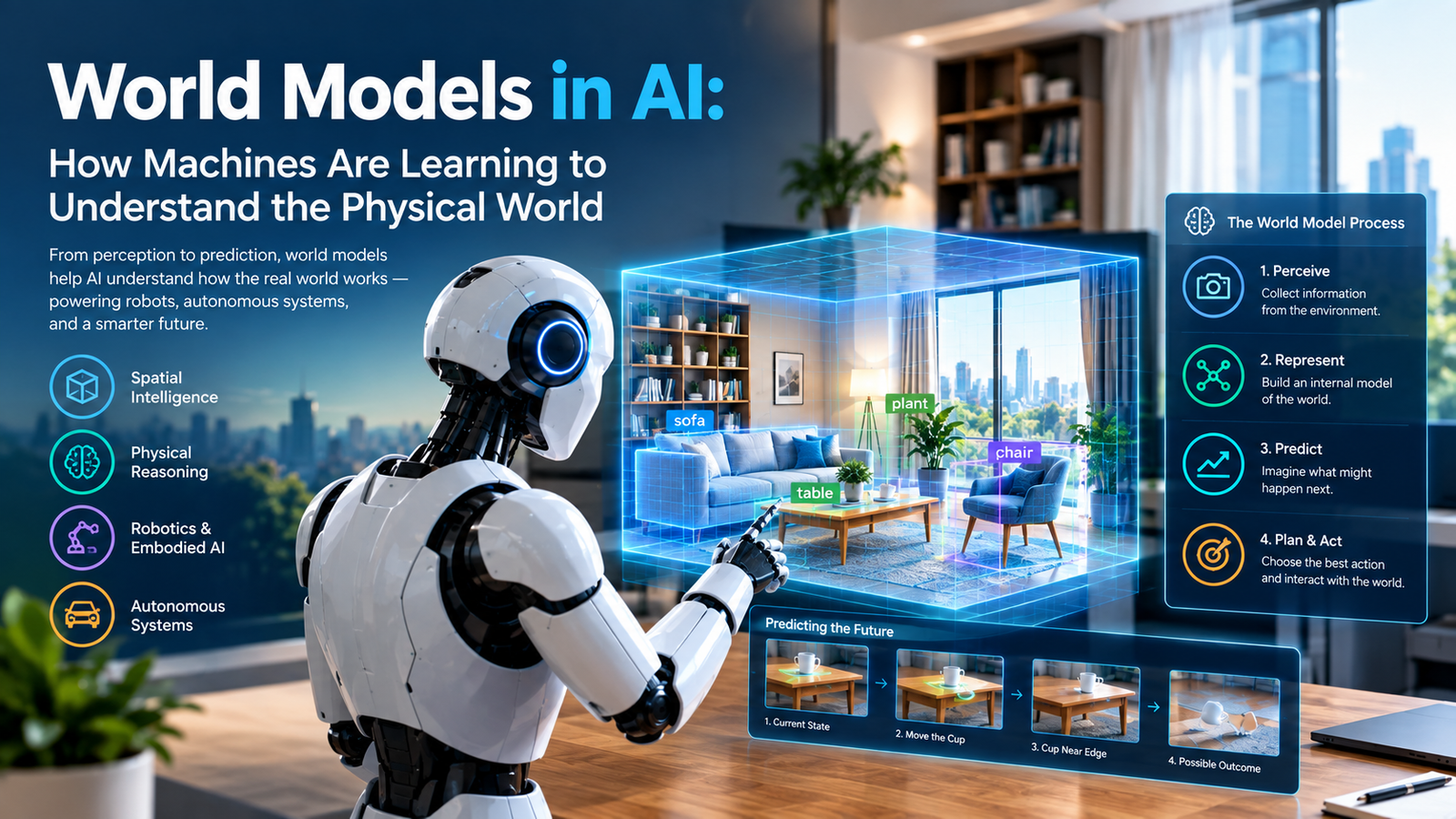
Artificial intelligence has made remarkable progress in understanding language, recognizing images, generating content, and solving increasingly complex problems. Yet a major difference exists between knowing information and understanding how the real world behaves.
An AI system may recognize a cup in an image, for example, but recognizing a cup is not the same as understanding that the cup occupies physical space, can be picked up, can fall, can break, and will move if a person pushes it. Humans continuously make these predictions without consciously calculating every possibility. For machines, developing this kind of understanding is much harder.
This is why world models matter: they give AI a way to build internal representations of the physical world and use them to predict what may happen next.
A world model is an AI system designed to build an internal representation of an environment and use it to predict how that environment may change over time. In simple terms, it helps an AI system understand not just what is happening now, but what could happen next in the real world.
The idea is particularly important for robotics, autonomous vehicles, intelligent agents, simulation, and other forms of physical AI. Research from companies such as Google DeepMind, Meta, NVIDIA, and World Labs shows that the field is moving toward AI systems that can model space, time, actions, objects, and potential future states.
But what are world models, how do they work, and why could they matter for the next generation of AI?
What Are World Models?
In simple terms, what are world models?
A world model is an AI-based representation of how an environment works. It attempts to learn relationships between objects, events, actions, movement, space, and time so that an AI system can anticipate possible outcomes.
Traditional AI often focuses on mapping an input to an output:
Input → AI model → Output
For example:
- An image goes into a computer vision model.
- A language prompt goes into a language model.
- A sensor reading goes into a classification system.
A world model introduces another important concept:
Current state → Internal world representation → Possible future states → Action.
This lets an AI system consider possible consequences before acting.
Imagine a robot standing in a kitchen. It sees a glass near the edge of a table. A conventional recognition system may identify the object as a glass. A more sophisticated world model could represent additional information:
- The glass is on a table.
- The glass is close to the edge.
- The glass can be moved.
- A robot arm can potentially reach it.
- A sudden contact could cause it to fall.
- If it falls onto a hard surface, it could break.
The AI does not necessarily need to describe each statement in natural language explicitly. Instead, these relationships can exist in an internal learned representation that supports prediction and planning.
This is the central idea behind world models in AI: learning enough about an environment to predict how it behaves and support future action in the physical world.
How Is a World Model Different From a Traditional AI Model?
An AI model can be trained to perform a specific function. For example, a model can classify images, generate text, detect objects, summarize documents, or predict a numerical value.
A world model has a different emphasis: it attempts to model the environment itself.
Consider a robot trying to place a box on a shelf.
A traditional vision model might answer:
“There is a box.”
A control system might answer:
“Move the robot arm forward.”
A world model attempts to connect those pieces:
“There is a box in this location, the shelf is here, the arm is approaching from this direction, and moving in this way may result in the box being placed on the shelf.”
This distinction matters because physical tasks are dynamic. Actions change the environment.
For software agents, an incorrect response may produce a bad result on a screen. For robots and autonomous systems, an incorrect prediction can cause a collision, damage equipment, waste materials, or create an unsafe situation.
As a result, AI world modelling is closely connected to prediction, planning, simulation, and action in physical settings.
Why World Models Matter for AI
Modern AI has become very good at processing enormous quantities of data. Generative AI systems can produce realistic text, images, audio, and video. However, generating plausible content does not automatically mean an AI system has a reliable physical understanding of reality.
Physical environments have persistent rules.
Objects generally occupy space. People cannot walk through solid walls. A vehicle has momentum. A dropped object moves downward under gravity. A robot with limited reach cannot simply teleport its arm to another location.
A useful world model needs to capture patterns like these.
This matters because world models help AI systems understand and act more effectively in the physical world.
Better Prediction
An intelligent system should be able to estimate what might happen next.
For a robot, that could mean predicting whether a human is about to walk into its path.
For an autonomous vehicle, it could mean estimating how another road user might move.
For an industrial system, it could mean forecasting how objects and machines will behave during a process.
Better Planning
Prediction supports planning.
Suppose a robot needs to move an object from point A to point B. There may be dozens of possible routes. A world model can potentially help the system simulate different actions and estimate their outcomes before acting in the physical environment.
Safer Learning
Testing every possible behaviour with a physical robot can be expensive and risky.
AI simulation provides a virtual environment where models can test scenarios repeatedly without physically damaging equipment.
NVIDIA describes this approach as using world foundation models for simulation, synthetic data generation, and development of physical AI systems such as robots and autonomous vehicles.
Greater Adaptability
A robot trained for one exact situation may struggle when conditions change. World models aim to give autonomous systems a richer representation that can support adaptation to unfamiliar situations.
That is especially relevant to embodied AI, where intelligence must operate through a physical body in the real world.
How World Models in AI Work
No single universal architecture exists for world-model AI. Researchers are experimenting with different approaches.
At a high level, many world-model systems involve four major capabilities:
- Perception
- Representation
- Prediction
- Planning or action
1. Perception
The system first receives information about an environment.
This information might come from:
- Cameras
- Video
- Depth sensors
- LiDAR
- Audio
- Robot sensors
- Text
- 3D data
- Past actions
For an autonomous robot, cameras may provide visual observations while other sensors provide information about movement, position, or depth.
2. Internal Representation
The AI needs more than raw pixels.
It must develop an environment representation that captures relevant properties and relationships.
A useful representation could encode concepts such as:
- Object location
- Object movement
- Relative distance
- Surface geometry
- Spatial relationships
- Temporal changes
- Possible interactions
- Agent actions
This is one reason spatial intelligence has become an important research area.
3. Prediction
The model can then estimate possible future states.
If an object is moving, what happens next?
If a robot pushes something, where does it go?
If a person changes direction, what could happen?
If a vehicle brakes, how does traffic around it change?
A world model may generate, predict, or represent future states in different forms, including latent representations, trajectories, images, video, or simulated environments.
Google DeepMind describes Genie 3 as a general-purpose world model that can generate interactive environments and predict how a world evolves and how actions affect it.
4. Planning and Action
Prediction becomes useful when an AI system can use it to choose an action.
A robot may compare several possible movements and estimate which one is most likely to accomplish a task.
This creates a loop:
Observe → Model → Predict → Plan → Act → Observe Again
The process then repeats as the environment changes.
World Models and Physical AI
The relationship between world models for physical AI and robotics is one of the most important areas of current research.
Physical AI refers broadly to AI systems that perceive, reason about, and act in physical environments. Robots and autonomous vehicles are obvious examples.
NVIDIA describes physical AI as involving systems such as robots and autonomous vehicles that need to understand and interact with the real world. Its Cosmos platform is designed around world foundation models for simulation, synthetic data, reasoning, and physical AI development.
A world model can become an internal predictive layer for a physical AI system.
Imagine an autonomous warehouse robot.
It sees:
- shelves,
- packages,
- workers,
- forklifts,
- moving carts,
- open pathways.
But perception alone is not enough.
The robot needs to estimate what could happen next.
A person may cross its path. A forklift could move unexpectedly. A box may obstruct a previously available route.
A world model can help the robot reason about changing conditions instead of treating each image as an isolated event.
World Models for Robotics
World models for robotics have attracted significant research because physical robots face an enormous number of possible situations.
The real world is also difficult to reproduce perfectly in a laboratory.
A robot may encounter:
- Different lighting
- New objects
- Unpredictable human movement
- Slippery surfaces
- Cluttered environments
- Changing object positions
- Unexpected obstacles
A robot that relies heavily on memorized patterns can struggle when the environment differs from training data.
World models attempt to address this problem by learning broader environmental relationships.
Robot Training in Virtual Environments
One important application is simulation.
Instead of immediately placing a robot in a physical environment, developers can first train or test components in simulated environments.
This can create many variations of a task:
- Pick up a box.
- Move around an obstacle.
- Open a drawer.
- Navigate a hallway.
- Follow a human.
- Place an item on a shelf.
The system can repeat these experiences far more easily than a physical robot could in some circumstances.
NVIDIA’s research describes combining a digital twin of the robot with a digital representation of the world to support physical AI development.
Learning From Video
Video is another valuable source of information because it contains sequences rather than isolated observations.
A model can potentially learn that objects move, people interact, and environments change over time.
Meta’s V-JEPA 2 is an example of this line of research. Meta describes it as a self-supervised foundation world model trained on video for visual understanding and prediction, with research demonstrations involving robot planning and control in unfamiliar environments.
World Models and Spatial Intelligence
One of the most important concepts connected with world models is spatial intelligence.
Spatial intelligence is the ability to understand objects and environments in relation to space.
For an AI system, this could involve understanding:
- Where an object is
- How large it is
- How far away it is
- What is behind it
- How objects relate to one another
- How the environment looks from different viewpoints
- How an object might move
- How an action could change spatial relationships
This is more complex than image recognition.
An image can show a chair, but spatial intelligence involves understanding where the chair is, what surrounds it, how a person can move around it, and how it relates to the rest of the room.
World Labs describes its work on world models as focused on modelling the world and reasoning about objects, places, and interactions across space and time. Its Atlas model, introduced in September 2026, is described as an omni world model that operates across text, images, video, and 3D information in a shared spatial context.
This illustrates a broader shift from AI that mainly understands symbols and language toward systems designed to understand environments.
What Is AI World Modelling Used For?
The potential applications of AI world modelling extend well beyond robotics.
Autonomous Vehicles
Self-driving vehicles need to understand dynamic environments.
A vehicle must account for:
- Cars
- Pedestrians
- Bicycles
- Traffic signals
- Road layouts
- Construction zones
- Weather
- Vehicle movement
A world model can support prediction by helping a system consider how the environment may evolve.
Rather than asking only:
“What objects are visible?”
An autonomous system needs to consider:
“What is likely to happen next, and what could happen if I take a particular action?”
This is one reason world models are being explored for autonomous driving and related mobility systems. NVIDIA positions its Cosmos platform as a development tool for physical AI applications, including autonomous vehicles.
Industrial Robotics
Factories contain highly structured environments, but even structured environments can change.
Robots may need to handle:
- New products
- Different object orientations
- Manufacturing variations
- Human workers
- Equipment changes
- Unexpected obstacles
A predictive model could help robots adapt their movements based on current conditions.
Warehouse Automation
Modern warehouses increasingly rely on automation to sort, transport, and handle products.
World models could support systems that need to reason about changing layouts and object positions.
Smart Homes
Household environments are considerably less predictable than many industrial settings.
Objects move. People behave differently. Furniture can be rearranged.
An embodied AI assistant that can navigate a home would need a useful understanding of its surroundings.
Meta has described world-model applications for robotic assistants that can operate in physical environments and handle household tasks.
Simulation and Synthetic Data
Another major use case is generating training data.
Real-world data collection can be slow and expensive.
Synthetic environments can create controlled variations of:
- Weather
- Lighting
- Object placement
- Traffic
- Terrain
- Human movement
- Industrial conditions
This can help developers expose AI systems to situations that may be rare in real-world datasets.
NVIDIA describes Cosmos as a platform for world simulation and synthetic video generation intended to help physical AI developers create training data and test different scenarios.
Gaming and Virtual Worlds
World models can also have creative applications.
A world model can potentially generate interactive environments that respond to user actions.
Google DeepMind’s Genie 3 demonstrates this direction by generating interactive worlds from text prompts that users can explore in real time.
This could eventually influence:
- Game development
- Virtual reality
- Training environments
- Digital twins
- Interactive storytelling
- Education
World Models vs Generative AI
World models are closely related to generative AI, but the terms are not interchangeable.
Generative AI focuses on producing new content.
Examples include:
- Text
- Images
- Audio
- Video
- Code
A world model focuses more specifically on representing and predicting environments and how they evolve.
However, modern systems increasingly combine these capabilities.
For example, a world model may generate a visual future state of an environment. That makes generation part of the modelling process.
NVIDIA’s Cosmos 3 combines vision reasoning, world generation, and action prediction in a physical AI foundation model, according to NVIDIA’s May 2026 announcement.
This convergence suggests that future AI systems may not have rigid boundaries between perception, generation, simulation, reasoning, and action.
World Models vs Large Language Models
Large language models learn patterns in language and other training data. They are powerful tools for communication, coding, reasoning, and information processing.
World models focus more directly on environmental dynamics.
A language model may know that:
“A ball rolls down a hill.”
A world model ideally needs to learn relationships that let it predict what may happen when a ball is positioned on a slope and released.
That does not mean language models cannot reason about physical concepts. They can describe and reason about many real-world situations.
The difference is that world model AI seeks a deeper connection between perception, space, time, actions, and environmental outcomes.
Future systems may combine both.
A language model could understand the instruction:
“Bring me the bottle from the kitchen.”
A world model could help the system understand:
- where the kitchen is,
- where the bottle is,
- which route is available,
- what obstacles exist,
- how the bottle can be grasped,
- and what might happen during the movement.
Together, these capabilities could enable more capable autonomous AI systems.
The Connection Between World Models and Embodied AI
Embodied AI refers to AI systems that operate through a physical or simulated body.
A chat-bot primarily interacts through digital information. A robot interacts through sensors, motors, movement, and physical objects.
That difference is fundamental.
An embodied system needs to connect perception and action continuously.
For example:
See → Understand → Predict → Move → Observe → Adjust
A robot cannot rely entirely on fixed instructions because the world changes while it operates.
This makes world models especially relevant to embodied intelligence research. A 2025 survey of embodied intelligence research describes world models as tools that provide internal representations to support predictive planning and adaptive decision-making, complementing physical simulators.
AI Physical Reasoning
A major goal of these systems is AI physical reasoning.
Physical reasoning means understanding cause and effect in physical environments.
Consider a simple scenario.
A robot sees a small object resting on top of a larger object.
If the robot pushes the lower object, several things could happen. The upper object could move, fall, slide, or remain in place depending on the geometry and forces involved.
A model capable of physical reasoning needs to learn relationships between:
- Shape
- Position
- Motion
- Contact
- Gravity
- Force
- Time
- Occlusion
This does not necessarily require the AI to calculate classical physics equations explicitly in every situation. Machine learning systems can learn statistical regularities from large quantities of examples.
But an important challenge remains: a model must generalize beyond exactly what it has seen.
A useful world model therefore needs both broad experience and strong representations.
The Role of Video in World Models
Video may be one of the most useful data sources for learning about dynamic environments.
A still image provides information about one moment.
Video provides a sequence:
State 1 → State 2 → State 3 → State 4
From this sequence, an AI system can learn patterns of change.
For example, it can observe:
- Objects approaching each other.
- People walking
- Vehicles turning
- Doors opening
- Objects falling
- Robots moving
- Shadows changing
- Cameras moving through spaces
This gives AI models a richer source of information for temporal prediction.
Meta’s V-JEPA 2 research specifically focuses on learning from video to support visual understanding and prediction in the physical world.
Video alone, however, does not solve every problem. The model still needs to connect visual patterns with actions and consequences.
Why World Models Are Difficult to Build
Despite rapid progress, building reliable world models remains a difficult research problem.
The Real World Is Extremely Complex
The physical world contains almost unlimited variation.
A model trained in one environment may encounter another with:
- Different layouts
- Different lighting
- Different objects
- Different people
- Different weather
- Different surfaces
The system has to generalize rather than memorize.
Physics Is Hard to Approximate
Many real-world interactions depend on complex physical properties.
Consider:
- Flexible objects
- Liquids
- Glass
- Cloth
- Smoke
- Crowds
- Moving machinery
These can be difficult to model accurately.
Long-Term Prediction Is Difficult
Predicting one moment into the future may be easier than predicting what will happen several minutes later.
Small errors can accumulate.
If the model makes a slightly incorrect prediction at step one, the error can affect step two. Further into the future, the simulated environment may diverge significantly from reality.
Rare Events Matter
Some dangerous events are uncommon.
A robot may operate normally thousands of times before encountering an unusual situation.
Training AI to handle rare events is difficult because there may be little data.
Reality Has Hidden Information
Sensors do not reveal everything.
A camera cannot see through an object. A wall can hide another room. A person can partially block another person.
A useful world model needs to reason about information that is not directly observable.
The Simulation-to-Real Challenge
One of the biggest challenges in physical AI is often described as the sim-to-real gap.
A simulation can be useful even if it isn’t perfectly realistic.
For example, a simulated robot might learn to move on a virtual floor. The real floor could have slightly different friction, unevenness, lighting, or physical interactions.
When the robot enters the real world, these differences matter.
World models can reduce some of these limitations by helping systems learn richer representations of environments, but they do not magically eliminate the difference between virtual and physical reality.
Researchers therefore increasingly explore combinations of:
- Real-world data
- Synthetic data
- Physics simulation
- Video learning
- Robot interaction
- World models
- Reinforcement learning
These approaches can complement one another.
World Models and Synthetic Data
One of the most promising applications of world models is generating synthetic data.
Suppose a company wants to train a robot to operate in a warehouse.
Collecting thousands of carefully labelled examples of every possible condition could be expensive.
A world model or related simulation platform can potentially create additional scenarios.
For example:
- A box is rotated differently.
- A worker stands in another position.
- A shelf contains different products.
- Lighting becomes weaker.
- The robot approaches from another direction.
The goal is not simply to create attractive images. The generated data needs to be useful for learning decisions and behaviour.
That distinction is important.
High visual quality does not automatically mean high physical accuracy.
Researchers and companies therefore care about consistency, controllability, temporal coherence, and physical plausibility.
NVIDIA Cosmos and the Growth of Physical AI
NVIDIA has become a major player in developing world foundation models.
In January 2025, NVIDIA introduced Cosmos, a platform focused on world foundation models for physical AI. NVIDIA described these models as systems that can predict and generate physics-aware future states and support applications such as robotics and autonomous vehicles.
By May 2026, NVIDIA launched Cosmos 3, describing it as an open physical AI foundation model combining vision reasoning, world simulation, and action generation.
NVIDIA’s current Cosmos platform describes applications across:
- Robotics
- Autonomous vehicles
- Simulation
- Synthetic data
- Vision AI
- Physical scene understanding
and presents world models as part of a development stack for physical AI.
This illustrates how world-model research is moving from academic concepts toward developer platforms and practical engineering workflows.
Google DeepMind and Interactive World Models
Google DeepMind is another major contributor to the field.
Its Genie family explores generative world models for interactive environments.
According to Google DeepMind, Genie 3 can generate photo-realistic interactive environments from text descriptions and allow real-time exploration. The company presents this as progress toward systems that can understand how environments evolve and how actions influence them.
The significance is broader than graphics.
An interactive environment can become a place where AI agents learn, test strategies, and explore consequences.
Rather than training only through static datasets, an agent could potentially learn by acting within generated environments.
This concept could become particularly important for AI systems that need to operate in complex physical settings.
Meta V-JEPA and Predictive World Understanding
Meta’s V-JEPA 2 represents another approach.
Rather than focusing primarily on generating a complete visual world from text, V-JEPA 2 emphasizes learning representations from video and predicting what happens in physical environments.
Meta reports that its research system supports visual understanding and prediction and has been explored for robot planning and control in unfamiliar environments.
The broader idea is significant because intelligent action depends heavily on anticipating consequences.
A robot doesn’t just need to recognize an object. It needs to estimate how that object and its surroundings may change as it acts.
World Labs and Spatial Intelligence
World Labs focuses heavily on spatial intelligence and world models.
In September 2026, the company introduced Atlas, describing it as an omni world model designed to work natively with text, images, video, and 3D information within a shared spatial context.
The company’s research emphasizes a broader interpretation of world models: systems that can perceive, generate, reason about, and interact with virtual and physical environments.
This direction highlights an important point.
The future of AI may depend not only on understanding language but also on understanding the geometry and dynamics of the environments where people and machines operate.
World Models for Autonomous AI Systems
Developing autonomous AI systems requires more than generating a single correct response.
An autonomous system must often:
- Understand its environment.
- Determine its objective.
- Predict possible outcomes.
- Choose a plan.
- Take an action.
- Observe the result.
- Update its understanding.
- Continue.
World models can contribute to several stages of this cycle.
For example, an autonomous warehouse robot could build an internal representation of the warehouse, predict traffic from people and robots, compare potential paths, select an action, and update its plan after new sensor information arrives.
This is significantly different from a system that follows a predetermined sequence.
Autonomy depends on adapting to changing circumstances.
The Future of World Model AI
The future of world models in artificial intelligence will likely involve tighter integration across several AI capabilities.
Instead of separate systems for perception, language, simulation, planning, and action, future architectures may combine them into increasingly unified models.
Possible developments include:
Multimodal World Understanding
Future systems may combine:
- Text
- Images
- Video
- Audio
- 3D geometry
- Sensor data
- Robot actions
The goal would be to create a richer, more consistent representation of an environment.
More Realistic Simulation
World models may become better at maintaining consistency over longer periods.
This would make them more valuable for testing complex scenarios.
Better Robot Planning
As predictive models improve, robots may be able to reason about unfamiliar tasks before attempting them in the real world.
Digital Twins
Companies could create AI-supported digital versions of factories, warehouses, stores, vehicles, or buildings.
These models could help analyze processes and simulate changes.
Human-Robot Collaboration
Robots will often need to work around people.
A world model could help them predict human movement and respond appropriately to changing environments.
Interactive Virtual Worlds
Entertainment and education could benefit from environments that dynamically respond to user actions.
Are World Models the Same as Artificial General Intelligence?
World models are sometimes discussed in relation to artificial general intelligence, but they are not the same thing.
A world model is a particular approach for representing and predicting environments.
AGI is a much broader concept involving highly general intelligence across many tasks.
Google DeepMind describes world models as an important research direction toward more capable AI agents, but this does not mean that existing world models constitute AGI.
It is more accurate to think of world models as one potentially important component in developing increasingly capable AI systems.
Key Benefits of World Models
The potential advantages of AI world models can be summarized across several areas.
Prediction
They can help AI estimate future states rather than respond only to current observations.
Planning
They can support comparison of possible actions before execution.
Simulation
They can provide virtual environments for experimentation and testing.
Adaptability
They may help systems generalize to situations that differ from exact training examples.
Reduced Physical Testing
Virtual experimentation can reduce the need for physical trial and error.
Synthetic Data
World models can help generate additional scenarios for training and evaluation.
Spatial Understanding
They can support richer reasoning about objects, environments, and relationships.
Limitations and Risks
Developing world models also creates important challenges.
A model can produce a realistic-looking simulation that is not physically accurate.
This is sometimes called a simulation error or model mismatch.
For safety-critical applications, developers cannot assume that a visually convincing prediction is correct.
Autonomous vehicles, industrial robots, healthcare systems, and other physical applications may require rigorous testing and validation.
There are also questions around:
- Data quality
- Computational cost
- Bias
- Security
- Reliability
- Privacy
- Evaluation
- Real-world robustness
For example, a model trained predominantly in certain environments may perform differently in environments that are underrepresented in its training data.
As world models become connected to physical devices, security becomes another concern. A compromised AI system controlling machinery or transportation could create consequences very different from those of a flawed text-generation system.
Therefore, progress in world models will require not only larger models and more data, but also better evaluation and safety engineering.
World Models vs Traditional Simulation
World models and traditional simulators are related, but they are not identical.
Traditional physics simulators are often built using explicit physical rules and engineered environments.
A world model learns patterns from data.
This creates different strengths.
A physics simulator can provide highly controllable mechanics for known environments.
A learned world model may capture visual complexity and environmental variation that is difficult to hand-code.
Research increasingly explores combining both approaches.
A physical simulator can provide reliable structure, while a learned model can provide richer appearance, behaviour, or environmental variation.
The combination could become especially powerful for robotics and autonomous systems.
How Businesses Could Use World Models
For businesses, world models may eventually influence several industries.
Manufacturing companies could use digital environments to optimize robotic workflows.
Logistics companies could simulate warehouse operations.
Automotive companies could generate driving scenarios for autonomous systems.
Construction organizations could use spatial models to analyze sites.
Entertainment companies could build interactive virtual environments.
Training providers could create realistic worker simulations.
Retail companies could explore store layouts and autonomous inventory systems.
The technology is still developing, so practical value will vary by application. However, the underlying idea is becoming increasingly relevant as AI moves from purely digital tasks into environments where machines must perceive and act.
What Makes a Good World Model?
A useful world model should do more than generate realistic visuals.
Important qualities include:
Temporal consistency: The environment should remain coherent over time.
Spatial consistency: Objects should maintain meaningful positions and relationships.
Predictive ability: The model should support useful forecasts.
Action awareness: It should represent how actions can alter an environment.
Generalization: It should work across diverse conditions.
Controllability: Developers should be able to specify or manipulate relevant aspects of a scenario.
Efficiency: The system should operate within practical computational limits.
These qualities are especially important when world models are used for robotics or other physical applications.
Frequently Asked Questions About World Models in AI
What are world models in AI?
World models are AI systems that learn representations of environments and their dynamics so they can predict how those environments may change. They can support simulation, planning, robotics, autonomous systems, and other applications involving physical or virtual worlds.
What is a world model AI?
A world model AI is an AI system designed to represent and predict aspects of a world. It can combine information such as video, images, text, actions, and 3D data to estimate possible future states.
What is the difference between an AI model and a world model?
An AI model can be designed for many different tasks, such as classification, text generation, or image recognition. A world model specifically emphasizes understanding environments, their relationships, and how they evolve.
Why are world models important for robotics?
Robots operate in changing physical environments. World models can help them predict consequences, simulate actions, and plan movement before acting in the real world.
What is physical AI?
Physical AI generally refers to AI systems that perceive, reason about, and act within physical environments. Robots and autonomous vehicles are common examples.
Are world models generative AI?
Some world models use generative techniques to create future states, videos, images, or interactive environments. However, world models are broader than content generation because they can also support prediction, simulation, and action planning.
What is spatial intelligence?
Spatial intelligence is the ability to understand objects, environments, positions, distances, geometry, and spatial relationships. It is becoming an important part of AI research focused on physical environments.
Can world models control robots?
Researchers have explored some systems for robot planning and control. For example, Meta has reported experiments with V-JEPA 2 for zero-shot planning and robot control in unfamiliar environments. Such research does not mean that all world models are ready for general-purpose autonomous robot control.
Are world models ready for everyday use?
World-model technology is advancing quickly, but reliability varies significantly between systems and applications. Research prototypes and developer platforms are available, while demanding real-world applications still require extensive validation.
Final Thoughts: Why World Models Could Shape the Next Era of AI
The next major stage of artificial intelligence may depend on something humans use every moment without thinking about it: an internal understanding of the world.
People naturally predict what will happen when they move an object, walk across a room, open a door, or drive through an intersection. We continuously combine perception, memory, spatial reasoning, and physical intuition.
Machines are now beginning to approach pieces of that capability through world models.
From interactive environments created by Google DeepMind’s Genie 3 to Meta’s predictive, video-based V-JEPA 2, NVIDIA’s Cosmos platform for physical AI, and World Lab’s research into spatial intelligence, different approaches are converging on a common goal: enabling AI systems to understand environments and reason about how they change.
The significance of world models goes beyond robots.
They could influence autonomous vehicles, digital twins, simulation, industrial automation, virtual environments, smart spaces, and intelligent agents that interact with the physical world.
At the same time, major challenges remain. Real-world environments are unpredictable, physical interactions are hard to model, and prediction errors can become serious when AI systems control machines.
For that reason, we should not measure the evolution of world models in AI only by how realistic a generated scene looks. The more important question is whether the model can consistently represent space, time, actions, and consequences well enough to support reliable decisions.
The future of AI may therefore involve a shift from systems that mainly generate answers to systems that can understand environments, imagine possible futures, and act within the world.
That is what makes world models one of the most interesting directions in modern artificial intelligence—and a potentially important foundation for the growth of physical and embodied AI.





Leave a Reply