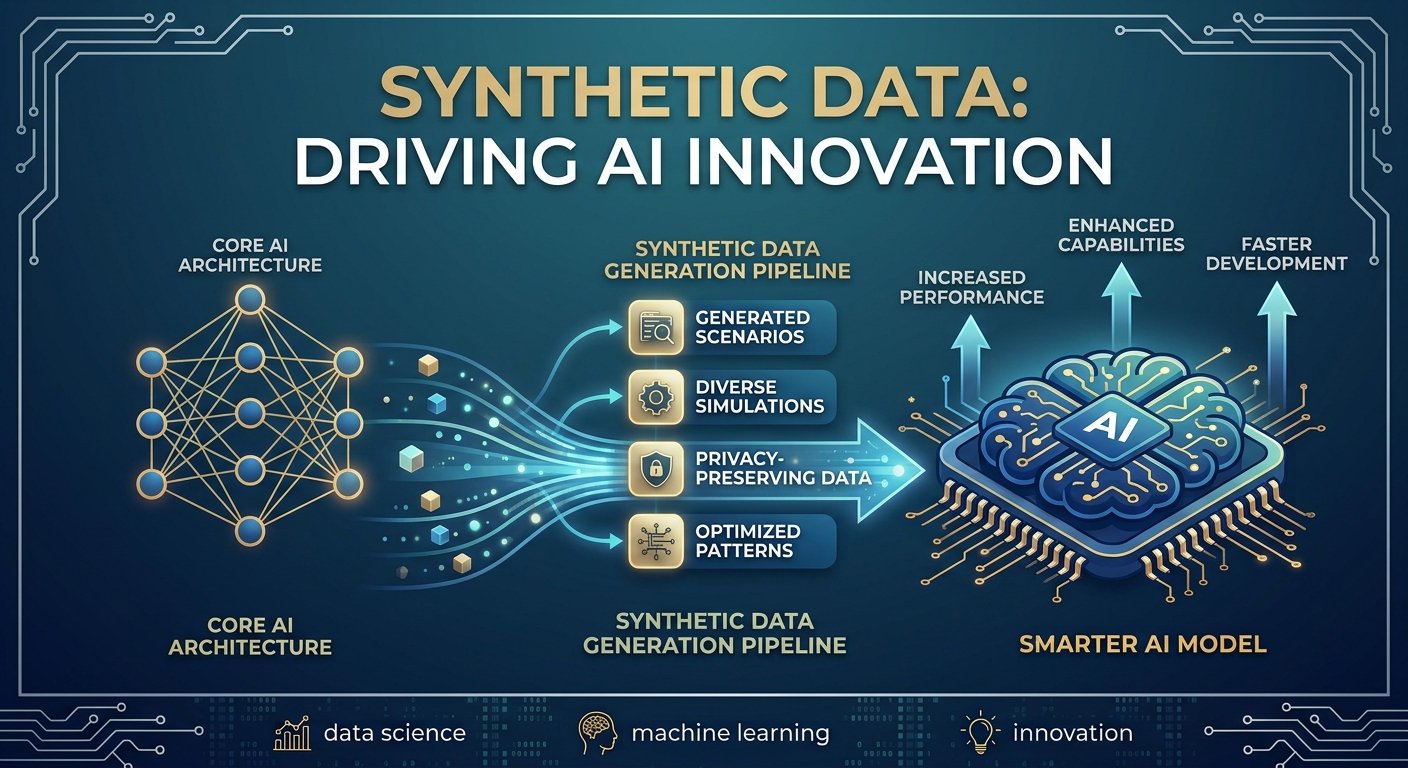
Artificial intelligence is advancing quickly, but one challenge still affects almost every AI project: data.
Machine learning models need large amounts of high-quality information to learn patterns, recognize objects, understand language, make predictions, and automate decisions. Yet collecting enough real-world data can be expensive, slow, legally complicated, or impossible when the information is sensitive. Healthcare records, financial transactions, customer information, security footage, and other private datasets cannot always be freely shared or used for experimentation.
Synthetic data is becoming increasingly important.
So, what is synthetic data, and why is it attracting so much attention in artificial intelligence? In simple terms, synthetic data is artificially created information designed to resemble useful characteristics of real-world data. You can generate it using statistical methods, simulations, machine learning, or generative AI. NIST defines synthetic data generation as a process that uses seed data to create artificial data with some of the seed data’s statistical characteristics.
Instead of waiting years to collect every possible real-world example, organizations can use synthetic data generation to create additional training examples, simulate rare events, test systems, and support machine learning development.
Synthetic datasets are becoming a valuable part of modern AI workflows in autonomous vehicles, healthcare, finance, robotics, cybersecurity, and generative AI.
This article explains how synthetic data works, why companies use it, how it compares with real data, its major benefits and limitations, and where it is likely to have the greatest impact.
What Is Synthetic Data?
Before exploring how it is generated, it is important to understand the basic idea.
Synthetic data is artificially generated information that is created to reproduce selected characteristics, relationships, structures, or patterns found in real-world data.
Unlike randomly generated fake information, useful synthetic data is created with a purpose. The goal may be to preserve statistical relationships, replicate realistic scenarios, create additional examples for machine learning, or simulate situations that are difficult to observe in the real world.
For example, imagine an American hospital wants to develop an AI system that predicts potential complications after surgery. Real patient records could be extremely valuable for training the model, but they also contain sensitive health information. Instead of giving developers unrestricted access to real patient identities and records, an organization could create artificial patient records that reproduce relevant patterns without directly representing actual individuals.
The exact method depends on the application.
Synthetic data may include:
- Images
- Videos
- Text
- Audio
- Financial transactions
- Medical records
- Sensor readings
- Customer behavior
- Geographic information
- Manufacturing data
- Autonomous-driving scenarios
- Software testing records
Generative AI can also produce synthetic content in different formats. NIST describes generative AI as models that can emulate characteristics of input data to generate derived synthetic content, including text, images, audio, and video.
The important point is that synthetic data is not simply random information. It is generated to satisfy a particular need.
Why Does AI Need More Training Data?
Modern AI systems depend heavily on training data.
A machine learning algorithm learns patterns from examples. If a model is trained to identify defective products, it needs examples of both normal and defective products. If an AI system is designed to detect fraudulent transactions, it needs examples that show legitimate and suspicious behaviour.
The quality, diversity, and relevance of those examples can influence how well a model performs.
However, obtaining real-world AI training data is often difficult.
A company developing an autonomous vehicle system might need millions of examples covering highways, city streets, rain, snow, pedestrians, bicycles, road construction, emergency vehicles, unusual traffic situations, and countless edge cases.
Not every one of those situations occurs frequently enough in the real world.
Similarly, a cybersecurity company may want examples of rare attacks. A financial institution may need examples of unusual fraudulent transactions. A medical AI developer may need examples of uncommon diseases.
Real-world collection has practical limits.
Data may be:
- Expensive to collect
- Difficult to label
- Restricted by privacy requirements
- Limited in volume
- Biased toward common situations
- Missing rare events
- Difficult to share between organizations
- Time-consuming to validate
The growing demand for AI systems has also increased pressure to obtain high-quality training data. OECD research has highlighted this demand and the legal and intellectual-property questions surrounding some data-collection practices.
Synthetic data provides another route.
Instead of relying exclusively on what already happened in the real world, developers can create additional scenarios that a model needs to learn.
How Does Synthetic Data Generation Work?
Synthetic data generation can use several different techniques. There is no single universal method.
The right approach depends on the type of data being created and how it will be used.
1. Statistical Methods
Traditional statistical modelling is one of the oldest approaches.
Suppose an organization has information about customer age, income, spending frequency, and purchasing behaviour. Statistical techniques can model relationships among these variables and generate new artificial records.
The synthetic records are not simply copies of existing customers. Instead, they follow modelled patterns.
This approach can work particularly well for structured tabular data.
Examples include:
- Banking transactions
- Insurance records
- Customer profiles
- Sales data
- Business metrics
- Inventory information
The goal is generally to preserve useful statistical relationships while producing new records.
2. Simulation-Based Generation
Simulation creates synthetic data by modelling how a real system behaves.
This is especially useful when you can represent a physical or operational environment computationally.
For example, an autonomous vehicle simulation can create traffic scenes involving roads, vehicles, pedestrians, weather conditions, signs, and obstacles.
A robotics company can simulate robot movements and sensor inputs.
A manufacturing company can simulate machinery operating under different conditions.
Instead of waiting for every possible event to happen in the real world, simulation can produce controlled examples at a much larger scale.
3. Generative AI Models
Generative models can also produce modern AI-generated data.
Generative models learn data characteristics and then generate new examples based on what they learn.
Depending on the model, the output could be:
- Text
- Images
- Audio
- Video
- Structured records
- Multimodal examples
For instance, a generative image model may produce artificial images of cars from different camera angles. A language model can generate conversation examples or instructions. A specialized model can generate structured information that resembles patterns in an existing dataset.
Microsoft says it sometimes trains on synthetic datasets created by prompting large language models to generate requested outputs that augment scarce real-world data, then reviews and filters them.
This illustrates an important point: synthetic generation is often part of a broader data pipeline, not a complete replacement for human-created data.
4. Generative Adversarial Networks
Generative Adversarial Networks, commonly called GANs, have also been used for synthetic data generation.
A GAN typically involves two competing neural networks.
One network generates artificial examples, while another attempts to distinguish generated examples from real ones.
Over repeated training, the generator attempts to produce increasingly realistic outputs.
GANs have been explored for applications such as:
- Image generation
- Medical imaging
- Fraud detection data
- Face images
- Industrial inspection
- Data augmentation
Although newer generative approaches have become prominent, GANs remain an important part of synthetic data research history.
5. Synthetic Data From Hybrid Pipelines
In practical AI development, organizations may combine multiple methods.
For example, a team could start with real data, use statistical modelling to understand distributions, use simulation to create edge cases, and then apply generative AI to expand specific categories.
This hybrid approach can be useful because real data and synthetic data have different strengths.
The objective is not always to create perfectly realistic information. Sometimes the goal is to create targeted examples that make an AI model more capable.
Types of Synthetic Data
Synthetic data can be classified in several ways.
Fully Synthetic Data
Fully synthetic datasets are generated without directly mapping each output record to a specific original record.
NIST’s discussion of synthetic data distinguishes fully synthetic datasets from partially synthetic approaches and notes that fully synthetic data can still carry disclosure risks when it is derived from confidential information.
Partially Synthetic Data
Partially synthetic data may retain some elements of the original dataset while modifying, replacing, or transforming certain attributes.
This can be useful when an organization wants to reduce exposure of sensitive information while retaining useful structure.
Simulated Test Data
Another category is test data created to mimic the structure and value ranges of real systems.
For example, software developers may need thousands of artificial customer accounts to test a banking application.
This type of data doesn’t need to preserve every statistical property of real users. It simply needs to behave realistically enough for testing.
Synthetic Training Data: How AI Learns From Artificial Examples
One of the most important applications is synthetic training data.
Machine learning systems learn from examples. If developers can produce useful additional examples, they can expand the range of situations represented during training.
Imagine an image-recognition model trained to identify potholes.
A real dataset may contain images captured on sunny days.
What happens when the model encounters:
- Rain
- Fog
- Snow
- Nighttime
- Different camera angles
- Poor image quality
- Road construction
- Partially hidden potholes
Synthetic generation can help create additional examples for these situations.
The same concept works for many other AI systems.
A facial-recognition research project could create different lighting conditions.
A robotics model could generate different object positions.
A voice system could create variations in background noise.
A fraud model could simulate transaction patterns that are uncommon in existing data.
The objective is to expose the model to a wider range of conditions.
Microsoft identifies data augmentation and testing/validation as important uses of synthetic data in machine learning, particularly when real-world data is scarce or expensive.
Synthetic Data for Machine Learning
Synthetic data for machine learning is especially useful when a dataset is too small, sensitive, unbalanced, or difficult to obtain.
Consider a classification problem where 99% of transactions are legitimate and only 1% are fraudulent.
A machine learning model may struggle to learn enough examples of fraud because fraudulent events are relatively rare.
Synthetic generation can create additional examples that represent specific fraud patterns.
However, developers need to be careful.
Artificially generating more examples does not automatically improve a model.
The generated examples must represent meaningful patterns rather than unrealistic artifacts.
A model trained on poor synthetic data can learn poor patterns.
That is why data quality evaluation matters as much as data quantity.
Synthetic Data vs Real Data
The debate around synthetic data vs real data is often presented as a choice between two competing approaches.
In practice, many organizations can benefit from using both.
| Source | Collected from the real world | Artificially generated |
| Real-world authenticity | Direct observation | Simulated or modeled |
| Privacy exposure | Can contain personal information | May reduce direct exposure, depending on generation method |
| Generation speed | Often slower | Can be highly scalable |
| Rare scenarios | Often difficult to obtain | Can be intentionally generated |
| Cost | Collection and labeling can be expensive | Generation may be more efficient at scale |
| Bias | May reflect real-world bias | Can reproduce source bias or introduce new bias |
| Validation | Directly tied to real events | Requires comparison and testing |
Real data has an obvious advantage: it represents actual events, people, environments, or behaviour.
Synthetic data has a different advantage: control.
Developers can intentionally create scenarios that may be difficult to collect naturally.
The best approach often depends on the problem.
For high-stakes systems, synthetic examples may complement real-world evidence rather than replace it.
Benefits of Synthetic Data
Synthetic data offers several major benefits for modern AI development.
1. More Data at Scale
Synthetic generation can produce very large quantities of examples.
This can be useful when manually collecting new examples would require substantial time, money, or infrastructure.
A developer can specify the desired characteristics and create additional records or scenarios.
2. Better Coverage of Rare Events
Rare events can be particularly valuable in AI training.
For example:
A self-driving system may encounter a pedestrian unexpectedly crossing a road only rarely.
A cybersecurity system may see a particular attack pattern only a few times.
A medical diagnostic system may have very few examples of a rare condition.
Synthetic generation can create controlled examples of those scenarios.
3. Privacy Support
Privacy is one of the most frequently discussed reasons for using synthetic data.
Organizations often work with datasets containing personal or confidential information.
Generating synthetic records can reduce the need to expose raw records to every developer or researcher.
However, synthetic data should not automatically be treated as completely anonymous.
NIST notes that fully synthetic datasets do not have zero disclosure risk because they can still contain information derived from non-public data.
This distinction is extremely important.
Synthetic data can support privacy goals, but you must evaluate privacy based on how the data was generated and what information it may reveal.
4. Faster Experimentation
Developers can use synthetic datasets to experiment without repeatedly collecting new real-world samples.
This can speed up:
- Prototyping
- Model development
- Software testing
- Data pipeline testing
- Algorithm comparison
- Scenario evaluation
When a team can generate new datasets quickly, it can test more ideas in less time.
5. Greater Control
Synthetic environments allow developers to control specific variables.
For example, a traffic simulation could intentionally change:
- Weather
- Time of day
- Vehicle density
- Pedestrian behavior
- Road design
- Lighting
This makes controlled experiments easier.
Synthetic Data Use Cases
The number of synthetic data use cases continues to expand across industries.
Healthcare
Healthcare is one of the most important areas for synthetic data.
Medical organizations handle highly sensitive information. Researchers may need realistic datasets for analysis, software development, clinical research, or AI experimentation without broadly distributing identifiable patient information.
Synthetic patient records can be designed around characteristics such as age, diagnoses, treatments, laboratory measurements, or hospital events.
However, synthetic healthcare data still needs rigorous validation.
A dataset that looks realistic but does not accurately represent clinically important relationships may lead researchers in the wrong direction.
Finance and Banking
Financial institutions use large quantities of sensitive information.
Synthetic transactions can support:
- Fraud detection research
- Risk modeling
- Anti-money-laundering research
- Software testing
- Financial forecasting
- Model development
OECD research has discussed synthetic data and differential privacy in collaborative anti-money-laundering work involving financial institutions, while also noting challenges in preserving complex statistical relationships and reducing artifacts.
For U.S. banks and fintech companies, controlled synthetic datasets can also provide a safer environment for early-stage experimentation.
Autonomous Vehicles
Self-driving technology requires AI models to understand complicated environments.
A vehicle may need to recognize:
- Cars
- Trucks
- Pedestrians
- Bicycles
- Traffic lights
- Road signs
- Lane markings
- Construction zones
- Emergency vehicles
Synthetic environments can generate situations that are difficult to capture repeatedly on public roads.
Real autonomous-driving datasets remain important. For example, the Waymo Open Dataset provides real lidar and camera data collected in diverse conditions for research into machine perception and autonomous driving.
Synthetic data can complement such real-world datasets by expanding coverage and creating controlled scenarios.
Robotics
Robots operate in physical environments that are often unpredictable.
Training physical robots entirely through real-world trial and error can be expensive and potentially dangerous.
Simulated environments let robotic systems practice tasks before performing them in the real world.
Examples include:
- Object manipulation
- Navigation
- Warehouse operations
- Picking and sorting
- Industrial assembly
- Obstacle avoidance
A robot can encounter thousands of simulated situations before being tested in a physical environment.
Cybersecurity
Cybersecurity models need to recognize suspicious behaviour.
But collecting real attack data can be difficult because real security incidents are often:
- Rare
- Sensitive
- Confidential
- Dangerous
- Difficult to share
Synthetic cybersecurity data can simulate attack patterns and abnormal system behaviour without requiring organizations to expose their entire production logs.
This can help security teams test detection systems and explore unusual scenarios.
Manufacturing
Factories produce large amounts of sensor and machine data.
Synthetic generation can model:
- Equipment failures
- Temperature changes
- Mechanical problems
- Production defects
- Sensor anomalies
A manufacturer can use those examples to test predictive maintenance and quality-control systems.
The advantage is particularly relevant when major equipment failures are rare.
Retail and E-Commerce
Retail businesses can use synthetic customer behaviour to study potential scenarios.
Generated data might represent:
- Purchases
- Product recommendations
- Customer segments
- Cart behavior
- Seasonal demand
- Inventory changes
Synthetic records can help teams test recommendation systems or forecasting models without exposing individual customer records.
Can Synthetic Data Replace Real Data?
This is one of the most important questions.
In many cases, synthetic data is better viewed as a supplement rather than a universal replacement.
Real data provides evidence about what actually happens.
Synthetic data provides controlled examples of what could happen or what may be needed for training and testing.
The two can work together.
A developer might train a model on a combination of real and synthetic datasets, then test the final system against carefully selected real-world data.
This creates an important feedback cycle:
Real data → synthetic generation → model training → real-world testing → improvement
Synthetic data is powerful precisely because it expands what developers can do with limited real-world information.
But it should not become an excuse to stop collecting representative real-world evidence.
The Biggest Challenges of Synthetic Data
Synthetic data offers major advantages, but it also introduces important problems.
1. Synthetic Data Can Contain Bias
One common misunderstanding is that artificial data is automatically unbiased.
It is not.
Suppose a model generates synthetic data based on an existing dataset with demographic imbalance.
The synthetic dataset may reproduce those same patterns.
Synthetic generation can also create new distortions.
This means organizations must evaluate both the source data and the generation process.
2. Quality Can Be Lower Than Expected
A large synthetic dataset is not necessarily high quality.
Thousands of unrealistic examples may be less useful than a smaller collection of accurate examples.
For machine learning, data should be evaluated for:
- Accuracy
- Diversity
- Relevance
- Consistency
- Coverage
- Statistical similarity
- Label quality
The right evaluation criteria depend on the application.
3. Privacy Is Not Guaranteed
It is tempting to assume that artificial data is automatically private.
That assumption can be dangerous.
A generative system trained on sensitive records may sometimes memorize or reproduce information from the underlying data. OECD research has specifically discussed the possibility that generative models may memorize training information and the use of differential privacy as one potential mitigation.
Organizations should therefore treat privacy as a technical and governance issue.
4. Models Can Learn Synthetic Artefacts
Generated data can contain patterns that do not exist in the real world.
Suppose a vision model is trained heavily on artificially generated images with a particular visual artifact.
The model might learn that artifact instead of the underlying object.
This is one reason to test synthetic datasets against independent real-world samples.
5. Over-generation Can Create Repetitive Data
Generating more examples is not the same as increasing meaningful diversity.
If a generator repeatedly produces similar examples, the dataset may become redundant.
A strong synthetic-data strategy focuses on diversity, coverage, and usefulness rather than raw record counts.
How to Create High-Quality Synthetic Datasets
Companies interested in synthetic datasets should follow a structured workflow.
Step 1: Define the Objective
Start with the problem.
Why is synthetic data needed?
Possible reasons include:
- Expanding a small dataset
- Creating rare examples
- Protecting sensitive information
- Testing software
- Improving model robustness
- Simulating future scenarios
Without a clear objective, synthetic generation can become an expensive experiment with little practical value.
Step 2: Understand the Real Data
When real data is available, analyze it before generating artificial examples.
Look at:
- Distributions
- Missing values
- Correlations
- Outliers
- Class imbalance
- Demographic representation
- Temporal patterns
This creates a foundation for evaluating the synthetic output.
Step 3: Choose the Generation Method
The generation method should match the data type.
For example:
Tabular data: statistical models or specialized generative models.
Images: GANs, diffusion models, simulations, or other image-generation approaches.
Text: language models and controlled generation pipelines.
Physical environments: simulation engines.
Sensor information: physics-based or statistical simulations.
No single synthetic data generator fits every situation.
Step 4: Generate Targeted Examples
Instead of generating everything randomly, define the scenarios you need.
For example, an autonomous-driving project might intentionally generate:
“Nighttime + rain + pedestrian + low visibility.”
A fraud-detection project might create:
“Unusual transaction pattern + new device + geographic anomaly.”
Targeted generation can provide more useful training examples than indiscriminate data expansion.
Step 5: Validate the Results
Validation is critical.
One approach is to compare important statistical properties between synthetic and confidential data.
NIST describes validation approaches in which statistics computed from confidential data are compared with corresponding statistics from synthetic data.
Teams can evaluate:
- Statistical similarity
- Model performance
- Data diversity
- Privacy risk
- Bias
- Real-world accuracy
Ideally, test the final model on independently collected real data.
Synthetic Data and Generative AI
Generative AI is expanding the possibilities of synthetic data.
Traditional data generation techniques often require carefully designed statistical models or simulations.
Generative AI can provide more flexible approaches.
A developer could potentially define a desired scenario in natural language and use a generative system to produce relevant examples.
For example:
“Generate 5,000 customer-support conversations involving billing disputes, with varied customer personalities and realistic resolutions.”
Or:
“Create images of road intersections under different weather and lighting conditions.”
This flexibility makes AI-generated data particularly attractive for modern development workflows.
At the same time, you must evaluate generated content carefully.
A fluent text generator can produce convincing but incorrect information.
A highly realistic image generator can still create physically unrealistic details.
The same principle applies to synthetic structured data: visual realism does not automatically mean statistical validity.
Synthetic Data and Privacy
Privacy is one of the strongest arguments for synthetic datasets, particularly in sectors handling sensitive information.
Organizations may want to share data with researchers, engineers, vendors, or development teams without giving everyone access to raw records.
Synthetic data can reduce direct exposure, but the privacy protection depends on the generation process.
More advanced approaches can incorporate formal privacy mechanisms such as differential privacy.
NIST describes a differentially private synthetic dataset as synthetic data produced using mechanisms that satisfy differential privacy.
Differential privacy is designed to limit how much an analysis’s output depends on any individual person’s participation in a dataset.
That does not mean every synthetic dataset uses differential privacy, nor does it mean synthetic data automatically provides formal privacy guarantees.
Organizations should distinguish between:
“The data does not look real”
and
“The data has been demonstrated to provide a specific privacy guarantee.”
Those are very different statements.
Synthetic Data in the United States
For U.S. organizations, synthetic data is relevant across technology, healthcare, finance, automotive, government, cybersecurity, and enterprise software.
The United States has a large AI ecosystem, and businesses increasingly need ways to develop models while managing privacy, intellectual property, security, and compliance concerns.
NIST’s work on data de-identification and synthetic data emphasizes both the utility and the limitations of artificial datasets. Its guidance notes that synthetic data releases can be misunderstood and that disclosure risk does not automatically become zero simply because the records are synthetic.
For U.S. businesses, the practical lesson is straightforward:
Treat synthetic data as an engineering tool, not a magic privacy solution.
Organizations still need appropriate governance, validation, documentation, and security practices.
Synthetic Data vs Data Augmentation
Synthetic data and data augmentation are closely related but are not identical.
Data augmentation typically modifies or transforms existing examples to create variations.
For instance, an image may be:
- Rotated
- Cropped
- Flipped
- Resized
- Adjusted for brightness
- Combined with noise
Synthetic data generation can go further by creating entirely new examples.
For example, a system might create a new synthetic image of a vehicle that never existed in the original dataset.
Both techniques can be valuable.
Data augmentation often improves variation around existing examples, while synthetic data can introduce new scenarios and controlled edge cases.
The Future of Synthetic Training Data
The future of synthetic training data is likely to involve increasingly sophisticated combinations of real data, simulations, generative models, and automated validation.
Instead of viewing data as a static collection, organizations may increasingly treat data generation as an active part of the AI development process.
AI systems could help identify gaps in a training dataset.
A pipeline might detect that a model performs poorly in a particular environment and automatically request synthetic examples covering that situation.
For example:
- Train the model.
- Evaluate performance.
- Identify weak scenarios.
- Generate targeted synthetic examples.
- Retrain the system.
- Test against real-world data.
- Repeat.
This creates an iterative data-engineering loop.
The long-term value of synthetic data may therefore come less from simply producing “more data” and more from producing the right data.
Will AI Training Data Become Mostly Synthetic?
Synthetic information may make up a much larger share of future AI training pipelines, but there are important reasons not to assume real data will disappear.
Real-world data provides grounding.
It captures unexpected behaviour, cultural differences, physical environments, human preferences, and events that developers may not think to simulate.
Synthetic generation works best when developers know what they want to represent.
Real-world data can reveal what they did not know they were missing.
For this reason, a combination of both approaches is likely to remain important.
The future may not be:
Synthetic data replacing real data.
Instead, it may be:
Real data providing grounding while synthetic data expands scale, diversity, and control.
Frequently Asked Questions About Synthetic Data
What is synthetic data in simple terms?
Synthetic data is artificially created information designed to reproduce useful characteristics of real-world information. You can generate it using statistical techniques, simulations, machine learning, or generative AI. NIST defines synthetic data generation as using seed data to create artificial data that reflects some of the seed data’s statistical characteristics.
Is synthetic data fake data?
Synthetic data is artificial, but “fake” can be misleading because high-quality synthetic data is intentionally generated to represent meaningful patterns. Its value depends on how accurately it serves the intended purpose.
Is synthetic data safe?
Synthetic data can reduce exposure to sensitive information, but it is not automatically risk-free. Depending on the generation technique, synthetic datasets may still reveal information derived from the source data.
Can synthetic data train AI models?
Yes. Synthetic datasets can train, fine-tune, test, and evaluate machine learning systems, especially when real data is limited or hard to obtain.
Is synthetic data better than real data?
There is no universal answer. Real data captures actual events, while synthetic data provides scale, control, and the ability to generate rare or difficult scenarios. Many AI workflows can benefit from combining both.
What are common synthetic data use cases?
Common applications include healthcare research, financial modelling, fraud detection, autonomous driving, robotics, cybersecurity, manufacturing, software testing, and machine learning data augmentation.
Does synthetic data remove bias?
No. Synthetic generation can reproduce biases in the source data or introduce new ones. Synthetic datasets must therefore be evaluated for representativeness and fairness.
What is synthetic data generation?
Synthetic data generation is the process of using statistical models, simulations, machine learning, or generative AI to create artificial information with desired characteristics.
Final Thoughts: Why Synthetic Data Matters for AI
The modern AI industry needs data at enormous scale, but real-world data is not always easy to collect, share, label, or use.
That is why synthetic data has become an important part of the conversation around AI development.
The answer to what synthetic data is is relatively simple: it is artificially generated information designed to be useful for a specific purpose. The more important question is how effectively that data represents the patterns, diversity, and edge cases an AI system needs to understand.
Synthetic data generation can help organizations expand datasets, simulate rare events, support privacy-conscious development, accelerate testing, and create targeted machine learning examples.
At the same time, synthetic datasets have limitations. Poorly generated data can contain bias, artifacts, unrealistic patterns, or privacy risks. Generating millions of records does not automatically create millions of useful examples.
The strongest approach, therefore, is not to choose between synthetic and real information as if one must eliminate the other.
Instead, organizations can combine them.
Real-world information provides grounding and evidence. Synthetic data provides flexibility, scale, and controlled experimentation. Together, they can create a stronger foundation for modern AI systems.
As artificial intelligence continues to expand into healthcare, finance, robotics, transportation, cybersecurity, manufacturing, and consumer technology, generating useful data on demand could become one of the most important capabilities in the AI development stack.
The future of AI may depend not only on smarter algorithms, but also on smarter ways to create, evaluate, and manage the data those algorithms learn from.





Leave a Reply