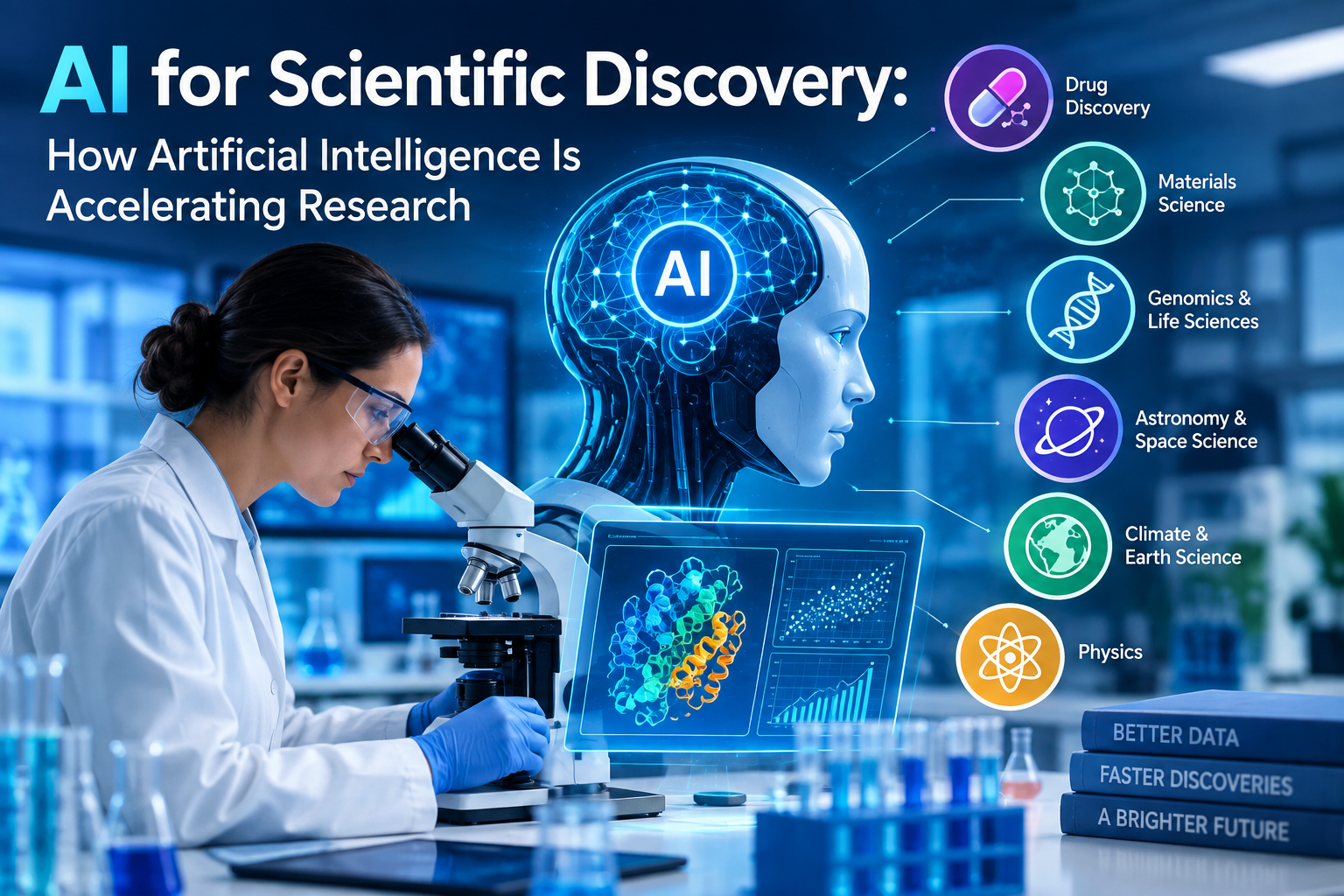
Scientific discovery has always depended on human curiosity, experimentation, observation, and careful analysis. But modern science now faces a new challenge: data is growing faster than researchers can examine it manually. From genomics and astronomy to climate science, physics, chemistry, and materials engineering, researchers now work with datasets containing millions or even billions of measurements, making AI increasingly important for scientific discovery.
AI in science is becoming increasingly important because it helps researchers manage this scale and accelerate discovery.
Artificial intelligence can analyze enormous datasets, identify patterns, generate predictions, simulate complex systems, assist with literature analysis, and help researchers determine the most promising experiments. Rather than replacing scientists, AI serves as an advanced research partner, helping humans explore possibilities that would otherwise take years to investigate.
The development of AI systems such as AlphaFold has shown how machine learning can help solve difficult scientific problems. AlphaFold has produced predictions for more than 200 million protein structures, and researchers worldwide use its database. Google DeepMind says more than 3 million researchers across over 190 countries have used the tool.
At the same time, newer AI systems are moving beyond prediction toward more automated research workflows. In 2026, researchers reported AI systems that can coordinate tasks such as literature search, hypothesis generation, data analysis, and experimental planning in biomedical research.
For the United States, this transformation has become a major scientific and technological priority. The U.S. Department of Energy is building a national AI-for-science ecosystem through initiatives such as the Genesis Mission, which brings together national laboratories, universities, industry, artificial intelligence, and high-performance computing to accelerate scientific discovery.
So, what exactly is AI in scientific research, and how is it changing the way discoveries are made?
What Is AI in Science?
AI in science refers to using artificial intelligence and machine learning technologies to support, accelerate, or automate scientific research and discovery.
Traditional scientific research often follows a cycle:
Observation → Hypothesis → Experiment → Analysis → Conclusion
AI can enhance nearly every stage of this process, from analysis to experimentation.
For example, scientists can use AI to analyze prior research, identify unusual patterns in experimental data, predict how a material may behave, estimate a molecule’s structure, simulate physical systems, or suggest potential explanations for an observed phenomenon.
In simple terms, AI allows researchers to ask more questions and evaluate more possibilities in less time.
The role of AI varies significantly between disciplines. A physicist might use machine learning to identify patterns in particle collisions. A biologist may use AI to study proteins or genomic data. A chemist may use an AI model to predict molecular properties. An astronomer might use computer vision to classify galaxies or detect objects in massive telescope datasets.
This makes artificial intelligence in scientific research less about one specific technology and more about how intelligent systems strengthen scientific methods and speed discovery.
Why AI Is Becoming Important for Scientific Research
Science has always produced large amounts of information, but technological advances have dramatically increased the scale.
Modern laboratories can generate genomic sequences, microscope images, chemical measurements, sensor readings, simulations, and other forms of high-dimensional data at unprecedented speed.
Human researchers remain essential for interpreting results and determining scientific meaning, but manually processing every possible data point can become a bottleneck.
AI addresses this problem in several important ways, helping explain its growing role in scientific discovery.
Processing Massive Scientific Datasets
Machine learning algorithms can process datasets that would be extremely difficult to examine manually.
An AI system can evaluate thousands or millions of observations, find statistical relationships, and identify patterns that deserve closer investigation.
This does not mean that every pattern discovered by AI is scientifically meaningful. Researchers still need to test whether the finding is real, reproducible, and theoretically reasonable.
However, AI can dramatically reduce the time required to move from raw data to a useful research question.
Making Predictions
Many scientific questions involve predicting something not yet directly observed.
Researchers may want to know:
- How will a molecule interact with a protein?
- Which material could be useful for a particular application?
- What will happen under a certain physical condition?
- Which biological process could be associated with a disease?
- Which astronomical objects deserve additional observation?
Machine learning models can estimate outcomes based on patterns learned from existing data.
Exploring Complex Systems
Many scientific systems are difficult to model because they involve thousands or millions of interacting variables.
Climate systems, biological networks, materials, particle interactions, and chemical reactions can become computationally expensive to simulate.
AI can provide efficient approximations or help researchers decide where to focus detailed simulations.
This combination of AI, simulations, and high-performance computing is becoming particularly important in computational science. Recent research describes AI and super-computing as complementary technologies that are reshaping scientific capabilities and research practices.
How AI in Scientific Research Works
AI-powered research is usually not as simple as entering a question into a chat-bot and receiving a scientific discovery.
A more realistic workflow involves several stages.
1. Collecting Scientific Data
AI models require data. Depending on the research area, that data could include:
- Experimental measurements
- Scientific publications
- Images
- Genomic sequences
- Chemical structures
- Sensor data
- Telescope observations
- Simulation results
- Clinical or biomedical datasets
Dataset quality strongly influences model quality.
Poorly labelled, incomplete, biased, or inconsistent data can produce unreliable conclusions.
2. Training or Adapting AI Models
Researchers use machine learning algorithms to identify relationships within the collected data.
Some models are trained specifically for a scientific problem, while others are adapted from broader foundation models.
The goal might be classification, prediction, generation, optimization, simulation, or anomaly detection.
3. Generating Predictions or Hypotheses
Once trained or adapted, an AI system can process new information.
For example, it might predict that a particular molecule has a desirable property or identify an unusual signal in a dataset.
In more advanced workflows, AI may generate competing hypotheses rather than a single prediction.
4. Experimental Validation
This is one of the most important stages.
An AI-generated prediction is not automatically a scientific fact.
Scientists must test it using laboratory experiments, simulations, observations, or other appropriate methods.
Treat a prediction that cannot be independently validated as a hypothesis, not a confirmed discovery.
5. Feedback and Improvement
Researchers can then feed experimental results back into the research workflow.
If an experiment fails, researchers can use the result to modify the model, change the research question, or prioritize another hypothesis.
This creates a powerful loop:
AI prediction → experiment → results → updated model → improved prediction
This rapid cycle is one reason automated scientific discovery is attracting significant attention and reshaping how research advances.
AI Scientific Discovery Across Different Fields
AI applications are not limited to one branch of science. Researchers are exploring the technology across nearly every major research discipline.
AI in Biology and Life Sciences
Biology is one of the clearest examples of how AI can accelerate scientific discovery.
Biological systems are incredibly complex. Understanding them often requires researchers to analyze interactions among genes, proteins, cells, tissues, and organisms.
Machine learning can help identify relationships within these large datasets.
Protein Structure Prediction
Protein structure prediction became a landmark example of AI scientific discovery with AlphaFold.
Protein shape plays an important role in biological function, but determining structures experimentally can be difficult and resource-intensive.
AlphaFold showed that deep learning could make highly accurate protein-structure predictions. Its database has since expanded to more than 200 million predicted structures, giving researchers a valuable resource for biological investigation.
Newer AlphaFold systems also focus on molecular interactions, giving researchers additional computational capabilities for studying biological systems.
The importance of this work extends beyond protein modelling. Structural predictions can provide researchers with clues about disease mechanisms, biological functions, and possible therapeutic strategies.
Genomics and Multi-Omics
Genomics produces enormous amounts of biological information.
AI can help researchers compare sequences, detect patterns, classify genetic variants, and investigate relationships between genes and biological traits.
Researchers are also increasingly working with multi-omics data, analyzing information from different biological layers together.
AI is particularly useful in this environment because machine learning models can process multiple variables simultaneously. As a result, researchers can integrate these layers more effectively and move closer to a complete scientific picture.
AI in Drug Discovery
AI in drug discovery is another major area of scientific research.
Developing a new medicine can involve identifying biological targets, designing candidate molecules, predicting properties, evaluating toxicity, and conducting laboratory and clinical testing.
AI can support parts of this process by:
- Predicting molecular properties
- Ranking potential compounds
- Suggesting molecular structures
- Studying protein-ligand interactions
- Identifying biological targets
- Analyzing biomedical literature
- Helping researchers prioritize experiments
The important point is that AI does not eliminate laboratory validation or clinical research.
Instead, its main advantage is reducing the search space.
Researchers may have thousands or millions of possible compounds to evaluate. An AI model can help identify a smaller set that appears most promising for further investigation.
Recent research has also explored AI agents that can execute broader biomedical research workflows, showing how AI for research is moving from individual prediction tasks toward more integrated systems.
AI in Materials Science
Materials science is another field where AI can be extremely valuable.
Scientists and engineers are often searching for materials with specific combinations of properties.
They may be looking for materials that are:
- Strong but lightweight
- Heat resistant
- Electrically conductive
- Energy efficient
- Corrosion resistant
- Suitable for batteries
- Useful for solar technologies
- Stable under extreme conditions
The number of possible material combinations can be enormous.
AI can help researchers predict material properties before synthesizing and testing every candidate.
This creates a computational screening process in which models prioritize promising materials for laboratory experiments.
The U.S. Department of Energy has specifically identified materials discovery as an area where AI and increasingly available scientific datasets could significantly accelerate discovery, design, and qualification.
This could have practical implications for batteries, energy storage, clean energy systems, advanced manufacturing, electronics, and other technologies.
AI in Physics
Physics frequently involves complex mathematical relationships and large experimental datasets.
AI can contribute to particle physics, quantum research, plasma science, astrophysics, fluid dynamics, and many other areas.
For example, machine learning can help scientists detect patterns in particle collision data or speed up parts of computational simulations.
AI may also help discover mathematical relationships or approximations that would be difficult to identify manually.
The combination of AI and high-performance computing is especially important for scientific problems that require enormous computational resources.
In the United States, the Department of Energy’s AI-for-science programs are targeting challenges spanning physics, energy, nuclear science, materials, and other research areas.
AI in Astronomy and Space Science
Astronomy generates an extraordinary volume of observations from telescopes and scientific instruments.
Researchers must identify stars, galaxies, exoplanets, supernovae, gravitational events, and other phenomena from large datasets.
Computer vision and machine learning can help classify astronomical objects and detect unusual signals.
This is especially useful when researchers want to search large datasets for rare events.
Instead of manually inspecting every image or measurement, scientists can use AI systems to screen data and flag observations that deserve human attention.
That shifts the scientist’s role from examining everything to focusing on the most interesting or uncertain cases.
AI in Climate and Earth Science
Climate science requires researchers to analyze information from satellites, sensors, weather stations, ocean measurements, atmospheric models, and historical observations.
AI can assist with tasks such as:
- Weather prediction
- Climate modeling
- Satellite image analysis
- Extreme-event detection
- Environmental monitoring
- Ocean modeling
- Wildfire analysis
- Energy forecasting
AI can also help accelerate certain simulations and make complex environmental datasets easier to analyze.
The broader trend is toward combining machine learning with physics-based models instead of treating AI as a completely independent replacement for scientific methods.
AI Research Tools Scientists Are Using
The phrase AI research tools covers a broad range of technologies.
Different tools solve different parts of the scientific workflow.
Literature Discovery Tools
Researchers spend significant amounts of time reading papers and finding relevant studies.
AI-powered literature systems can help researchers:
- Search large collections of scientific publications.
- Summarize research
- Identify related papers
- Extract concepts
- Compare studies
- Discover connections between research areas.
These tools can save time, but researchers should verify important claims against the original publications.
Data Analysis Tools
AI can help process complex datasets and identify trends.
For researchers without extensive programming expertise, AI-assisted interfaces can also make certain analysis tasks easier.
However, researchers still need to understand the statistical assumptions behind the analysis.
Scientific Coding Assistants
Modern language models can help researchers write, explain, debug, or modify code.
This is particularly useful for repetitive programming tasks and rapid prototyping.
A 2026 Nature Methods article describes how AI-assisted software generation is beginning to change scientific software development, including allowing researchers to build specialized tools with less dependence on traditional software-engineering support.
Simulation and Modelling Tools
AI can work alongside scientific simulations.
A model may learn from previous simulations and estimate outcomes for new conditions, reducing the need to run every expensive calculation from scratch.
This approach is sometimes called surrogate modelling or learned approximation.
Laboratory Automation
One of the most ambitious AI applications involves connecting intelligent software with laboratory equipment.
In this model, AI does more than analyze existing data.
It can potentially:
- Review previous research
- Generate a hypothesis
- Suggest an experiment
- Select experimental parameters
- Trigger automated equipment
- Analyze the results
- Propose the next experiment.
This is a major step toward automated scientific discovery.
The Rise of Automated Scientific Discovery
Traditional research can be slow because each stage often depends on human decision-making.
AI systems are increasingly being designed to connect these stages.
A 2026 Nature study introduced a multi-agent research system called Robin that integrates literature-search and data-analysis agents and can generate hypotheses, propose experiments, interpret results, and update hypotheses in experimental biology.
Another 2026 study described Biomni, an AI agent designed to autonomously perform diverse biomedical research tasks by combining large language model reasoning, retrieval, planning, and code-based execution across many biomedical domains.
These systems represent a major shift in AI-driven research.
Earlier scientific AI systems often performed a single task.
For example:
Input → Prediction
Newer research agents are moving toward:
Question → Literature → Hypothesis → Analysis → Experiment → Results → New Hypothesis
This does not mean fully autonomous science is already a general reality. Scientific experimentation still requires appropriate equipment, controls, expertise, safety procedures, and human oversight.
Nevertheless, the direction is significant.
How AI Makes Scientific Discovery Faster
Researchers believe AI can accelerate science for several reasons.
Reducing the Search Space
Scientific problems often contain an enormous number of possibilities.
Consider drug discovery. Researchers may have millions of molecular combinations to investigate.
Testing every possibility experimentally would be unrealistic.
AI can prioritize candidates before laboratory testing, allowing researchers to focus resources on more promising options.
Discovering Hidden Patterns
Humans reason well but have limited capacity to analyze huge datasets simultaneously.
Machine learning can process many dimensions at once and uncover relationships that may not be obvious.
A scientist can then investigate whether those patterns represent meaningful scientific phenomena.
Accelerating Simulations
Some scientific simulations are computationally expensive.
AI-based approximations can sometimes produce useful estimates much faster than conventional calculations.
The result is not always a replacement for detailed simulation. Instead, AI can help researchers determine which scenarios deserve the most computational attention.
Supporting Repetitive Tasks
Scientific workflows often contain repetitive activities, including data cleaning, classification, literature organization, and preliminary analysis.
Automating these tasks allows scientists to spend more time on experimental design, interpretation, and creative problem-solving.
Connecting Different Knowledge Domains
One of the most exciting possibilities is AI systems’ ability to combine information from different sources.
A complex research problem may involve publications, databases, simulations, experiments, and observations.
AI can help connect these pieces.
This is particularly valuable for interdisciplinary research, where important discoveries may occur at the intersection of traditionally separate fields.
The Role of Generative AI in Scientific Research
Generative AI has expanded what AI can do in scientific research.
Instead of simply classifying or predicting data, generative models can create new content.
In science, this can include:
- Molecular structures
- Material candidates
- Protein designs
- Experimental plans
- Code
- Research summaries
- Scientific hypotheses
- Simulated datasets
For example, a generative model might propose molecular structures with particular properties.
Researchers can then evaluate those candidates computationally and experimentally.
Generative AI can also help scientists communicate complex information by summarizing literature or explaining technical concepts.
However, a key limitation remains: language models can produce convincing but incorrect information.
Scientific researchers therefore need verification mechanisms, reliable sources, domain-specific datasets, and experimental validation.
AI and the Future of Hypothesis Generation
One of the most interesting questions is whether AI can help scientists generate genuinely useful hypotheses.
Historically, hypothesis generation has been considered a highly creative human activity.
Researchers observe something unusual, connect ideas, develop a potential explanation, and design experiments to test it.
AI can now help by scanning huge amounts of information and identifying relationships across datasets.
For example, an AI system might detect that two seemingly unrelated biological pathways have similar patterns.
That does not prove they are connected.
But it could provide scientists with a new research direction.
This distinction is extremely important.
AI can generate hypotheses, but a scientific hypothesis becomes valuable only when evidence supports it.
Benefits of AI-Driven Research
The growing use of AI across science offers several potential advantages.
Faster Research
AI can perform many computational tasks far faster than manual analysis.
This can shorten the time between collecting data and identifying useful findings.
Lower Computational and Experimental Costs
By filtering candidates before physical experiments, AI can reduce unnecessary laboratory tests.
This does not guarantee lower costs in every project, but targeted experimentation can improve resource efficiency.
Better Use of Scientific Data
Large datasets are valuable only when researchers can extract useful information.
AI provides methods for analyzing datasets at scales that would be impractical for humans alone.
Improved Collaboration
AI systems can help organize information across disciplines.
A biologist working with computational scientists, for example, may use AI-supported tools to bridge technical gaps and accelerate communication.
Greater Research Accessibility
Some AI-powered systems can help researchers with limited programming expertise perform sophisticated tasks.
This could broaden access to computational research.
AlphaFold is a key example of how a widely accessible scientific resource can support researchers globally.
Challenges and Risks of AI in Science
AI offers enormous potential, but it also introduces serious challenges.
Incorrect Results
AI systems can make errors.
A prediction may look convincing while being scientifically wrong.
This is particularly dangerous when researchers assume that an AI-generated result must be correct simply because it comes from a sophisticated model.
Data Quality Problems
AI models depend heavily on data.
If training datasets contain errors, biases, missing information, or inconsistent measurements, models can produce unreliable outputs.
Scientific AI therefore requires careful data curation.
Reproducibility
Science depends on reproducibility.
Researchers need to understand how results were produced and, where practical, replicate them.
Black-box AI systems can make this difficult.
Lack of Interpret-ability
In some models, it can be hard to determine why a particular prediction was made.
Scientists may need explanations before accepting AI-generated results, particularly in high-stakes fields.
Hallucinations in Generative AI
Generative AI can invent references, numbers, explanations, or experimental details.
Researchers should never assume that generated content is factual simply because it is written confidently.
Privacy and Security
Biomedical research may involve sensitive information.
Researchers need appropriate controls for data privacy, access, storage, and security.
Automation Without Adequate Oversight
A system that can independently perform multiple research tasks could introduce mistakes at several stages.
Human oversight remains essential for scientific quality, ethics, safety, and accountability.
AI Is Not Replacing Scientists
One of the biggest misconceptions about artificial intelligence in scientific research is that AI will make scientists unnecessary.
That is unlikely.
Scientific discovery involves more than processing information.
Researchers need to understand:
- What questions are worth asking
- Whether a hypothesis makes scientific sense
- How experiments should be designed
- Which controls are necessary
- Whether results are statistically meaningful
- How findings fit with existing knowledge
- What limitations should be reported
AI can assist with many of these activities, but human expertise remains critical.
The most realistic model is not:
AI vs. Scientist
It is:
AI + Scientist
A scientist using AI effectively may be able to explore far more possibilities than a scientist working without computational assistance.
AI and the U.S. Scientific Research Landscape
The United States is investing heavily in AI-enabled scientific research.
The Department of Energy has positioned AI-for-science as a major national effort. It has established the Genesis Mission to bring together national laboratories, academia, industry, advanced computing, AI, and other technologies.
In July 2026, DOE announced more than $800 million in committed partner support for the Genesis Mission, including computing resources, AI models, cloud infrastructure, scientific expertise, research partnerships, and funding.
DOE also announced nearly 300 projects selected through a major response process covering areas including energy, discovery science, and national security.
These developments illustrate how AI-driven research is increasingly being treated as part of the nation’s broader research infrastructure rather than simply a software experiment.
The United States also has a large ecosystem of universities, national laboratories, biotechnology companies, pharmaceutical companies, technology firms, and research institutions that can combine AI with scientific expertise.
This creates an environment in which AI for research may increasingly influence both fundamental science and commercial innovation.
AI in Scientific Research and the Scientific Method
AI does not eliminate the scientific method.
Instead, it can make parts of the method more efficient.
Traditional scientific research emphasizes observation, hypothesis formation, experimentation, analysis, and verification.
AI can support each stage.
Observation
AI can analyze enormous datasets and detect unusual signals.
Hypothesis Formation
AI can identify relationships and suggest possible explanations.
Experiment Design
AI can help researchers compare possible experimental conditions.
Data Analysis
Machine learning can process complex datasets and identify patterns.
Verification
Human researchers can use experiments and independent analyses to determine whether AI-generated predictions are correct.
The fundamental scientific principle remains the same:
Interesting predictions require evidence.
This is why combining AI with traditional scientific methods is more powerful than either approach alone.
What the Future of AI Scientific Discovery Could Look Like
The future of AI scientific discovery is likely to involve increasingly integrated systems.
Instead of having separate tools for literature search, data analysis, simulation, and experimentation, researchers may use connected AI platforms that coordinate multiple activities.
A future research workflow could look like this:
Research Question
↓
AI Literature Analysis
↓
Hypothesis Generation
↓
Simulation and Prediction
↓
Experiment Selection
↓
Automated Laboratory Testing
↓
AI Data Analysis
↓
Human Scientific Review
↓
New Hypothesis
This approach could create a continuously improving research loop.
AI agents may become better at using scientific databases, writing code, operating approved research tools, analyzing results, and coordinating specialized models.
Research in 2026 already shows movement in this direction, particularly in biomedical science, where researchers are investigating multi-agent systems and autonomous research agents.
However, the long-term impact will depend on whether these systems can produce results that are reliable, reproducible, interpretable, and scientifically meaningful.
From AI Tools to AI Research Partners
The most important change may be the transition from AI as a simple tool to AI as a research partner.
An ordinary software application performs predefined instructions.
A more advanced AI research system can potentially reason through a complex task, retrieve information, write code, use specialized tools, analyze results, and adapt its approach.
Recent research argues that AI tools are expanding individual scientist’s analytical capabilities while also changing the direction and structure of scientific research.
This creates both opportunity and responsibility.
Researchers may be able to explore more ideas than ever before, but they must also get better at evaluating evidence, detecting errors, and understanding the limits of AI-generated results.
How Researchers Can Use AI Responsibly
Scientists and research organizations can reduce risks by creating clear workflows for AI use.
First, researchers should verify important AI-generated claims against reliable scientific literature and original data.
Second, researchers should independently test critical findings whenever possible.
Third, researchers should document how they used AI systems, including relevant datasets, model versions, prompts or procedures, and computational methods when appropriate.
Fourth, researchers should protect sensitive research data through appropriate security and privacy practices.
Finally, AI should be treated as an aid to scientific reasoning rather than an unquestionable authority.
The objective is not to make science fully automated.
The objective is to make science more capable, efficient, and rigorous.
Will AI Change Scientific Careers?
The rise of AI in science will likely change the skills researchers need.
Future scientists may benefit from a combination of:
- Scientific domain expertise
- Statistics
- Data analysis
- Machine learning
- Programming
- Computational modeling
- Experimental design
- AI literacy
This does not mean every scientist needs to become a machine-learning engineer.
Instead, researchers will increasingly need to understand what AI can and cannot do, and how to evaluate its outputs.
This shift is already reflected in U.S. AI-for-science workforce initiatives. The Department of Energy has emphasized developing researchers with dual competencies in AI and a scientific or engineering discipline.
This interdisciplinary combination could become one of the most valuable skill sets in future research.
AI in Science: A New Era of Discovery
The history of science is filled with technologies that changed what researchers could observe and measure.
Telescopes expanded our view of the universe. Microscopes revealed microscopic life. Computers made complex calculations practical. High-performance computing enabled massive simulations.
AI may represent another major change.
Instead of simply helping scientists calculate faster, AI can help them search, predict, generate, classify, simulate, and optimize at scales that were previously difficult to achieve.
From protein structures and drug discovery to materials science, astronomy, climate modelling, physics, and biotechnology, researchers are experimenting with increasingly sophisticated AI methods.
The most promising future is not one in which machines independently replace scientific judgment.
It is one in which humans and intelligent systems work together.
Scientists provide questions, context, scepticism, creativity, and experimental judgment. AI provides computation, pattern recognition, large-scale search, prediction, and automation.
Together, they can create a faster and more interconnected approach to discovery.
Final Thoughts
AI in science is transforming the research process from data collection and analysis to hypothesis generation, simulation, experimentation, and discovery.
The impact is already visible in fields such as biology and materials science, while emerging AI agents are pushing toward more automated research workflows. AlphaFold demonstrates how AI can solve challenging biological prediction problems and provide useful scientific infrastructure at global scale. Meanwhile, newer multi-agent research systems show how AI may increasingly connect literature analysis, hypothesis development, experimentation, and data interpretation.
For researchers in the United States and around the world, the opportunity is significant. AI can help scientists analyze larger datasets, evaluate more possibilities, reduce repetitive work, and explore problems that have traditionally been too complex or expensive to tackle efficiently.
But scientific progress still depends on evidence.
AI-generated predictions must be tested. AI-generated hypotheses must be challenged. Data must be carefully evaluated. Results must be reproducible.
The future of AI in scientific research will therefore not be defined simply by how intelligent machines become. It will be defined by how effectively scientists combine artificial intelligence with rigorous scientific methods.
As AI becomes more deeply integrated into laboratories, simulations, scientific databases, and research infrastructure, it could become one of the most important technologies shaping the next generation of scientific discovery.
The laboratory of the future may not be purely human or purely automated. It may be a collaborative environment where scientists and AI systems work together to ask better questions, test more possibilities, and discover answers faster.





Leave a Reply