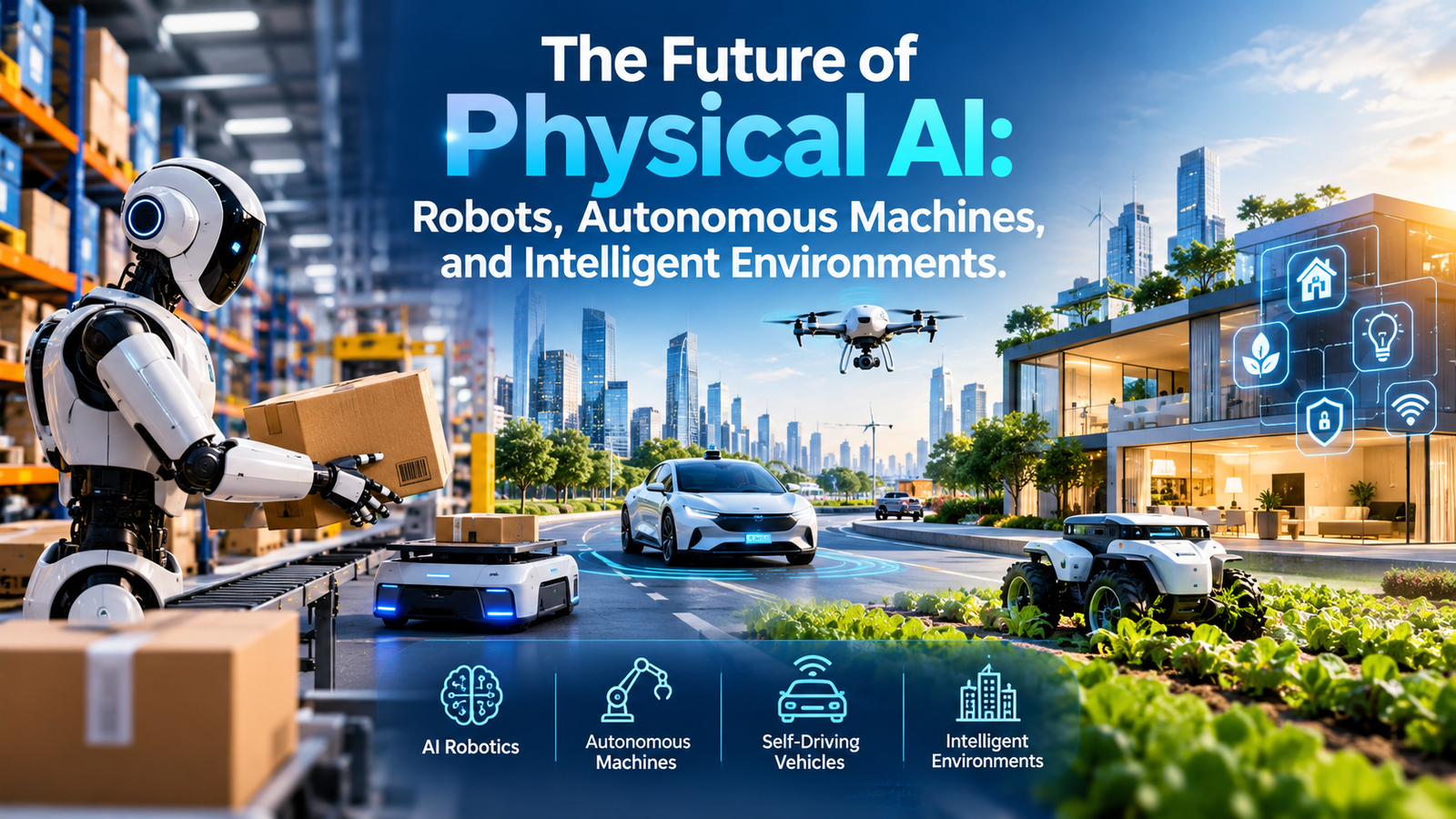
Artificial intelligence is moving beyond screens and software into the physical world. A new generation of AI systems is beginning to interact with robots, autonomous machines, smart environments, vehicles, industrial equipment, and other intelligent devices. This shift is commonly described as physical AI.
Traditional AI has largely operated in digital environments. It can analyze information, generate text and images, recognize patterns, recommend products, and help people make decisions. Physical AI takes this capability further by allowing intelligent systems to perceive their surroundings, make decisions, and take physical action.
This development is closely connected to physical intelligence, embodied AI, robotics, computer vision, machine learning, simulation, and increasingly sophisticated world models. Instead of simply producing an answer, an AI system can observe what is happening around it and decide what to do next.
The implications are significant. Physical AI could make factories more flexible, warehouses more automated, vehicles more independent, and homes and workplaces more responsive to people and machines. More broadly, it points to a future where AI can act in the world, not just describe it.
But the future of physical AI is not simply about building robots that look human. Its real promise is creating machines that can understand physical environments, adapt to changing conditions, and perform useful tasks safely and reliably. This article explores that shift.
What Is Physical AI?
Physical AI refers to artificial intelligence systems that can perceive, reason about, and interact with the physical world. In other words, it is AI designed to move from digital output to physical action.
Unlike conventional software AI, which primarily operates through computers and digital interfaces, physical AI connects intelligence with physical actions. A system may use cameras, microphones, lidar, radar, force sensors, temperature sensors, GPS, or other sensors to understand its environment. It can then use that information to make decisions and control physical hardware.
A simple example is a warehouse robot.
A traditional software system might tell a worker where a package is located. A physical AI system could identify the package, navigate through the warehouse, avoid obstacles, pick up the item, and transport it to another location.
The difference is important.
Physical AI creates a connection between:
Perception → Reasoning → Decision → Action → Feedback
The system observes its environment, interprets what it sees, chooses an action, performs it, and then uses new information to decide what to do next.
This creates a continuous interaction between AI and the physical world.
Physical AI vs Traditional AI
Traditional AI is extremely powerful in digital environments. Large language models can understand language, generate content, summarize information, write code, and answer questions. Computer vision systems can identify objects and analyze images.
However, physical environments are much more complicated than digital ones.
A robot operating in a real warehouse must deal with:
- Moving people
- Unexpected obstacles
- Different lighting conditions
- Slippery or uneven surfaces
- Objects in different positions
- Mechanical limitations
- Battery constraints
- Physical collisions
- Uncertain sensor information
A software model can make an incorrect prediction and generate another response. A physical machine may damage equipment, drop an object, or injure someone if it makes the wrong decision.
This is why physical AI requires more than an intelligent model. It needs sensors, actuators, control systems, robotics hardware, simulation, safety mechanisms, and reliable decision-making. The thesis is simple: physical AI succeeds only when intelligence is matched with the ability to act safely in the real world.
The Rise of Physical Intelligence
Physical intelligence is an intelligent system’s ability to understand and respond to physical conditions.
Humans naturally demonstrate physical intelligence. We can walk across a room, pick up a glass, recognize that an object is fragile, and adjust our movements when something unexpected happens.
Robots have historically struggled with this kind of flexibility.
A robot designed for a highly controlled manufacturing process can perform a repetitive task extremely well. But moving the same robot into an unpredictable environment introduces many new challenges.
Modern AI is helping change this.
Machine learning lets robots learn patterns from large datasets. Computer vision can help machines identify objects and environments. Reinforcement learning can help systems learn actions through interaction. Generative AI can provide more flexible reasoning and communication capabilities.
Together, these technologies are helping create machines that can respond to physical situations rather than simply following rigid instructions.
Embodied AI and the Connection Between Intelligence and Action
Embodied AI is another key concept in developing physical AI.
Embodied AI focuses on intelligent systems that have a physical or simulated body through which they interact with an environment.
The idea is that intelligence is not only about processing information. It can also develop through interaction with the environment.
For example, a robot learning to manipulate an object needs to understand more than what the object looks like. It needs to know where the object is, how to grasp it, how much force to apply, and what could happen if the object moves.
This creates a close relationship between perception and action.
A robot’s camera may identify a cup. Its control system must determine how to reach the cup. Its gripper must apply an appropriate amount of force. Its sensors can then provide feedback about whether the action was successful.
This combination of perception, reasoning, movement, and feedback is central to embodied AI.
Why Physical AI Is Becoming Important
Several technological developments are contributing to the growth of physical AI.
More Powerful AI Models
Modern AI models can process increasingly complex information. Models can work with text, images, audio, video, and other forms of data.
This multimodal capability can help physical systems understand their surroundings more effectively.
A robot may need to combine visual information, language instructions, and sensor readings before deciding what to do.
Better Sensors
Robots are becoming more capable as their sensors improve.
Cameras provide visual information. Lidar can help measure distances and construct maps. Radar can detect objects and movement. Force sensors can help robots understand physical contact.
Combining these inputs can give machines a richer understanding of their environment.
Faster Computing
Physical AI often requires quick decisions.
A moving robot cannot always send every sensor reading to a distant server and wait for a response. Many applications require some processing directly on the device.
Advances in edge computing and specialized AI hardware are helping make real-time processing more practical.
Better Simulation
Training physical systems in the real world can be expensive and risky.
Simulation allows developers to create virtual environments where robots can practice tasks without damaging physical equipment.
A robot can perform thousands or millions of simulated actions before deployment in a real environment.
This makes simulation an important part of modern robotics development.
AI Robotics: Where Physical AI Becomes Real
AI robotics is one of the most visible applications of physical AI.
Traditional industrial robots are generally designed for specific tasks. They can be extremely precise and reliable in controlled environments.
AI-powered robots aim to become more adaptable.
Instead of manually programming every possible movement, developers can use machine learning and other AI techniques to help robots learn behaviors from data, demonstrations, simulation, or interaction.
This could allow robots to handle more complicated environments.
For example, a warehouse robot may need to recognize different packages, navigate changing layouts, cooperate with human workers, and respond to unexpected objects.
The goal is not necessarily to replace every human task. In many situations, the more realistic objective is to create machines that handle repetitive, dangerous, physically demanding, or highly structured work.
AI-Powered Robots in Manufacturing
Manufacturing is one of the most important areas for physical AI.
Factories already use robots for welding, painting, assembly, packaging, inspection, and material handling.
Physical AI could make these systems more flexible.
A traditional robotic arm may repeat the same movement. An AI-powered robot could potentially recognize different objects and adjust its movements based on their location, shape, or orientation.
Computer vision can help identify defects. Machine learning can analyze production data. Predictive systems can identify potential equipment problems before failures occur.
The result could be factories that are more adaptive and data-driven.
However, industrial adoption depends heavily on reliability. Manufacturing companies cannot tolerate frequent errors simply because a system is intelligent.
For this reason, physical AI in factories will likely develop around carefully defined tasks where AI provides measurable advantages.
Autonomous Robots and the Future of Work
Autonomous robots are machines that can perform tasks with limited direct human control.
They already appear in warehouses, hospitals, agriculture, security, cleaning, delivery, and other environments.
The future of autonomy is likely to involve greater adaptability, with robots becoming better able to handle changing tasks and environments.
Instead of following fixed routes, autonomous machines could continuously analyze their environment and adjust their behaviour. This points to a future where autonomy is more adaptive and responsive, with machines better able to handle changing tasks and environments.
For example, a warehouse robot may encounter a blocked path. Rather than stopping and waiting for human instructions, it could recognize the obstacle, calculate an alternative route, and continue its task.
This kind of flexibility is one of the major goals of physical AI.
Autonomous Machines Beyond Robots
Physical AI is not limited to robots with arms and legs.
Autonomous machines can include vehicles, agricultural equipment, drones, industrial machines, mining equipment, delivery systems, and other physical devices.
Autonomous agricultural machines could potentially identify crops, monitor soil conditions, detect weeds, and perform targeted operations.
Mining equipment could use sensors and AI systems to navigate challenging environments.
Autonomous vehicles can combine cameras, radar, lidar, maps, and AI models to understand roads and surrounding traffic.
These applications demonstrate that physical AI is better understood as a broad technological category rather than simply another name for humanoid robots.
Humanoid Robots and General-Purpose Machines
Humanoid robots have attracted significant attention because their body structure resembles the human environment.
Doors, stairs, shelves, tools, workstations, and many other objects are designed for humans. A robot with a human-like body could operate in these environments without major infrastructure changes.
However, creating a capable humanoid robot is extremely difficult.
It must maintain balance, understand surroundings, manipulate objects, plan movements, and operate safely around humans.
The long-term appeal of humanoid robotics is flexibility.
Instead of designing a specialized machine for every task, a general-purpose robot could potentially learn multiple tasks and operate across different environments.
Whether this vision becomes economically practical at scale will depend on cost, reliability, safety, energy efficiency, and AI models’ ability to generalize across tasks.
The Role of World Models
World models could become one of the most important technologies behind advanced physical AI.
A world model is broadly designed to represent how an environment works and how it may change when actions are taken.
For physical AI, this concept is valuable because a robot needs to predict consequences.
If a robot pushes an object, what will happen?
If it moves around an obstacle, where will it end up?
If it picks up an object, how will the object’s position and orientation change?
A capable physical AI system needs some internal understanding of these relationships.
World models could help AI systems reason about possible actions before executing them.
Instead of simply reacting to what a camera sees, a machine could potentially predict different outcomes and select the most appropriate action.
This matters most when actions are expensive, dangerous, or hard to reverse.
Intelligent Environments
The future of physical AI is not only about machines moving through the world. The environments themselves can become intelligent.
Intelligent environments combine sensors, connected devices, AI systems, and automated infrastructure to respond to changing conditions.
Consider a modern warehouse.
Cameras can monitor activity. Robots can move inventory. Sensors can track temperature and equipment conditions. AI systems can optimize routes and workflows.
The environment becomes part of the intelligent system.
Similar concepts can appear in offices, hospitals, factories, transportation networks, homes, and cities.
An intelligent building could adjust lighting and heating based on occupancy. A hospital environment could coordinate equipment and autonomous delivery systems. A factory could automatically adjust production workflows based on demand.
This creates a future where intelligence is distributed across machines and infrastructure rather than contained inside one computer.
Physical AI in Healthcare
Healthcare is another area where physical AI could have important applications.
Robotic systems are already used in surgery, rehabilitation, logistics, and other medical applications.
Future systems could become more adaptive while remaining under appropriate human supervision.
For example, robots could help transport supplies through hospitals, assist patients with mobility, or support rehabilitation exercises.
The potential benefits are significant, but healthcare requires an exceptionally high safety standard.
A physical AI system operating around patients cannot be treated like a consumer chat-bot. Medical regulations, human oversight, reliability, cybersecurity, privacy, and clinical validation are essential.
The most valuable systems may therefore assist healthcare professionals rather than attempt to operate without meaningful human control.
Physical AI in Logistics and Warehousing
Warehouses are particularly suitable environments for autonomous machines because many tasks involve repetitive movement.
Robots can transport goods, sort packages, move inventory, and support order fulfilment.
AI can help coordinate these machines.
Instead of controlling each robot independently, an intelligent system can optimize traffic throughout a facility.
It can consider:
- Robot locations
- Package priorities
- Warehouse layout
- Charging requirements
- Human worker activity
- Delivery deadlines
- Potential obstacles
This creates more coordinated automation.
As e-commerce and same-day delivery continue to influence logistics, companies have strong incentives to improve warehouse efficiency.
Physical AI in Agriculture
Agriculture presents another major opportunity.
Farm environments are unpredictable. Weather changes, crops grow differently, and fields contain complex physical conditions.
AI-powered machines could potentially help farmers monitor crops, identify weeds, inspect plants, collect agricultural data, and perform selected physical tasks.
Computer vision can help identify plant conditions. Autonomous machines can navigate fields. Drones can collect aerial imagery.
Physical AI could therefore support more precise agriculture, applying resources such as water, fertilizer, and pesticides based on actual field conditions.
The biggest challenge is that agricultural environments are far less controlled than factories.
Machines need to operate across mud, dust, uneven ground, changing weather, and biological variation.
Autonomous Vehicles and Physical AI
Autonomous vehicles are another major example of physical intelligence.
A vehicle must continuously understand its surroundings and make decisions while moving at potentially high speeds.
It needs to detect vehicles, pedestrians, road markings, traffic signals, obstacles, and changing road conditions.
AI systems can combine information from multiple sensors to build an environmental representation.
The challenge is not simply recognizing objects. The vehicle must understand how those objects are moving and predict what could happen next.
This is where perception, planning, control, and world-model-like reasoning become especially important.
Safety remains the central requirement.
An autonomous vehicle must perform reliably across many unusual situations, including scenarios that may not have appeared in its training data.
Intelligent Homes and Consumer Robotics
Physical AI may eventually become more visible in everyday homes.
Robotic vacuum cleaners already demonstrate a basic form of environmental awareness. Future household robots could potentially perform a broader range of tasks.
A more capable home robot might understand natural-language instructions, recognize household objects, navigate rooms, and perform simple manipulation tasks.
For example, a user could ask a robot to organize items, bring something from another room, or prepare an area for a specific activity.
However, homes are challenging environments.
Every home is different. Objects can be placed anywhere. People and pets move unpredictably. Lighting conditions change. Furniture layouts vary.
This makes general-purpose home robotics one of the hardest physical AI problems.
The Importance of Simulation and Training Data
One major obstacle in physical AI is data.
AI models require large amounts of information to learn useful behaviors. But collecting physical-world data can be expensive.
A robot cannot safely practice every possible task millions of times in the real world.
Simulation provides an alternative.
Developers can create virtual environments where robots practice navigation, manipulation, object recognition, and other behaviors.
Synthetic data can also help generate training examples.
The challenge is ensuring that skills learned in simulation transfer effectively to the real world.
This problem is sometimes called the simulation-to-reality gap.
A simulated environment may not perfectly represent friction, lighting, object flexibility, sensor noise, or mechanical imperfections.
Closing this gap is a major research and engineering challenge.
The Hardware Behind Physical AI
Software alone cannot create physical intelligence.
A physical AI system needs hardware that can sense and act.
Important components include:
Sensors
Sensors allow machines to perceive the world.
Common technologies include:
- Cameras
- Lidar
- Radar
- Microphones
- GPS
- Inertial sensors
- Force and torque sensors
- Temperature sensors
- Pressure sensors
Different applications require different combinations.
Actuators
Actuators convert decisions into physical movement.
They can control robotic joints, wheels, grippers, motors, and other mechanisms.
AI Computing
AI models require computing resources to process sensor information and make decisions.
Some processing can occur in the cloud, while latency-sensitive applications may require edge computing.
Energy Systems
Battery life is a major constraint for mobile robots.
A robot that can perform a sophisticated task but requires constant charging may not be practical.
Energy efficiency will therefore become increasingly important as physical AI expands.
Challenges Facing the Future of Physical AI
Despite rapid progress, physical AI faces serious challenges.
Safety
Physical systems can cause real-world harm.
A robot working around humans must understand safety boundaries and respond appropriately to unexpected situations.
Reliability
AI systems can make mistakes.
A physical AI system must operate reliably across changing environments, not just ideal test conditions.
Cost
Advanced sensors, actuators, computing hardware, batteries, and mechanical systems can be expensive.
For widespread adoption, companies need a clear economic reason to deploy these systems.
Energy Consumption
Powerful computing and physical movement require energy.
Improving efficiency will be important for mobile robots and autonomous machines.
Cybersecurity
Connected physical systems can become cybersecurity targets.
A compromised robot, vehicle, industrial machine, or building system could create consequences beyond data loss.
Human Trust
People need to understand how machines behave around them.
Trust will depend on predictable behaviour, safety mechanisms, transparency, and effective human oversight.
Will Physical AI Replace Human Workers?
One of the most common questions about physical AI is whether robots will replace people.
The answer is complicated.
Automation can reduce the need for human labour in certain repetitive tasks. However, it can also create new jobs and change existing ones.
Factories may need more robotics engineers, technicians, AI specialists, safety experts, and maintenance professionals.
In many workplaces, the likely outcome will be collaboration between humans and machines.
Humans can focus on tasks that require judgment, communication, creativity, problem-solving, and social understanding, while machines can handle repetitive, dangerous, or physically demanding work.
The transition will not necessarily be simple.
Workers may need new skills as automation changes job requirements.
Organizations that adopt physical AI successfully will likely need to invest not only in machines but also in training and workforce development.
Human-Robot Collaboration
The future of robotics may depend less on replacing humans and more on working alongside them.
A collaborative robot, often called a cobot, can operate in environments designed for human workers.
For example, a human might perform a complex assembly task while a robot brings materials and handles repetitive movements.
AI can make these interactions more flexible.
Instead of programming every interaction manually, systems could potentially understand human instructions and adapt their behaviour.
This could make robots useful in smaller businesses and workplaces where traditional industrial automation has historically been difficult to justify.
The Future of AI Robotics in the United States
The United States is likely to remain an important market for physical AI because of its strong technology, robotics, manufacturing, logistics, automotive, aerospace, and research sectors.
Several industries have clear incentives to automate.
Labour shortages, productivity pressures, supply-chain requirements, and demand for faster services can all encourage investment in intelligent machines.
The development of physical AI may also create opportunities for startups.
Instead of building robots entirely from scratch, companies can specialize in specific parts of the technology stack, such as:
- Robotics software
- Computer vision
- AI models
- Simulation
- Sensors
- Robot control systems
- Industrial automation
- Autonomous navigation
- Safety systems
- Robotics infrastructure
This ecosystem could contribute to a broader robotics economy.
What the Next Generation of Physical AI May Look Like
The next generation of physical AI will probably be defined by greater adaptability rather than simply greater mechanical capability.
Future systems may become better at understanding instructions, recognizing unfamiliar objects, learning new tasks, and adapting to different environments.
A robot might not need separate programming for every task.
Instead, developers could provide demonstrations, natural-language instructions, simulations, or other forms of training.
This could move robotics toward more general-purpose systems.
However, general intelligence in the physical world remains an extremely difficult engineering problem.
The real world contains enormous variation.
A robot that works perfectly in one environment may fail in another.
The future will therefore depend on continued improvements in perception, reasoning, learning, control, hardware, simulation, and safety.
Physical AI and the Convergence of Technologies
Physical AI is not a single technology.
It represents the convergence of several fields.
These include:
Artificial intelligence: Provides reasoning and learning capabilities.
Machine learning: Helps systems learn patterns from data.
Computer vision: Allows machines to interpret visual information.
Robotics: Provides physical movement and manipulation.
Edge computing: Enables local processing with low latency.
Simulation: Allows machines to practice in virtual environments.
World models: Help systems understand environments and predict outcomes.
Sensors: Provide information about the physical world.
Actuators: Allow machines to perform physical actions.
When these technologies work together, they create systems that can interact with the world in increasingly sophisticated ways.
The Economic Impact of Physical AI
The economic impact could extend across many industries.
Businesses may use physical AI to increase productivity, reduce repetitive work, improve safety, and operate continuously.
Warehouses could process orders more efficiently. Manufacturers could automate flexible production. Agriculture could become more precise. Logistics companies could optimize transportation.
New industries could also emerge.
Companies may develop specialized robots for construction, healthcare, hospitality, agriculture, disaster response, and other fields.
At the same time, the economic transition could create challenges.
Businesses will need to determine where automation produces genuine value rather than adopting robotics simply because the technology is available.
The most successful applications are likely to be those where AI solves a clearly defined physical problem.
Ethical Considerations
Physical AI introduces ethical questions that digital AI does not always face in the same way.
Who is responsible if an autonomous machine causes harm?
How should robots behave when safety requirements conflict?
How much human oversight should be required?
What data can intelligent environments collect?
How should businesses protect workers when they use monitoring technologies?
These questions will become increasingly important.
Organizations developing physical AI should consider safety, privacy, transparency, cybersecurity, accessibility, and human oversight from the beginning.
Technology adoption should not be driven solely by what machines can do. It should also consider whether those capabilities are appropriate and beneficial.
A More Intelligent Physical World
The biggest change physical AI may bring may not be the appearance of humanoid robots.
It may be the gradual transformation of the physical environment itself.
Machines, buildings, vehicles, factories, warehouses, and infrastructure could increasingly communicate with intelligent systems.
Instead of isolated devices, we could see interconnected physical systems.
A warehouse robot could communicate with inventory software.
A vehicle could interact with traffic infrastructure.
A factory machine could report its condition to an AI system.
A smart building could coordinate heating, lighting, security, and occupancy.
This creates a vision of a physical world that responds more quickly to information.
What Businesses Should Consider Before Adopting Physical AI
Companies interested in physical AI should start with the problem, not the technology.
The first question should not be, “Where can we use a robot?”
Instead, businesses should ask:
- Which physical tasks are repetitive?
- Which processes create safety risks?
- Where are productivity bottlenecks?
- Which activities generate measurable costs?
- What data is available?
- What level of human supervision is required?
- Can the environment support automation?
A pilot project can help determine whether physical AI creates measurable value before a company makes a larger investment.
Businesses should also consider maintenance, cybersecurity, worker training, integration, and long-term operating costs.
The Skills Needed for the Physical AI Era
The growth of physical AI is likely to create demand for people with interdisciplinary skills.
Important areas include:
- Artificial intelligence
- Machine learning
- Robotics
- Computer vision
- Software engineering
- Mechanical engineering
- Electrical engineering
- Control systems
- Embedded systems
- Data science
- Simulation
- Cybersecurity
The most valuable professionals may be those who understand both AI and physical systems.
For students and technology professionals, learning AI fundamentals while building robotics knowledge can provide a strong foundation for this emerging field.
The Future of Physical AI
The future of physical AI will likely unfold gradually rather than instantly.
Some applications will mature quickly because they operate in structured environments.
Factories, warehouses, logistics centres, and controlled industrial environments are natural starting points.
Other applications, such as fully general-purpose household robots, are much harder because they require machines to operate safely in unpredictable environments.
Over time, improvements in AI models, sensors, simulation, robotics hardware, and world models could make physical systems increasingly capable.
The most important milestone may be when machines can reliably learn and transfer skills across different environments.
That would represent a major shift from specialized automation toward adaptable physical intelligence.
Conclusion
Physical AI represents a major evolution in artificial intelligence. Instead of limiting intelligent systems to computers and digital interfaces, it connects AI with robots, autonomous machines, vehicles, sensors, and intelligent environments.
The technology combines artificial intelligence with robotics, computer vision, machine learning, simulation, edge computing, and physical control systems.
Its potential applications are broad. Manufacturing, logistics, healthcare, agriculture, transportation, construction, and consumer technology could all benefit from machines that can understand and interact with their surroundings.
However, intelligence alone will not determine the future. Safety, reliability, affordability, energy efficiency, cybersecurity, regulation, and human trust will matter just as much.
The most successful physical AI systems may not be the most futuristic-looking machines. They may be the systems that quietly solve real problems, work reliably alongside people, and make physical tasks safer and more efficient.
As embodied AI, AI robotics, autonomous robots, world models, and intelligent environments continue to develop, the boundary between digital intelligence and the physical world will become increasingly connected.
The future of AI may therefore not exist only on our screens.
It may move, sense, learn, adapt, and act in the world around us.





Leave a Reply