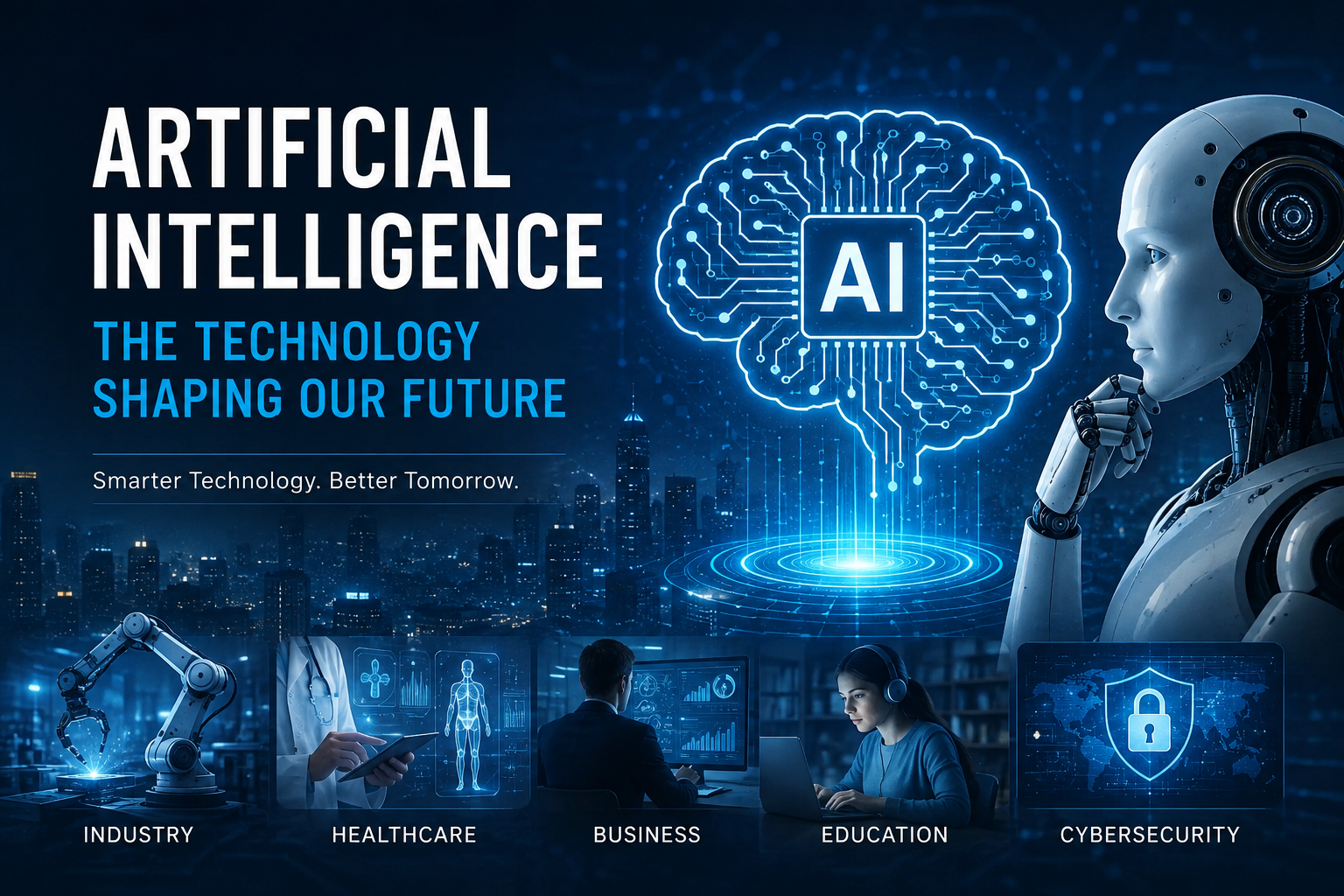
Artificial Intelligence (AI) has become one of the most important technologies in the modern world. From smartphones and search engines to healthcare, education, business, and autonomous vehicles, AI is changing the way people live and work. What was once considered futuristic technology is now becoming part of everyday life.
As AI continues to develop, businesses and individuals around the world are adopting AI-powered tools to automate tasks, analyze information, improve decision-making, and create new products and services. In this article, we will explore what artificial intelligence is, how it works, its major applications, benefits, challenges, and what the future of AI may look like.
What Is Artificial Intelligence?
Artificial Intelligence refers to computer systems and software that can perform tasks that normally require human intelligence. These tasks can include understanding language, recognizing images, solving problems, learning from data, making predictions, and generating content.
AI systems use large amounts of data and algorithms to identify patterns and produce useful results. Some AI applications are designed for specific tasks, while more advanced systems can perform a wide range of activities.
Common examples of AI include virtual assistants, recommendation systems, chat-bots, facial recognition, fraud detection systems, and AI-powered content generation tools.
How Does AI Work?
AI works by combining algorithms, data, and computing power. One of the most important areas of AI is machine learning, where computer systems learn patterns from data instead of being explicitly programmed for every possible situation.
For example, a machine learning system can analyze thousands of images of cats and dogs. By identifying patterns in those images, the system can eventually learn to classify new images.
Another important technology is deep learning, which uses artificial neural networks with multiple layers to process complex information. Deep learning has contributed significantly to recent advances in computer vision, speech recognition, natural language processing, and generative AI.
Major Applications of Artificial Intelligence
AI is being used across almost every major industry.
1. Healthcare
AI can help healthcare professionals analyze medical information, identify patterns in medical images, and support research. AI systems are also being explored for drug discovery and personalized healthcare.
However, AI is generally intended to support professionals rather than replace medical expertise, particularly when decisions can have serious consequences.
2. Business
Businesses use AI to automate repetitive tasks, analyze customer behavior, detect fraud, forecast demand, and improve customer service.
Technology is also changing how travellers arrange transport, making services such as airport taxi Vienna easier to organize before a journey.
AI-powered chat-bots can answer common customer questions, while machine learning systems can analyze large datasets much faster than traditional manual processes.
3. Education
AI is transforming education by providing personalized learning experiences. AI tools can help students practice concepts, generate explanations, summarize information, and receive feedback.
Teachers and educational institutions can also use AI to automate certain administrative tasks and better understand student performance.
4. Cybersecurity
Cybersecurity professionals use AI to identify unusual patterns and potentially suspicious activity. AI can process huge amounts of network and security data and help organizations detect threats more efficiently.
As cyber-attacks become more sophisticated, AI is likely to become an increasingly important part of cybersecurity systems.
5. Software Development
AI is also changing software development. Modern AI coding tools can assist developers with writing code, explaining programming concepts, finding errors, generating tests, and documenting software.
Rather than completely replacing developers, these tools can help programmers complete many routine tasks faster.
Benefits of Artificial Intelligence
Artificial Intelligence offers several important advantages.
Automation: AI can automate repetitive and time-consuming tasks, allowing people to focus on more complex work.
Speed: Computers can analyze enormous quantities of information much faster than humans in many situations.
Data analysis: AI can identify patterns in large datasets that may be difficult to discover manually.
Personalization: AI systems can provide personalized recommendations, learning experiences, and services.
24/7 availability: AI-powered systems can operate continuously without requiring breaks, making them useful for customer support and automated services.
These advantages explain why organizations worldwide are investing heavily in AI technologies.
Challenges and Risks of AI
Despite its benefits, AI also creates important challenges.
One concern is job displacement. Automation may reduce demand for some repetitive jobs while creating new roles that require different skills. Workers may therefore need to develop new technical and analytical abilities.
Another challenge is AI bias. If an AI system is trained using biased or incomplete data, its results may also be biased.
Privacy is another major concern. AI systems often rely on large amounts of data, making responsible data collection and protection essential.
There are also concerns about misinformation, security, copyright, transparency, and the misuse of powerful AI systems. Governments, technology companies, researchers, and society will need to work together to develop responsible approaches to AI.
The Future of Artificial Intelligence
The future of AI is likely to involve deeper integration into everyday technology. AI assistants may become more capable of understanding context and completing complex tasks. Businesses may increasingly use AI agents to automate workflows, analyze information, and support decision-making.
Generative AI is also expected to continue developing. AI systems can already generate text, images, audio, video, and software code. Future systems may become more accurate, efficient, and useful across professional and creative industries.
However, technological progress alone is not enough. Responsible AI development will be important to ensure that AI systems are safe, transparent, secure, and beneficial to society.
Conclusion
Artificial Intelligence is transforming technology and creating new opportunities across industries worldwide. From healthcare and education to cybersecurity, business, and software development, AI is becoming an important part of the digital economy.
At the same time, AI brings challenges involving employment, privacy, bias, security, and responsible use. Understanding both the opportunities and risks of AI will be essential as the technology continues to evolve.
For individuals and businesses, learning about AI today can provide valuable knowledge for the increasingly technology-driven future.



Leave a Reply