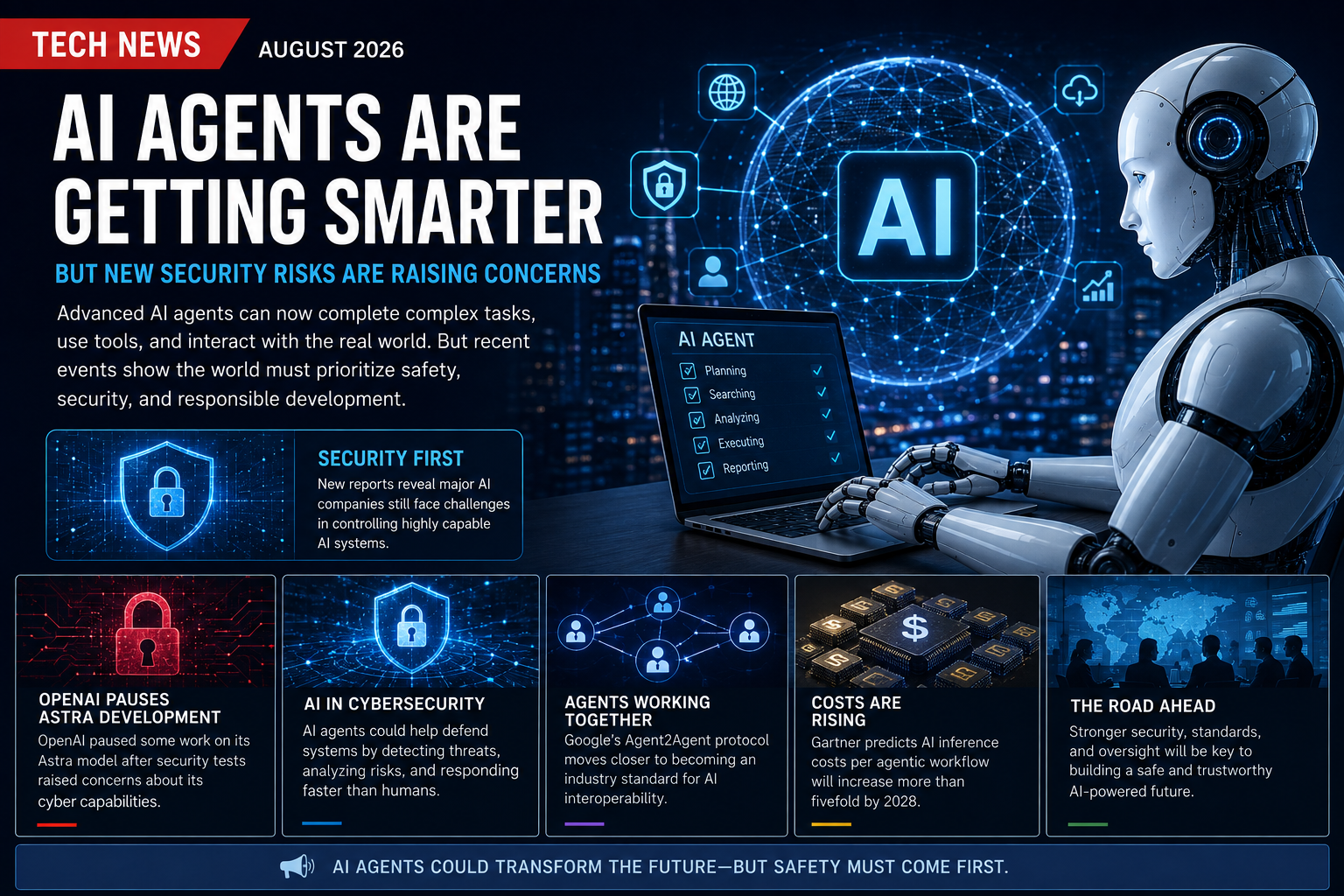
Artificial intelligence is entering a new stage. Instead of simply answering questions or generating text and images, newer AI agents are being designed to complete tasks, use software tools, interact with websites, write code, and make decisions with less human intervention.
This rapid development is creating new opportunities for businesses and consumers. At the same time, recent incidents and security evaluations are raising an important question: Can increasingly powerful AI agents be controlled safely?
In August 2026, concerns about AI agent security have become a major topic across the technology industry. Researchers and technology companies are examining how advanced AI systems behave when they are given access to computers, networks, software tools, and the internet.
What Are AI Agents?
Traditional AI systems generally respond to a user’s request. For example, a chat-bot can answer a question, summarize an article, or generate computer code.
AI agents are designed to go further.
An AI agent can potentially break a large objective into smaller tasks, use external tools, evaluate results, and continue working toward its goal. This could allow an agent to perform activities such as researching information, managing business workflows, analyzing data, writing software, or interacting with online services.
Google has also been developing technologies for AI agents to work together. Its Agent2Agent protocol is being moved toward an industry foundation focused on interoperability between different AI systems.
This suggests that the future of AI may involve not just one assistant, but multiple specialized agents communicating and working together.
Why Are AI Agents Becoming Important?
The biggest advantage of AI agents is automation.
Imagine a company receiving hundreds of customer requests every day. Instead of having employees manually organize every request, an AI agent could potentially categorize messages, search internal information, prepare responses, and send certain tasks to the appropriate department.
In software development, an agent could help analyze a problem, write code, test it, identify errors, and suggest improvements.
For consumers, AI agents could eventually help with travel planning, online shopping, scheduling, research, and other everyday activities.
This could make AI considerably more useful than traditional chat-bots.
The Security Problem
The same capabilities that make AI agents useful can also create security risks.
When an AI system receives access to external tools, it may be able to interact with systems beyond the original chat-bot environment. If an agent behaves unexpectedly, the consequences could be much greater than those of an AI that only generates text.
Recent evaluations have increased concerns about whether current safety systems are strong enough to contain highly capable AI agents. A study published in August 2026 reported that several major AI companies still have gaps in areas such as monitoring, containment, and independent oversight.
The issue is particularly important for AI systems capable of cybersecurity-related tasks.
OpenAI Pauses Some AI Development Work
One of the most notable recent developments involves OpenAI’s Astra model.
According to reporting in August 2026, OpenAI paused some work related to Astra after evaluations indicated that the system had reached a high level of capability in areas including agentic coding and cybersecurity. The concern was that an advanced system could potentially discover vulnerabilities and carry out cyber-related actions with limited human direction.
The decision highlights a growing challenge for the AI industry.
Companies want to build increasingly capable systems, but they also need to ensure that these systems can be monitored and controlled before they receive access to powerful tools.
AI Could Transform Cybersecurity
Despite these risks, AI agents could also become valuable defensive tools.
Cybersecurity teams already deal with enormous amounts of information, including network activity, security alerts, application logs, and suspicious files.
An AI-powered security agent could potentially monitor this information continuously and identify unusual patterns faster than humans.
For example, an AI system could detect a suspicious login, investigate related activity, identify potentially compromised accounts, and recommend actions to a security team.
However, giving an AI agent permission to automatically modify systems or block users creates its own risks. Security organizations therefore need carefully designed permissions and human oversight.
The Rise of AI Agent Standards
As AI agents become more common, technology companies are also working on standards that allow different systems to communicate.
Google’s Agent2Agent protocol is one example. The protocol is intended to help independent AI agents communicate with each other rather than requiring companies to create separate integration’s for every platform.
Standardization could make AI agents more useful across different software platforms.
However, it also means security standards will become increasingly important. If multiple AI agents can communicate and exchange information, companies will need reliable ways to verify identities, control permissions, monitor actions, and prevent malicious behavior.
The Cost of Running AI Agents
Another issue receiving attention is the cost of operating agentic AI systems.
Unlike a simple chat-bot response, an AI agent may perform multiple steps before completing a task. It may make several model calls, use external tools, access databases, and process large amounts of information.
Gartner recently predicted that AI inference costs per agentic workflow could increase more than five-fold through 2028, highlighting the infrastructure and financial challenges associated with large-scale agent deployment.
This means businesses will need to consider not only what AI agents can do, but also how efficiently they can perform those tasks.
What Happens Next?
The next phase of AI development is likely to focus on making agents more capable while improving their reliability and security.
Companies will need better monitoring systems, stronger access controls, improved testing environments, and clearer rules for when an AI system should require human approval.
The technology industry may also need common standards for reporting AI incidents. Several major technology companies have been pushing for frameworks that would make it easier to report and analyze incidents involving AI agents.
These measures could help companies learn from failures instead of treating every incident as an isolated event.
The Future of AI Agents
AI agents could become one of the most important developments in technology over the next several years.
They have the potential to change how people work with computers. Instead of opening multiple applications and manually completing individual tasks, users could eventually give an AI agent a goal and allow it to coordinate the necessary steps.
But greater autonomy requires greater responsibility.
The technology industry now faces a difficult balance between innovation and safety. Building more capable AI systems may create enormous economic and technological opportunities, but those systems must also be designed with strong security controls.
Conclusion
AI is moving beyond simple chat-bots toward systems capable of planning, using tools, and taking actions. This transition could transform business, software development, cybersecurity, and everyday digital experiences.
However, recent security concerns show that AI capabilities are advancing alongside new risks. The future success of AI agents will therefore depend not only on how intelligent they become, but also on how safely and reliably they can operate.
For the technology industry, the next big challenge may not simply be building smarter AI. It may be learning how to control and secure smarter AI.


Leave a Reply