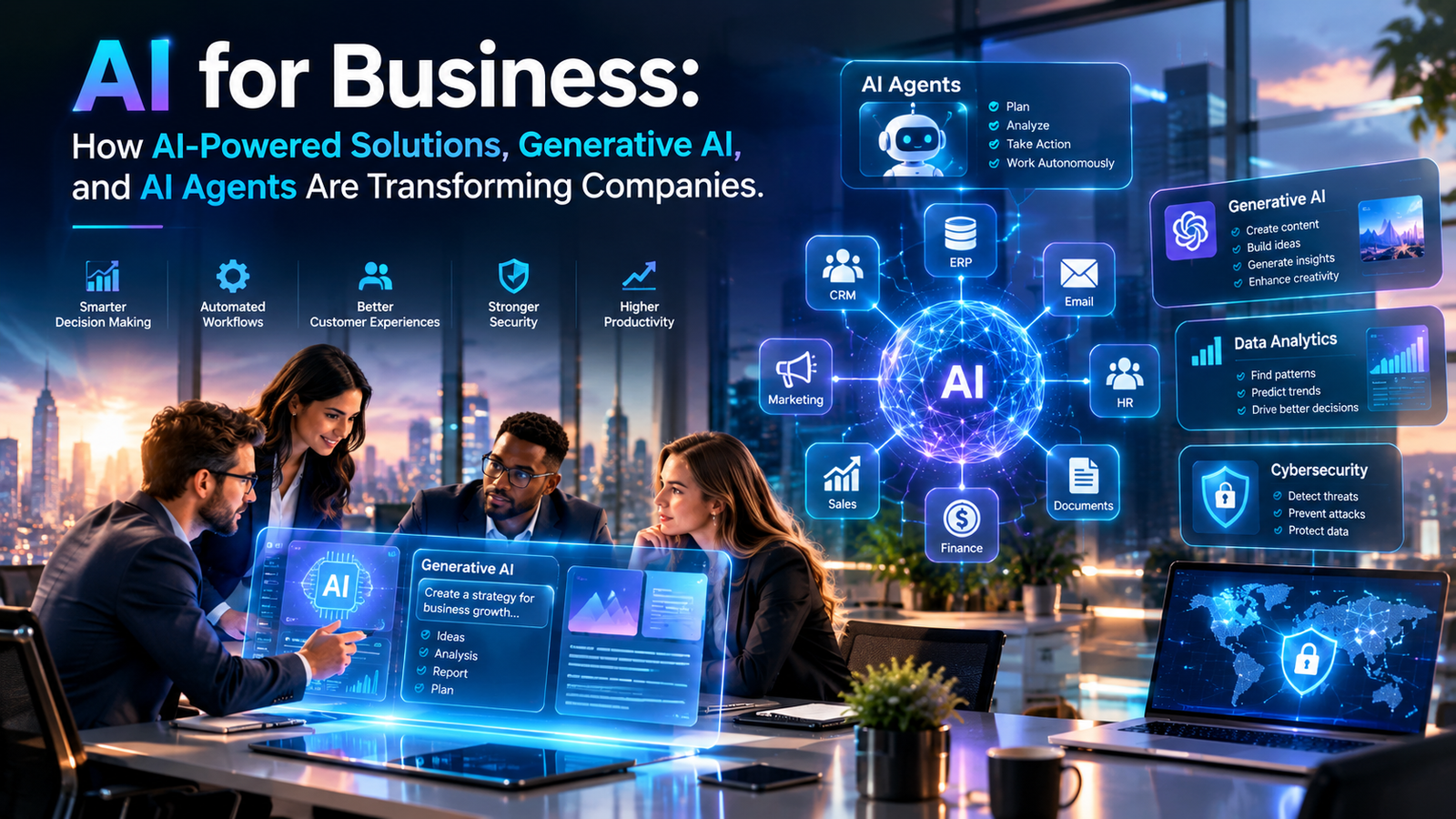
Artificial intelligence is changing how companies operate, compete, and serve customers. For business leaders, the core question is not whether AI will matter, but how to use it effectively. What once seemed like futuristic technology is now becoming part of everyday business, from customer support and marketing to sales, software development, finance, data analysis, and operations.
For many organizations, AI is no longer simply an experiment. Businesses are looking for practical ways to use artificial intelligence to save time, improve productivity, understand customers, reduce repetitive work, and make better decisions. The key challenge is choosing applications that create real business value.
This is why AI business solutions matter.
Modern AI business solutions can do much more than answer questions. Depending on how they are designed, they can analyze large amounts of information, generate content, summarize documents, assist employees, identify patterns, recommend actions, and automate multi-step workflows.
At the same time, two areas are receiving particular attention: generative AI for business and AI agents.
Generative AI can create text, images, code, summaries, reports, and other forms of content. AI agents take this further by letting software work toward defined goals and interact with tools or business systems to complete tasks. IBM describes the shift as an evolution from early AI applications focused on routine automation toward systems capable of addressing more complex business challenges.
For businesses in the United States, this creates an important opportunity. Companies that learn to use AI responsibly may work more efficiently, give employees better tools, and create better customer experiences.
But adopting AI is not simply about choosing the latest application.
The most successful approach begins with a basic question:
What business problem are we trying to solve?
Once companies have a clear answer, they can choose the right solution by matching the business problem to the tool: traditional automation, an AI-powered application, generative AI, an AI assistant, or a more autonomous AI agent.
This guide explores how AI is transforming modern companies, how businesses can adopt these technologies, what AI agents can do, and why governance, security, and human oversight matter as companies make these choices. It focuses on how to choose the right AI solution for the right business problem.
What Are AI Business Solutions?
AI business solutions are applications, platforms, systems, or services that use artificial intelligence to solve specific business problems.
The phrase can describe many different technologies because AI is not a single product.
A company might use an AI-powered customer support platform, a predictive analytics system, a generative AI writing assistant, or an AI agent connected to internal business software.
The underlying technology can also vary. Depending on the application, an AI business solution may use machine learning, natural language processing, computer vision, large language models, predictive models, recommendation systems, or agentic workflows.
The important part is not the technical label.
The important part is the result.
Suppose a company has hundreds of customer questions arriving every day. Employees may spend hours answering repetitive requests. An AI solution could classify incoming messages, retrieve information from a trusted knowledge base, draft answers, and route complex issues to human support staff.
Another company may have employees spending entire afternoons searching through documents to find information. An AI knowledge assistant could allow employees to ask questions in natural language and retrieve relevant internal information.
A finance team might use AI to extract information from invoices.
A sales team might use AI to summarize customer calls.
A marketing team might use generative AI to create early campaign drafts.
A software company might use AI to assist programmers with documentation, testing, and code generation.
These examples show the range of AI business solutions.
Why Businesses Are Interested in AI
Businesses generally adopt technology because they expect an improvement in one or more areas:
Productivity: Employees can complete certain tasks faster.
Efficiency: Repetitive manual processes can be reduced.
Decision-making: Businesses can analyze more information and identify patterns.
Customer experience: Customers can receive faster and more personalized support.
Scalability: Companies can handle increasing workloads without increasing every cost at the same rate.
Innovation: Teams can experiment with products, services, and ideas more quickly.
IBM identifies business applications such as customer experiences, operations, decision-making, document processing, procurement, employee on-boarding, compliance documentation, and claims processing as areas where AI is being applied.
However, an AI system isn’t automatically valuable just because it uses advanced technology. Adopt it only when it fits the workflow and the business problem.
The solution needs to fit the workflow.
Sometimes, a simple automation is better than an AI system. In other situations, AI can provide significant advantages when a task involves language, uncertainty, large volumes of information, or many different steps. In other words, adopt AI when those conditions make it the better fit.
That is why businesses should think about AI as a toolbox rather than a single solution.
Why AI Is Becoming Important for U.S. Businesses
The U.S. business environment is highly competitive. Companies of all sizes are under pressure to improve productivity, control expenses, understand customers, and respond quickly to market changes.
AI can help address several of these challenges at once, which is why it is becoming increasingly important.
One reason is the amount of information modern businesses produce.
Customer emails, support conversations, invoices, contracts, product reviews, financial reports, sales records, websites, employee documents, and social media interactions can create enormous amounts of data.
People can analyze only so much information manually.
AI systems can process large volumes of information quickly, helping employees find patterns and identify relevant details.
Another major advantage is language.
Many business processes involve reading and writing. Employees spend time drafting emails, writing reports, summarizing meetings, reviewing documents, responding to customers, and searching for information.
Generative AI is particularly useful in these areas because it can work with natural-language instructions and create new content. IBM notes that generative AI is being used across areas such as content creation, customer service, software development, document processing, data analysis, and workflow automation.
AI Can Support Employees Instead of Simply Replacing Them
One of the most important points about business AI is that automation does not always mean eliminating human workers.
In many situations, the more useful model is human and AI working together.
For example, a customer service representative may receive an AI-generated summary of a customer’s history before beginning a conversation.
A salesperson may receive an AI-generated briefing before meeting a potential client.
A manager may receive a summary of a long report instead of reading hundreds of pages, then identify the sections that deserve closer attention.
In these situations, AI supports the employee.
The human still provides context, judgment, communication skills, accountability, and decision-making.
The Competitive Advantage
As AI becomes easier to access, simply having an AI application may not be a sustainable competitive advantage.
The bigger advantage is knowing how to integrate AI into the right workflows.
A business that connects AI to trustworthy internal information, measures outcomes, protects sensitive data, trains employees, and applies AI to the right workflows may gain more value than a business that purchases several popular tools.
This is why an effective AI strategy should combine technology with process redesign, employee training, governance, and measurement.
How AI-Powered Solutions Are Changing Business Operations
AI-powered software is increasingly being integrated into everyday business operations.
Instead of creating a separate AI department, companies can embed intelligent capabilities into existing workflows.
This is already happening in customer support, marketing, sales, finance, operations, human resources, IT, and data analysis.
AI for Customer Service
Customer service is one of the most practical areas for AI.
Companies receive repetitive questions every day:
- Where is my order?
- How can I reset my account?
- What is your return policy?
- How do I change my subscription?
- When will my payment be processed?
- Which product should I choose?
A traditional customer service team can answer these questions, but repetitive requests consume employee time.
An AI-powered assistant can handle many basic interactions by understanding the customer’s question and retrieving information from approved sources.
More advanced systems can summarize previous conversations, recommend next actions, classify tickets, and route complex problems to appropriate employees.
Generative AI can also help customer service representatives rather than interacting directly with customers.
For example, an AI system might read a conversation and create a suggested response for a human employee to review.
That creates a useful balance.
Customers get faster service, while employees retain control over sensitive or complicated cases.
IBM describes customer support, virtual agents, information retrieval, interaction summaries, and next-best-action recommendations as important generative AI use cases for customer experience.
AI for Marketing
Marketing teams deal with a constant stream of creative and analytical work.
They may need to research audiences, write content, create campaigns, analyze customer behavior, produce social media posts, test messaging, and personalize communications.
Generative AI can assist with many of these tasks.
For example, marketers can use AI to brainstorm campaign ideas, produce an initial article outline, summarize customer feedback, generate alternative headlines, or adapt a message for different audiences.
AI can also help analyze data.
Suppose an online store sees a sudden decline in sales for a certain product.
An AI system could help examine customer reviews, product descriptions, traffic patterns, and historical sales information to identify possible causes.
The marketing team can then investigate those findings.
The strongest use of generative AI is often not replacing creative employees but accelerating their work.
A marketer who previously spent an hour preparing five concepts might use AI to develop an initial set of ideas in minutes and then spend more time improving the best ones.
Human creativity remains essential for strategy, originality, brand positioning, and final editorial judgment.
AI for Sales
Sales teams spend significant amounts of time researching prospects and managing customer information.
An AI-powered sales system can help organize this information.
Possible applications include:
- Lead prioritization
- Customer research
- Meeting summaries
- Follow-up email drafts
- CRM data organization
- Opportunity analysis
- Customer sentiment analysis
- Sales forecasting
Imagine a salesperson preparing for a meeting with a potential customer.
Instead of opening several systems and manually reviewing previous interactions, the salesperson could receive a summary containing the customer’s recent activity, previous conversations, current products, outstanding issues, and relevant recommendations.
That does not replace the salesperson.
It reduces preparation time.
AI can also identify patterns that humans might miss when working with large datasets.
For example, a system could identify that customers with certain characteristics are more likely to renew a subscription or purchase an additional product.
The sales team could use that information to prioritize outreach.
AI for Data Analysis
Data is one of the most valuable resources in a company, but raw data isn’t automatically useful.
Businesses need to interpret it.
AI can help analyze structured and unstructured information, identify patterns, summarize trends, detect unusual behavior, and generate explanations.
For example, a business owner might ask:
“Why did sales decline last month?”
A traditional analytics system may provide a dashboard.
A modern AI interface could analyze connected information and explain the major changes in natural language.
Exact accuracy depends on the system, data quality, model capabilities, and workflow design.
AI can also help nontechnical employees interact with data.
Instead of requiring every employee to understand complex query languages, an AI interface lets users ask questions in plain language.
This can make business intelligence more accessible across an organization.
Still, businesses should validate important conclusions.
AI-generated analysis can contain errors, misunderstand data, or overlook context.
For high-impact decisions, human review remains essential.
Generative AI for Business: From Content Creation to Business Intelligence
Generative AI for business has moved beyond simple content generation.
Businesses increasingly use generative AI to support knowledge work, research, customer service, software development, document processing, and workflow automation.
Generative AI runs on models that create new content based on instructions and context.
Depending on the system, this could include text, code, images, audio, video, summaries, reports, or structured outputs.
For businesses, interacting with information using natural language can be particularly powerful.
Instead of learning exactly how an enterprise application works, an employee can ask the system for what they need.
That creates a more conversational approach to software.
IBM identifies natural-language interaction, routine-work augmentation, adaptability, enterprise knowledge assistance, document processing, customer support, software development, and data analysis as key enterprise generative AI applications.
How Companies Use Generative AI
One of the simplest use cases is content creation.
A marketing department may use generative AI to draft an email campaign.
A company could use it to transform a long report into an executive summary.
A product manager could use it to create an initial requirements document.
A support department could use it to summarize customer conversations.
A developer could ask an AI system to explain a complex section of code.
An HR team could create an initial draft of an internal communication.
The important phrase here is initial draft.
Businesses should not automatically treat AI output as final.
Human review helps verify facts, maintain brand standards, identify errors, and ensure that the result fits the intended audience.
Generative AI can also work with company information when it is connected to approved knowledge sources.
This can make the technology more useful because employees are not limited to generic answers.
For example, an internal AI assistant could help employees find information from approved company policies, product documentation, procedures, and knowledge bases.
This is sometimes more valuable than simply asking a general AI chat-bot a question.
Why Generative AI Is Different
Traditional automation usually follows predetermined rules.
If a specific condition occurs, the software performs a defined action.
Generative AI works differently.
It can interpret flexible natural-language requests and produce outputs that are not necessarily identical every time.
That makes it particularly useful for tasks involving language, creativity, and unstructured information.
Consider two scenarios.
A traditional workflow might require employees to select specific fields before generating a predefined report.
A generative AI interface might allow an employee to ask:
“Summarize this quarter’s sales performance, explain the biggest changes, and identify areas that need management attention.”
That flexibility is one of generative AI’s major strengths.
It can also make software accessible to people who are not technical specialists.
However, flexibility comes with risk.
Generative AI can produce inaccurate information, misunderstand instructions, expose sensitive data if improperly configured, or produce content that requires substantial editing.
Businesses therefore need evaluation and governance rather than assuming that generated output is always reliable.
What Are AI Agents?
AI agents are systems designed to work toward a specific goal by interpreting information, deciding what steps to take, and using available tools or systems to perform actions.
The concept is closely related to agentic AI.
A generative AI chat-bot might answer a question.
An AI agent can be designed to do more than answer questions.
For example, a customer support agent could potentially:
- Read a customer’s message.
- Identify the issue.
- Look up the customer’s account.
- Search approved company information.
- Determine the appropriate response.
- Update a support ticket.
- Escalate the issue if it falls outside its permissions.
The exact behavior depends on the system’s design and the tools it can access.
Microsoft currently describes business agents as systems that can execute business processes and provides an ecosystem for creating, deploying, and managing agents.
This is why AI agents are attracting attention.
They connect AI’s reasoning and language capabilities with real-world actions.
AI Agents Are More Than Chat-bots
The easiest way to understand the difference is to compare their roles.
A chat-bot primarily communicates.
A generative AI assistant creates or summarizes information.
An AI agent can plan and execute a sequence of actions toward a goal.
For example:
Chat-bot: “What is our refund policy?”
Generative AI assistant: “Summarize this customer’s issue and draft a response.”
AI agent: “Review this refund request, check the policy, verify the order, prepare the appropriate action, and send it for approval.”
These categories can overlap, but an agent generally has a greater ability to act.
AI Agents vs. Traditional Automation
Traditional automation remains extremely valuable.
If a process is predictable and follows fixed rules, traditional automation may be the simplest and most reliable option.
For example:
When a customer submits a form → create a ticket → notify the support team.
You don’t need an advanced AI agent if the process is completely deterministic.
AI agents become more useful when the workflow involves ambiguity.
Imagine that a company receives invoices in different formats.
A traditional automation system may struggle if the layouts vary significantly.
An AI-powered system can interpret the documents, identify relevant information, and decide which workflow to trigger.
Another difference is adaptability.
Traditional automation typically performs predefined instructions.
Agents can be designed to determine which available actions are appropriate based on the situation.
That flexibility can increase productivity, but it also introduces additional risks.
An automated rule usually does exactly what it was programmed to do.
An AI agent may misinterpret a situation.
Therefore, companies need controls around agent permissions, data access, actions, monitoring, and escalation.
The right question is not:
“Should we replace automation with AI?”
The better question is:
“Which parts of this workflow benefit from intelligence, and which parts are better handled by traditional automation?”
Often, the best answer is a combination of both.
Practical AI Agent Use Cases for Companies
AI agents can be useful wherever business processes involve multiple steps and decision points.
Customer Support
An agent can classify requests, search company knowledge, summarize customer history, and recommend or perform approved actions.
IT Support
An IT agent could help employees troubleshoot common problems, search internal documentation, create support tickets, and escalate complicated issues.
Sales Operations
A sales agent could research potential customers, organize information, prepare account summaries, and update records.
Human Resources
An HR agent could answer routine questions about approved policies and guide employees through standard procedures.
Finance
Finance agents could assist with document processing, reporting workflows, reconciliation tasks, and information retrieval.
Research
Research agents can help gather information, compare documents, organize findings, and generate initial summaries.
E-Commerce
An agent could help customers discover products, answer questions, track orders, or coordinate support requests.
Internal Knowledge
A company agent can serve as a conversational interface to internal knowledge, letting employees ask questions instead of manually searching across multiple systems.
The best use cases usually have clear goals, reliable data, defined permissions, measurable outcomes, and manageable risk.
IBM recommends starting with frequent, well-defined workflows with trusted data, clear ownership, measurable results, and appropriate human oversight.
What Is an AI Agent Platform?
An AI agent platform provides tools and infrastructure that businesses can use to create, connect, deploy, monitor, and manage AI agents.
A platform may provide functionality such as:
- Agent development
- Model access
- Tool integration
- Data connections
- Workflow orchestration
- Authentication
- Permissions
- Monitoring
- Evaluation
- Human approval
- Security controls
The goal is to reduce the complexity of building an agent from scratch.
An enterprise may have dozens of systems, databases, applications, and internal knowledge sources.
A platform can help connect agents with the appropriate tools while giving administrators greater control.
Microsoft’s agent ecosystem currently includes tools for planning, building, adopting, and continuously improving agents, reflecting the broader movement toward managed enterprise agent environments.
Why the Platform Matters
Creating an AI agent is only the beginning.
A business also needs to know:
- What information can the agent access?
- Which employees can use it?
- What actions can it take?
- How are decisions logged?
- How are errors detected?
- What happens when it does not know the answer?
- When should a human take over?
These questions matter most when agents interact with financial systems, customer records, employee information, or other sensitive resources.
What Is an AI Agent Builder?
An AI agent builder is a tool or development environment that helps users create AI agents.
Modern agent builders can make development easier by providing prebuilt components, templates, connectors, configuration interfaces, and workflow tools.
A company could use an agent builder to create an internal assistant that answers employee questions using approved company documentation.
Another organization could create a sales agent that gathers customer information from connected business systems.
The technical complexity varies between platforms.
Some are designed for professional developers.
Others offer low-code or visual experiences that let business teams build agents with less programming.
This accessibility matters because AI development is increasingly cross-functional.
Business experts understand the workflow.
IT teams understand infrastructure.
Security teams understand risk.
Legal and compliance teams understand obligations.
An effective AI project brings these perspectives together.
An agent builder can simplify implementation, but it does not eliminate the need for good design.
Building an AI Governance Framework
As businesses deploy more advanced AI systems, governance becomes increasingly important.
An AI governance framework establishes the policies, responsibilities, controls, and processes used to manage AI throughout its life-cycle.
Governance should address questions such as:
Who is responsible for an AI system?
What data can it access?
How is the system tested?
What risks have been identified?
How are outputs monitored?
When is human approval required?
How are incidents handled?
How frequently is the system reviewed?
In the United States, organizations can use the NIST AI Risk Management Framework as a voluntary resource for managing AI-related risks. NIST says the framework is intended for organizations designing, developing, deploying, or using AI and is designed to be flexible across sectors and use cases.
NIST also published a Generative AI Profile that addresses risks associated with generative AI and helps organizations incorporate risk management throughout the AI life-cycle.
Key Parts of AI Governance
A practical governance program can include:
Risk assessment: Understand what could go wrong.
Data governance: Establish rules around data quality, access, privacy, and use.
Security: Protect AI systems and connected business infrastructure.
Evaluation: Test AI performance before and after deployment.
Human oversight: Establish where people need to review or approve actions.
Monitoring: Track errors, changes, unusual behavior, and performance.
Accountability: Clearly define who owns the system and its outcomes.
Documentation: Keep records of important AI systems, their purpose, data sources, and controls.
Governance should not be treated as paperwork that slows innovation.
Done correctly, it enables businesses to experiment with AI while managing risk.
NIST’s current AI RMF information also notes that the framework is being revised, reinforcing the broader reality that AI governance is an evolving discipline rather than a one-time project.
AI Security and Privacy
AI creates new security and privacy considerations for businesses.
Companies need to know how their information is handled when employees use AI applications.
Sensitive information might include:
- Customer records
- Payment information
- Employee information
- Contracts
- Source code
- Business strategies
- Proprietary research
- Internal documents
A company should not assume that every consumer AI application is appropriate for confidential information.
Clear policies are important.
Employees should know which tools are approved, what information they can enter, and what information must remain inside secure business systems.
AI agents make these questions even more important.
An agent with access to internal information may be able to perform useful tasks, but excessive permissions can create unnecessary risk.
A useful principle is least privilege.
Give an AI system only the access it needs to perform its intended task.
For example, a customer-service agent may need to read order information but have no reason to modify financial records.
A sales agent might need access to CRM information but not employee payroll data.
Businesses should also evaluate vendors, monitor access, protect credentials, and maintain appropriate logging.
Design security into the system rather than adding it after deployment.
AI Business Solutions for Small Businesses
AI is not only for large corporations.
Small businesses can also use AI business solutions to reduce repetitive work and compete more effectively.
A small company does not necessarily need a custom AI model or a large technology department.
It could start with relatively simple use cases.
Marketing
AI can help brainstorm content ideas, prepare draft social posts, create email outlines, summarize research, and organize campaigns.
Customer Service
Small businesses can use AI assistants to answer routine questions, organize customer requests, and provide support information.
Administration
AI can summarize meetings, organize notes, draft emails, and extract important information from documents.
Sales
AI can help research prospects, summarize interactions, and prepare follow-up communications.
Operations
AI can help identify repetitive processes that may be candidates for automation.
For a small business, the goal should not be to introduce AI into every department.
Instead, identify one task that creates a clear bottleneck.
For example:
If an owner spends five hours each week answering repetitive customer questions, an AI support solution may be worth testing.
If employees spend hours creating routine reports, generative AI may help accelerate the process.
The business can then measure the result.
AI Business Solutions for Enterprises
Large organizations have more complex AI opportunities.
An enterprise may have thousands of employees and large quantities of internal information spread across many systems.
AI can potentially connect this information in more accessible ways.
Enterprise applications can include:
- AI knowledge assistants
- Enterprise search
- Customer service agents
- Sales agents
- Document intelligence
- Code assistants
- Data analysis systems
- Workflow automation
- Fraud detection
- Forecasting
- Risk analysis
The scale can create major productivity opportunities, but it also requires stronger governance.
An enterprise AI deployment may involve multiple departments, data sources, vendors, models, applications, and access levels.
This means organizations need clear ownership and controls.
One useful strategy is to create an AI center of excellence or cross-functional AI team responsible for standards, evaluation, security, and adoption.
The goal is not necessarily to centralize every AI decision.
Instead, a central team can create common standards while individual departments identify practical use cases.
How to Choose the Right AI Business Solution
Choosing the right AI solution can be difficult because the market contains thousands of products and rapidly changing capabilities.
A good selection process should start with the business problem.
1. Define the Problem
Do not begin with:
“We need AI.”
Begin with:
“This process is slow, expensive, repetitive, or difficult. Can AI improve it?”
That change in thinking can prevent unnecessary technology investments.
2. Define the Desired Outcome
Determine what success looks like.
For example:
- Reduce response time
- Lower operating costs
- Improve customer satisfaction
- Increase sales productivity
- Reduce manual data entry.
- Improve report preparation time.
3. Evaluate the Data
AI depends on information.
Poor-quality, outdated, incomplete, or inaccessible data can limit results.
4. Consider Integration
An AI application becomes more useful when it works with systems employees already use.
Ask whether the solution integrates with the company’s CRM, databases, collaboration tools, customer systems, or other important applications.
5. Evaluate Security
Determine how data is stored, processed, protected, and accessed.
6. Test Before Scaling
Run a pilot.
Measure performance.
Find problems.
Improve the workflow.
Then expand.
IBM similarly recommends selecting use cases with clear owners, trusted data, measurable outcomes, and appropriate oversight before scaling generative AI across an organization.
Common AI Mistakes Businesses Should Avoid
AI can create impressive results, but poor implementation can waste time and money.
Mistake 1: Adopting AI Because Everyone Else Is
Trends are not business strategies.
A company should adopt AI because it solves a meaningful problem.
Mistake 2: Expecting Perfect Accuracy
AI systems can make mistakes.
Review generated content and AI-generated analysis when accuracy matters.
Mistake 3: Ignoring Employees
Employees need training and clear guidance.
AI adoption is much easier when people understand how the technology helps them rather than seeing it only as a threat.
Mistake 4: Giving AI Too Much Access
Agents and AI applications should receive only the permissions necessary for their jobs.
Mistake 5: Ignoring Data Quality
AI cannot reliably fix fundamentally poor information.
Mistake 6: Failing to Measure Results
A business should measure whether an AI implementation actually improves productivity, quality, cost, revenue, customer experience, or another relevant metric.
Mistake 7: Treating Governance as Optional
AI governance should be part of the implementation process from the beginning.
Mistake 8: Publishing AI-Generated Content Without Review
Generative AI can accelerate content creation, but human editing remains essential for accuracy, originality, brand voice, and usefulness.
The strongest AI implementations usually combine technology with responsible human oversight.
The Future of AI Business Solutions
The future of AI in business is likely to involve deeper integration.
Instead of employees opening a separate AI website whenever they need help, AI capabilities are increasingly being embedded into the applications where work already happens.
Business software may increasingly include intelligent assistants and agents.
Employees may interact with enterprise systems through natural language.
Customer service platforms may automatically summarize conversations and recommend next actions.
Sales systems may identify opportunities.
Operations platforms may use AI to identify bottlenecks.
Knowledge systems may become conversational.
And AI agents may increasingly coordinate multi-step workflows.
The transition matters because it changes how people interact with software.
For decades, employees had to learn each application’s interface.
With AI, people can increasingly describe what they want in natural language.
Instead of asking:
“Which menu contains this report?”
an employee may eventually ask:
“Show me the biggest changes in customer retention this quarter and explain what may have caused them.”
That could make business technology more accessible.
However, greater AI autonomy also increases the need for responsible design.
The more an AI system can do, the more important permissions, monitoring, evaluation, security, and governance become.
AI Agents Could Become Digital Coworkers
One of the most interesting possibilities is AI agents evolving into digital coworkers.
A future business environment could contain specialized agents responsible for different tasks:
Sales agent: researches prospects.
Marketing agent: supports campaign workflows.
Finance agent: helps prepare financial reports.
Support agent: handles customer questions.
Research agent: gathers and organizes information.
IT agent: handles routine technical requests.
Humans would still manage strategy, relationships, high-impact decisions, and accountability.
The organization could combine human employees with specialized digital systems effectively.
This idea is already reflected in the growing enterprise focus on agents that can execute business processes, not just provide conversational answers.
The Importance of Trust
The future of AI business solutions will not depend only on how powerful models become.
Trust will matter just as much.
Businesses need to know:
- Where information comes from
- Why a system produced an output
- What actions an agent can take
- Who is responsible for the results
- How errors are detected
- How sensitive information is protected
Companies that build these practices early may be better prepared as AI becomes more autonomous.
Frequently Asked Questions About AI Business Solutions
What are AI business solutions?
AI business solutions are software, platforms, and systems that use artificial intelligence to solve business problems. They can support customer service, marketing, sales, data analysis, operations, employee productivity, and workflow automation.
How can AI help U.S. businesses?
AI can help businesses automate repetitive work, analyze large amounts of information, support employees, improve customer service, generate content, identify patterns, and assist decision-making.
What is generative AI for business?
Generative AI for business means using AI systems that can produce new content such as text, code, images, summaries, reports, and other outputs for business-related tasks.
What are AI agents?
AI agents are systems designed to pursue specific goals and potentially perform multiple actions using connected tools or business systems. Their capabilities depend on their design, permissions, data access, and environment.
What is an AI agent platform?
An AI agent platform provides tools to build, integrate, deploy, manage, and monitor AI agents.
What is an AI agent builder?
An AI agent builder is a software environment that helps businesses or developers create and configure AI agents. Depending on the platform, it may provide visual workflows, integration’s, templates, tools, and deployment features.
What is the best AI app for business?
No single AI app is best for every business. The right application depends on the company’s objectives, workflow, data, security requirements, integration’s, budget, and employee’s needs.
Can small businesses use AI business solutions?
Yes. Small businesses can use AI for marketing, customer support, administration, sales, research, data analysis, and workflow automation without necessarily building complex custom AI systems.
Are AI agents better than traditional automation?
Not always. Traditional automation can be better for predictable, rule-based processes. AI agents become more useful when a workflow involves natural language, ambiguity, multiple steps, or dynamic decisions.
Why does AI governance matter?
AI governance helps organizations manage risks related to data, privacy, security, accuracy, accountability, and responsible use. NIST’s AI Risk Management Framework provides a voluntary approach organizations can use to manage AI risks.
Will AI replace employees?
AI may automate some tasks and change the way many jobs are performed, but businesses still need people for strategy, judgment, creativity, relationships, leadership, accountability, and complex decision-making.
What should a company do before adopting AI?
The company should identify a specific business problem, define the desired outcome, evaluate data and security requirements, select an appropriate solution, run a controlled pilot, measure results, and establish governance before expanding.
Final Thoughts
AI is changing business from the inside out.
The biggest opportunity is not simply using a chat-bot or generating content. It is redesigning the way work gets done.
AI business solutions can help companies automate repetitive processes, improve customer experiences, analyze information, support employees, and discover new opportunities.
Generative AI is making it easier to create and interact with information using natural language.
AI agents are taking another step by connecting AI reasoning with actions and workflows.
For small companies, this can mean doing more with limited resources.
For enterprises, it can mean transforming complex processes that involve thousands of employees and enormous amounts of information.
But successful AI adoption requires more than technology.
Companies need reliable data, strong security, clear objectives, appropriate human oversight, measurable outcomes, and an effective AI governance framework.
The smartest businesses will not necessarily be the ones that use the most AI tools.
They will be the ones that understand where AI creates genuine value.
That means starting with real problems, choosing the right technology, testing carefully, learning from results, and scaling what works.
AI is becoming a new layer of business infrastructure.
Generative AI can help people create.
AI-powered systems can help people analyze.
AI agents can help people act.
And together, these technologies could fundamentally change how modern companies operate.
The future of business will not be humans versus AI.
It is much more likely to be humans working with increasingly capable AI systems.
The organizations that learn how to make that partnership useful, secure, and responsible will be in a stronger position as the next chapter of business technology unfolds.





Leave a Reply