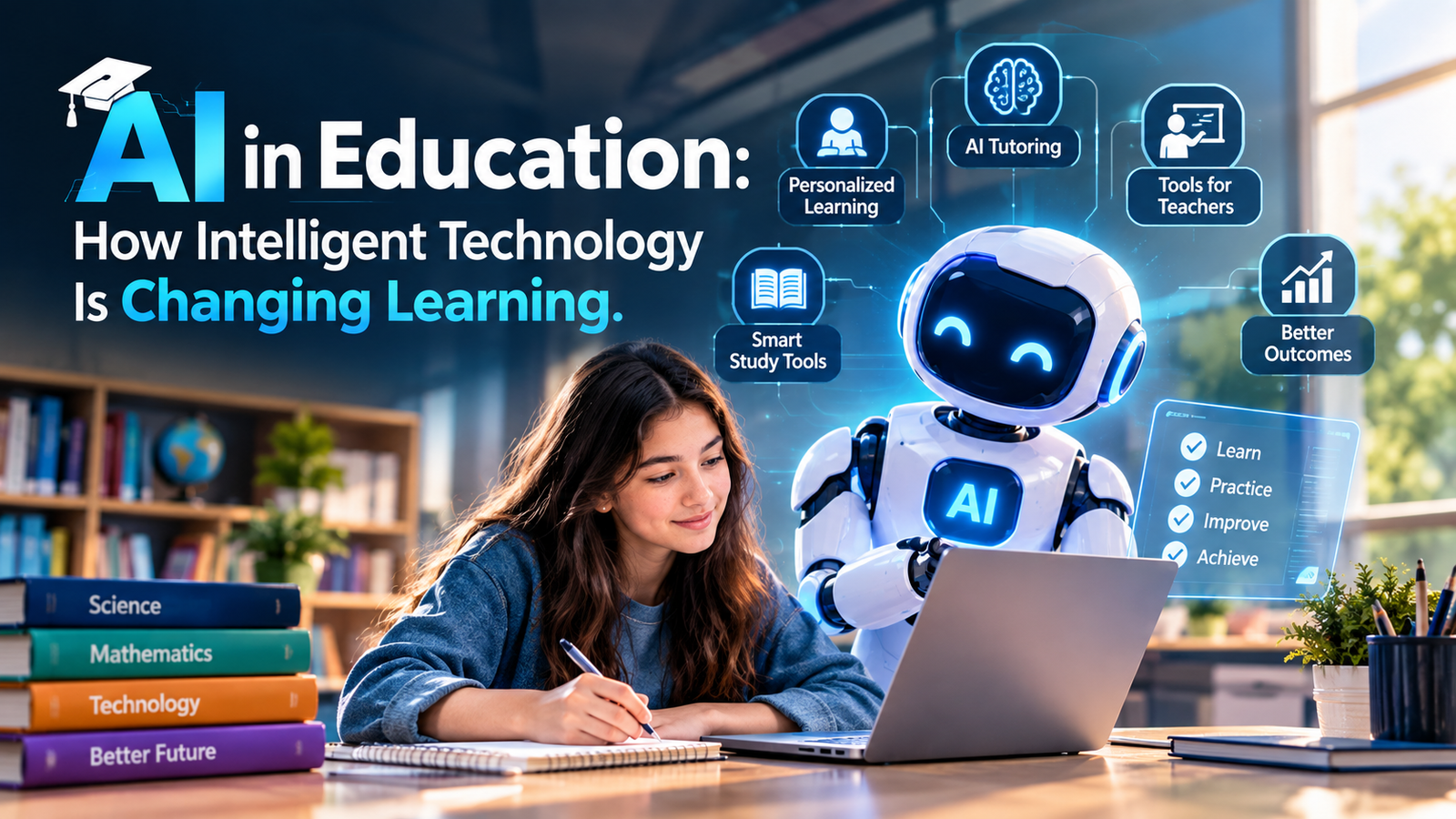
Artificial intelligence is moving from science-fiction concepts into everyday classrooms, colleges, online courses, and educational software. Its central promise is to change how people teach, study, practice, and evaluate knowledge by offering tutoring, adaptation, and support that respond to student needs.
In the United States, this transformation is already visible. Students use chat-bots and other AI applications for research, math, writing assistance, brainstorming, and studying. At the same time, teachers and schools experiment with tools that support lesson planning, differentiated instruction, assessment, and administrative work. A 2026 Pew Research Centre survey found that 55% of U.S. teens had used AI chat-bots for some amount of schoolwork: 10% said chat-bots helped with all or most of their schoolwork, 21% with some, and 23% with a little.
At the same time, artificial intelligence in education raises important questions. How much should students depend on AI? How can teachers verify AI-generated information? What happens to student privacy when educational systems process personal data? How can schools use new technology without allowing it to replace the human relationships at the centre of learning?
The answer is not simply to accept or reject AI. The more useful approach is to understand where AI can genuinely improve education, where it has limitations, and how educators can use it responsibly. That is the article’s central argument. This article explores how AI in education is changing learning in the U.S., its main applications, its benefits and challenges, useful tools, and what the future may look like. tools and what the future of AI in education may look like. It focuses on where AI can support learning responsibly and where human guidance remains essential.
What Is AI in Education?
AI: Traditional educational software generally follows instructions created by developers or teachers. AI systems can go further by analyzing information, identifying patterns, generating content, responding to questions, making predictions, or adapting based on data. AI systems can also analyze information, identify patterns, generate content, respond to questions, make predictions, or adapt their behavior based on data.
For example, a conventional math program may provide a fixed set of questions. An AI-enabled learning platform can analyze a student’s answers and potentially identify which concepts are causing difficulty. It can then recommend additional practice, adjust the difficulty level, or provide targeted explanations.
This is one reason AI-powered education is receiving attention. Instead of giving every learner the same digital experience, AI can help create systems that respond to differences between students and support more effective learning.
AI in education can include:
- Intelligent tutoring systems
- Adaptive learning platforms
- Generative AI assistants
- Automated feedbThe U.S. Department of Education has recognized personalized learning, differentiated instruction, professional development, and administrative efficiency as areas where AI may support education when implemented within applicable requirements.s personalized learning, differentEducation has always changed alongside technology. Computers introduced digital learning, the internet expanded access to information, smartphones made educational content more portable, and cloud platforms connected students and teachers beyond the traditional classroom. Digital learning, the internet, smartphones, and cloud platforms have connected students and teachers beyond the traditional classroom.
Generative AI accelerated this process because students and teachers can now interact with sophisticated language systems using ordinary conversational prompts.
Instead of searching for information one web-page at a time, a student can ask an AI system to explain a difficult concept in simpler language. A teacher can request examples of a historical concept, create differentiated practice questions, or brainstorm lesson activities.
The technology therefore changes not only what educational software can do, but also how people interact with digital learning systems.
Student adoption is an important part of this shift. Pew Research Centre reported that this adoption creates a practical challenge for schools: AI is already part of many student’s digital lives, so education systems must decide how to teach responsible use. This adoption creates a practical challenge for schools: AI is already part of many student’s digital lives, so education systems must decide how to teach responsible use rather than treating the technology as something students will never encounter.
How Artificial Intelligence in Education Is Changing Learning
The biggest change may be the shift toward more adaptive and interactive learning.
A traditional classroom must serve students with different backgrounds, abilities, interests, and learning speeds. One teacher may have limited time to provide individual feedback to every student.
AI cannot eliminate that problem, but it can provide additional digital support.
1. Personalized Learning With AI
One of the most discussed applications is personalized learning with AI.
Students do not learn at the same pace. One learner may understand fractions immediately but struggle with algebra, while another may need more practice with reading comprehension but perform strongly in science.
AI-enabled platforms can analyze student interactions and use that information to recommend content, exercises, or feedback.
For instance, if a student repeatedly makes errors involving quadratic equations, research published in 2025 examined AI-supported adaptive education using techniques such as supervised learning, clustering, reinforcement learning, and multimodal analytics. The review also highlighted concerns involving interpret-ability, privacy, and scalability. Personalization, however, should not be confused with simply making education easier. Effective Personalization should help students meet meaningful learning objectives while identifying where they need support. should not be confused with simply making education easier. Effective Personalization should help students meet meaningful learning objectives while identifying where they need additional support.
2. AI Tutoring
AI tutoring is another major development.
An AI tutor can act as an always-available study assistant. Students may ask it to explain a concept, generate practice questions, walk through a problem, quiz them, or provide feedback on a draft.
A useful AI tutor should encourage learning rather than deliver answers.
For example, imagine a student asks:
“What is photosynthesis?”
An answer-producing system might provide a definition and stop.
A learning-focused system could explain photosynthesis, ask the student to describe it in their own words, identify misunderstandings, and provide a short follow-up. Research on AI-driven intelligent tutoring systems in K-12 education has found generally positive effects, but some advantages become smaller when compared with other tutoring technologies. The review called for longer-term research and more diverse student samples. Note that some advantages become smaller when intelligent tutoring systems are compared with other tutoring technologies. The review called for longer-term research and more diverse student samples.
This suggests that a student can spend hours practicing but may not know why an answer is incorrect. Teachers also face time constraints when providing individual feedback on every assignment.s of learning.
A student can spend hours practicing but may not know exactly why an answer is incorrect. Teachers also face time constraints when providing individual feedback on every assignment.
AI systems can help analyze writing, coding, mathematical work, language practice, and other activities.
For example, an AI learning tool might point out:
- a grammar problem
- a missing step in a mathematical solution
- unclear organization in an essay
- a coding error
- a vocabulary gap
- a repeated conceptual mistake
Instant feedback allows students to identify problems earlier.
However, AI feedback should not automatically be treated as correct. Teachers and students need to evaluate whether suggestions are accurate and appropriate for the assignment.
AI Learning Tools for Students
The rapid development of educational AI has produced many kinds of AI learning tools.
Students can use AI applications for different stages of the learning process rather than relying on one tool for everything.
Research and Brainstorming
Students can use AI to generate research questions, identify possible project angles, summarize complex concepts, and create study outlines.
The important step is verification. An AI system may produce an explanation that sounds convincing while containing factual errors or unsupported claims.
Students should therefore compare important information against textbooks, academic sources, official websites, and teacher-provided materials.
Writing Support
AI tools can help students brainstorm ideas, improve organization, identify unclear sentences, and practice language skills.
Used appropriately, this can act like a digital writing coach.
Used poorly, however, students may submit AI-generated work without understanding it.
That difference matters especially when schools have academic-integrity rules about AI-generated content.
Mathematics Practice
AI can provide step-by-step explanations and additional practice questions.
A student who struggles with equations can ask for a simpler explanation, try a problem independently, and then compare the solution process.
The strongest learning pattern is not “ask AI and copy the answer.” It is “attempt, receive guidance, check, and try again.”
Language Learning
AI-powered conversation tools can provide opportunities to practice vocabulary, grammar, pronunciation, and conversation.
A learner studying English, Spanish, French, or another language can practice dialogues without needing another person available at that moment.
Voice-enabled AI may make these experiences increasingly interactive.
Study Planning
Students can also use AI to break large assignments into manageable tasks.
For example, a system could turn a three-week research project into a schedule that includes research, outlining, drafting, revision, source verification, and final proofreading.
This can support time management without completing the student’s academic work for them.
AI Tools for Teachers
AI is not only a student technology. AI tools for teachers can also support many routine tasks.
Teachers spend significant amounts of time preparing lessons, developing materials, communicating with families, grading, documenting progress, and handling administrative responsibilities.
AI may help reduce some of that workload.
Lesson Planning
A teacher can use an AI assistant to brainstorm lesson ideas, discussion questions, examples, differentiated activities, and formative assessments.
For example, a teacher covering the American Civil Rights Movement could ask an AI system to create:
- a beginner-level reading activity
- discussion questions
- vocabulary exercises
- an advanced analysis prompt
- a short quiz
The teacher can then review and adapt the material.
The teacher remains responsible for accuracy, age appropriateness, curriculum alignment, and instructional quality.
Creating Educational Materials
Teachers can use AI to generate draft worksheets, question banks, study guides, rubrics, and classroom activities.
AI can also help transform the same topic into different formats.
A difficult scientific concept could become a short explanation, a classroom dialogue, flashcards, and a series of practice questions.
This can save preparation time and let educators spend more time interacting with students.
Differentiated Instruction
Every classroom includes students with different needs.
A teacher may ask an AI system to suggest different versions of an activity while keeping the same learning objective.
For example:
A student who needs additional support may receive simpler language and more guided practice.
A grade-level student may receive standard material.
An advanced student may receive a more challenging application problem.
This is where AI-powered education can complement teacher judgment rather than replace it.
Administrative Support
AI can also assist with non-instructional work such as drafting routine messages, organizing information, summarizing notes, and creating basic reports.
The Department of Education’s 2025 guidance identified administrative efficiency as one potential area of AI use, alongside teaching and learning applications.
Reducing repetitive administrative work could allow educators to devote more time to instructional planning and students.
Generative AI in Education
Generative AI in education has become one of the most visible aspects of artificial intelligence in schools and universities.
Generative AI systems can produce text, images, code, explanations, questions, summaries, and other forms of content.
This makes them unusually flexible educational assistants.
A student can use generative AI to ask:
“Explain Newton’s laws as if I were a beginner.”
Then:
“Give me five practice questions.”
Then:
“Check my answers but don’t tell me the solutions immediately.”
This interaction resembles a personalized study session.
Teachers can use the same technology from another perspective:
“Create three discussion questions about the causes of the American Revolution for a high school classroom.”
The teacher can then improve the draft, add appropriate sources, and adapt it to students.
The major educational question is therefore not whether generative AI can generate content. It clearly can.
The question is whether the content-generation process produces better learning.
A 2025 meta-analysis of 26 empirical studies found a statistically significant but relatively small overall effect of generative AI on student learning outcomes, with results varying by educational level, intervention duration, and subject area.
That finding matters because it shows why schools should evaluate specific uses rather than assuming every use of generative AI automatically improves learning.
Machine Learning in Education
Machine learning underpins many AI systems in education.
Machine learning lets software identify patterns in data and use them to make predictions or recommendations.
In an educational setting, machine learning may analyze learning behavior, recommend content, identify areas of difficulty, or support institutional decision-making.
Consider an online mathematics course.
A platform might collect information about which questions students answer correctly, how frequently they practice, which concepts they revisit, and where errors occur.
A machine learning model could use these patterns to help recommend what the learner should study next.
This is different from a human teacher’s understanding of a student. Machine learning sees patterns in available data, while teachers can incorporate context that may not appear in a digital record.
For that reason, machine learning should generally be treated as a support mechanism rather than an unquestionable decision-maker.
The Benefits of AI in Education
AI can potentially improve education in several important ways.
Greater Access to Learning Support
Students can access digital assistance outside normal classroom hours.
An AI-based study assistant doesn’t need to operate on a school bell schedule or a tutoring appointment.
For students studying independently, this can be valuable.
Faster Feedback
Students can receive immediate responses to practice work, allowing them to correct misunderstandings sooner.
Personalized Practice
AI systems can identify areas that need more practice and recommend appropriate activities.
Support for Teachers
AI can reduce time spent on some routine preparation and administrative tasks.
Accessibility
Artificial intelligence can support learners through speech recognition, text-to-speech, translation, captioning, and other accessibility-related functions.
More Interactive Learning
Conversational systems can make digital learning more interactive by allowing students to ask follow-up questions rather than navigating a fixed sequence of pages.
Support for Diverse Learning Needs
AI can potentially generate multiple explanations or presentation formats for the same concept.
This flexibility may help some students engage with material in ways that better match their needs.
However, benefits depend heavily on implementation. UNESCO’s work on AI and education emphasis’s that AI can expand access and Personalization while also creating risks involving inequality, privacy, safety, ethics, and governance.
Challenges and Risks of AI in Education
AI in education also introduces serious challenges.
1. Accuracy and AI Hallucinations
AI systems can generate false or misleading information.
A response can sound authoritative while being wrong.
Students therefore need strong verification habits.
For academic work, check important facts against reliable sources rather than accepting them simply because an AI system provided them.
2. Academic Integrity
One of the most difficult questions involves student work.
If a student asks AI to write an entire essay and submits it as original work, the technology is no longer simply assisting learning.
It may instead prevent teachers from accurately evaluating the student’s own knowledge and writing ability.
Schools therefore need clear policies explaining when AI use is permitted, restricted, or prohibited.
In Pew’s 2026 survey, 59% of U.S. teens said AI cheating happens at least somewhat often at their school.
This does not mean every AI-assisted assignment is cheating. Context and institutional rules matter.
3. Student Privacy
AI systems may process student information, including educational records and behavioural data.
Schools need to understand what information a technology collects, where it stores it, how it uses it, and who can access it.
In the U.S., FERPA applies to educational agencies and institutions that receive funding from programs administered by the U.S. Department of Education, including public schools, school districts, and many colleges and universities.
Schools should therefore consider privacy requirements when evaluating AI vendors and educational platforms.
4. Bias and Fairness
AI systems learn from data and are shaped by their design.
If data or system design contains problematic patterns, AI-supported recommendations can potentially reproduce or amplify them.
Educational institutions should test tools across diverse student populations and avoid assuming that an AI system is neutral simply because it is automated.
5. Digital Inequality
Not every student has the same access to high-quality devices, internet connections, software subscriptions, or supportive learning environments.
If some students have access to powerful AI tools while others do not, technology could increase educational inequality rather than reduce it.
6. Reduced Independent Thinking
Over-dependence is also a risk.
When students use AI to generate every idea, answer every question, and write every assignment, they may have fewer opportunities to practice independent reasoning.
The goal should be to use AI to strengthen thinking, not eliminate the need for thinking.
7. Teacher Training
Buying AI software is easier than teaching people how to use it effectively.
Teachers need professional development covering prompting, verification, privacy, academic integrity, instructional design, and responsible classroom use.
The U.S. Department of Education’s 2025 AI guidance specifically identified professional development for educators as an area worth supporting.
AI Should Support Teachers, Not Replace Them
One of the biggest misconceptions about AI in education is that artificial intelligence will simply replace teachers.
Education involves far more than delivering information.
Teachers motivate students, recognize emotional and social needs, manage classroom dynamics, understand family contexts, build trust, encourage curiosity, and make decisions based on situations that may not be visible in a dataset.
An AI system can explain a mathematical formula.
A teacher can notice that a student understands the formula but has lost confidence and needs encouragement.
That human relationship remains essential.
The U.S. Department of Education’s August 2026 guidance on education technology emphasis’s instructional value, evidence, educator judgment, transparency for parents, student outcomes, and maintaining a human-centric core of teaching.
This suggests a practical model: AI handles certain repetitive or information-heavy tasks while educators remain central to instructional and human decisions.
How Students Can Use AI Responsibly
Students can benefit substantially from AI without allowing it to do all the intellectual work.
A useful rule is to treat AI as a learning partner, not a shortcut.
For example, students can ask AI to:
- explain a difficult concept
- provide additional practice questions
- quiz them
- identify gaps in an explanation
- give feedback on organization
- suggest research questions
- simplify complex language
- provide alternative examples
Students should be cautious about asking AI to complete an assignment meant to demonstrate their own knowledge.
Before using AI for academic work, students should also check their school’s or instructor’s policy.
The strongest habit is verification. Students should question AI-generated claims, compare answers with trustworthy sources, and learn to recognize uncertainty.
These skills matter more than ever because AI literacy is becoming part of general digital literacy.
How Teachers Can Introduce AI Into the Classroom
Teachers do not need to transform an entire curriculum overnight.
A gradual approach can be more practical.
Start with low-risk activities, such as asking students to compare an AI-generated explanation with a textbook.
For example, a teacher might give students an AI response about climate change and ask them to identify:
What is accurate?
What is vague?
What needs a source?
What information may be missing?
This turns AI into an object of critical analysis.
Another activity could require students to solve a problem independently before asking AI for feedback.
The learning process becomes:
Attempt → Feedback → Verification → Revision → Reflection
That approach gives students a reason to think before turning to technology.
AI Literacy Is Becoming an Important Student Skill
Knowing how to use AI effectively is not simply about knowing which chat-bot to open.
AI literacy involves understanding:
- what AI systems can and cannot do
- how prompts influence responses
- why AI may produce errors
- how to verify information
- how to protect personal data
- how to recognize bias
- when AI use is academically appropriate
- how to disclose AI assistance when required
These abilities can become increasingly important in higher education and the workplace.
Students entering careers in business, healthcare, engineering, technology, communications, design, and many other fields may encounter AI-powered software.
Education therefore has an opportunity to teach not only how to use AI, but how to use it thoughtfully.
AI in Higher Education
AI’s influence extends beyond K-12 schools.
Colleges and universities are exploring AI for teaching, research, student support, academic advising, institutional operations, and administrative services.
A university might use AI to support student questions about course requirements or campus services.
Professors may use AI to brainstorm materials, create practice questions, or experiment with new assessment formats.
Students can use AI for study assistance, coding support, language practice, research brainstorming, and preparation.
At the same time, higher education institutions must address academic integrity, privacy, assessment design, and transparency.
In January 2026, the U.S. Department of Education announced $169 million in grants under the Fund for the Improvement of Post-secondary Education, including support for responsible uses of AI intended to enhance teaching and learning.
This illustrates how artificial intelligence is becoming part of broader institutional conversations about the future of post-secondary education.
The Future of AI in Education
The future of AI in education will likely involve more personalized, conversational, multimodal, and integrated learning systems.
Instead of using AI as a separate chat-bot, educational platforms may increasingly build AI capabilities directly into learning environments.
Imagine an online course where an AI assistant can understand a student’s learning history, explain a concept, generate practice questions, provide feedback, and recommend the next lesson.
Imagine a language-learning application that combines text, voice, pronunciation analysis, and conversation.
Imagine a science platform where students can interact with simulations and receive explanations adapted to their previous mistakes.
These experiences could make digital learning more responsive.
However, the future should not be measured only by how advanced AI becomes.
The more meaningful question is whether these systems improve learning.
UNESCO emphasis’s a human-centric approach to generative AI and has developed competency frameworks and guidance for students and teachers.
This principle matters because technological capability and educational value are not the same.
A more powerful AI model does not automatically produce better teaching.
What AI-Powered Education Could Look Like in the Future
Several developments are likely to receive increasing attention.
AI Learning Companions
Students may have persistent AI learning assistants that help them study over longer periods.
These systems could potentially remember learning goals and provide personalized practice while operating within school-defined privacy and safety rules.
More Natural Voice Interaction
Voice-based AI may allow students to have spoken conversations with educational assistants.
This could be especially useful for language learning and interactive practice.
Multimodal Learning
AI systems increasingly work across text, images, audio, and other information formats.
Students could upload a diagram, ask questions about it, listen to an explanation, and receive additional exercises.
Adaptive Assessments
Assessments could become more responsive.
Instead of giving every learner the same sequence of questions, AI-supported systems could potentially adjust difficulty based on demonstrated understanding.
Teacher Copilots
Teachers may increasingly use AI assistants for preparation, administrative support, content generation, and data interpretation.
The teacher would still review outputs and make final instructional decisions.
Greater Focus on AI Literacy
Schools may increasingly teach students how AI works, how to evaluate AI-generated information, and how to use it responsibly.
A Practical Framework for Schools
For U.S. schools and educational organizations considering AI adoption, technology should start with an educational problem, not a technology trend.
A practical evaluation framework can ask:
What problem are we trying to solve?
An AI tool should have a clear instructional or operational purpose.
Does it improve learning or save meaningful time?
Schools should look for evidence rather than relying only on marketing claims.
What data does it collect?
Examine privacy and security before implementation.
How does the tool handle errors?
Teachers and students need ways to identify and correct inaccurate outputs.
Does the system support educator judgment?
AI should not automatically make high-impact decisions simply because it is convenient.
How will students without equal access be supported?
Schools should consider whether AI creates or reduces technology gaps.
The Department of Education’s August 2026 guidance encourages educational technology decisions grounded in evidence, educator judgment, transparency, and student outcomes.
The Right Balance Between Technology and Human Learning
The future of education is unlikely to be purely human or purely artificial.
Instead, classrooms may become environments where people and intelligent systems work together.
AI excels at processing information, generating drafts, identifying patterns, and responding quickly.
Teachers are essential for judgment, relationships, motivation, context, ethics, and deeper educational decisions.
Students need both.
The goal is not to create learners who can produce answers faster.
The goal is to create learners who understand ideas, question information, solve problems, communicate effectively, and continue learning independently.
That distinction should guide AI development in education.
Frequently Asked Questions About AI in Education
What is AI in education?
AI in education uses artificial intelligence technologies to support teaching, learning, assessment, educational administration, and student services. Examples include adaptive learning platforms, intelligent tutoring systems, generative AI assistants, automated feedback, and learning analytics.
What are AI tools for students used for?
AI tools for students can help with studying, research brainstorming, practice questions, explanations, writing feedback, language learning, mathematics practice, coding assistance, and study planning. Students should follow their school’s academic-integrity rules and verify important information.
What are AI tools for teachers used for?
AI tools for teachers can assist with lesson planning, worksheet creation, question generation, differentiated instruction, feedback drafts, communication, and certain administrative tasks. Teachers should review AI-generated material for accuracy and appropriateness before using it.
Can AI replace teachers?
AI can automate or assist with certain tasks, but teaching involves human judgment, relationships, motivation, classroom management, and social-emotional support. Current educational guidance emphasis’s keeping teaching human-centric rather than treating AI as a complete substitute for educators.
Is generative AI good for education?
Generative AI can provide useful explanations, practice, brainstorming, and feedback, but its educational impact depends on how it is used. Research has found positive effects in some contexts while also showing variation across educational levels, subjects, and intervention designs.
What are the biggest risks of AI in education?
Major concerns include inaccurate information, academic-integrity problems, privacy risks, bias, unequal access, over-dependence on technology, and inadequate teacher training.
What is personalized learning with AI?
Personalized learning with AI uses data and AI techniques to adapt educational content, practice, feedback, or recommendations to individual learners. The objective is to make instruction more responsive to student’s demonstrated needs.
What is the future of AI in education?
The future of AI in education is likely to include more adaptive learning platforms, conversational tutors, multimodal educational assistants, AI-supported teacher tools, and a stronger emphasis on AI literacy, privacy, and responsible use.
Conclusion
AI in education is changing the relationship between students, teachers, content, and technology.
From AI learning tools and intelligent tutoring to generative AI in education, adaptive platforms, and machine learning, artificial intelligence can provide faster feedback, personalized practice, broader access to learning support, and new ways for educators to prepare instruction.
But technology alone cannot solve education’s fundamental challenges.
AI can make an incorrect statement sound convincing. It can create new privacy concerns. It can make academic dishonesty easier. It can also widen inequalities when access to technology is uneven.
The most productive path, then, is not blind adoption or complete rejection.
It is responsible integration.
Students should learn how to question and verify AI-generated information. Teachers should remain central to instructional decisions. Schools should establish clear policies around privacy, academic integrity, transparency, and appropriate use. Educational leaders should evaluate tools based on evidence and student outcomes, not novelty.
The real promise of AI-powered education is not that machines can teach everything.
It is that intelligent technology can give students and educators more tools to learn, practice, create, analyze, and solve problems.
When AI is designed around genuine educational goals and used with strong human oversight, it can become a powerful addition to the learning environment.
The future of education will not be defined simply by how much AI schools use. It will be defined by how wisely they use it.





Leave a Reply