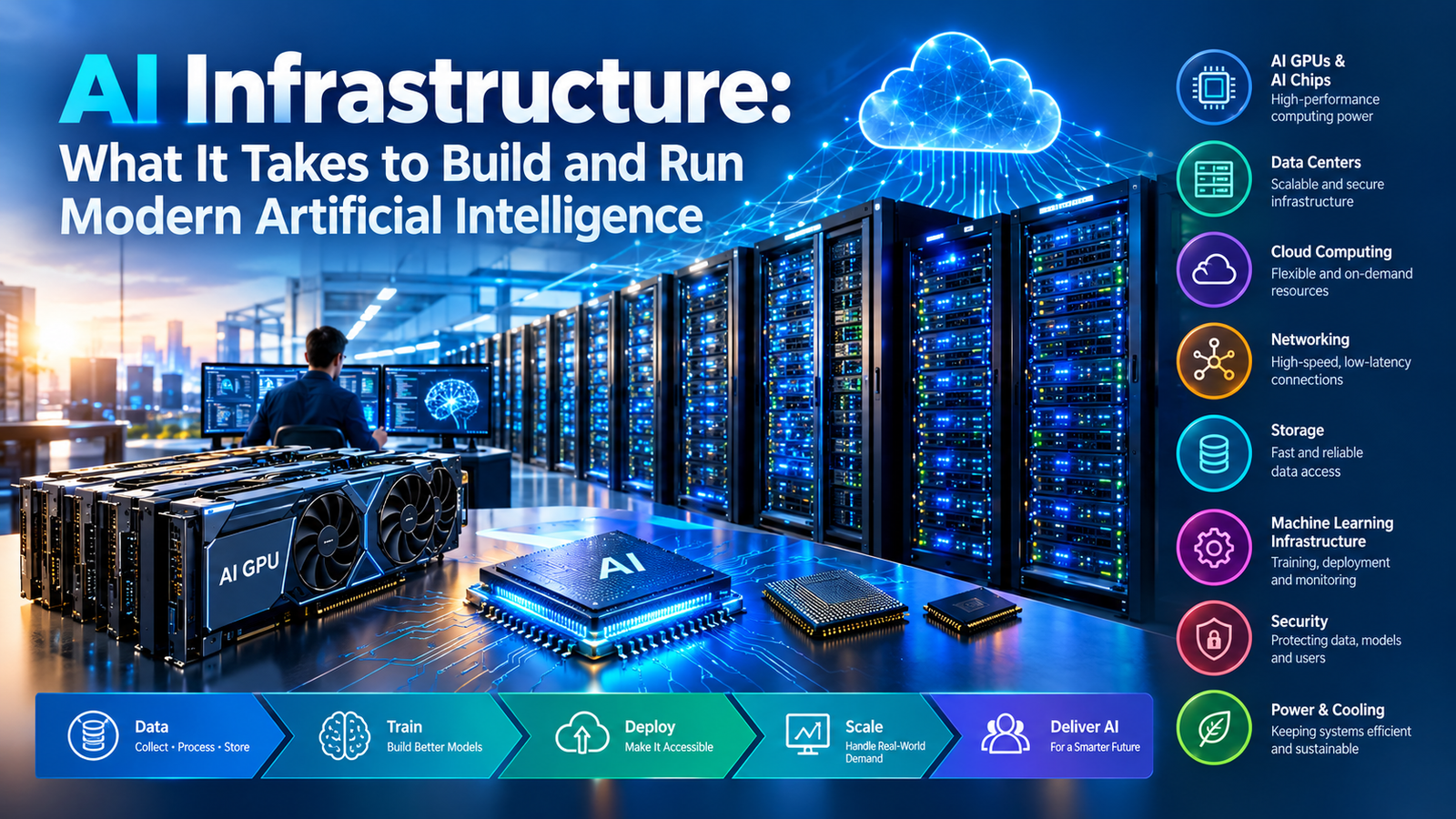
Artificial intelligence has moved beyond research laboratories. Today, AI systems power search engines, recommendation platforms, fraud detection, customer-service tools, medical applications, autonomous machines, productivity software, and generative AI applications used by millions of people.
Behind every one of these systems is AI infrastructure, which users rarely see.
AI infrastructure is the combination of computing hardware, data centres, networking, storage, software, cloud platforms, and operational systems required to develop, train, deploy, and operate artificial intelligence models. As AI models become larger and more capable, the infrastructure supporting them has become one of the most important parts of the technology ecosystem.
Training a modern AI model can require enormous computing power. Running that model for millions of users can create a different infrastructure challenge. Companies must consider GPUs, AI chips, high-speed networking, storage, cooling, electricity, security, data pipelines, cloud platforms, and model deployment systems.
The result is a rapidly evolving technology stack designed for the demands of artificial intelligence.
This article explains what AI infrastructure is, how it works, what components it requires, why GPUs and AI chips matter, how AI data centres operate, and what companies need to build and run modern AI systems.
What Is AI Infrastructure?
AI infrastructure refers to the hardware and software systems that provide the computing resources necessary to build, train, deploy, and operate artificial intelligence applications.
Traditional software can often run on general-purpose CPUs and conventional cloud infrastructure. AI workloads, however, can require substantially different resources. Training large machine learning models involves processing enormous datasets and performing billions or even trillions of mathematical operations.
AI infrastructure is designed to handle these workloads efficiently, bridging the gap between general-purpose systems and AI demands.
At a high level, AI infrastructure includes:
- AI computing hardware
- GPUs and specialized AI chips
- CPUs and memory
- High-speed networking
- Data storage
- AI data centres
- Cloud computing platforms
- Machine learning frameworks
- Data pipelines
- Model training systems
- Model deployment platforms
- Monitoring and security systems
- Power and cooling infrastructure
These components form a technology foundation.
For example, imagine a company building a generative AI assistant. It needs large datasets to train the model, storage systems to hold that data, GPUs to perform training calculations, networking equipment to connect thousands of processors, software frameworks to manage training, and deployment infrastructure to deliver responses to users.
Without the underlying infrastructure, the AI model cannot operate at scale, underscoring why the next section matters.
Why AI Infrastructure Matters
The rapid growth of artificial intelligence has created unprecedented demand for computing resources.
AI models are becoming larger, datasets are expanding, and users expect AI applications to respond almost instantly. These requirements place significant pressure on companies to build efficient infrastructure.
Consider a generative AI application. When a user submits a question, the request must travel through a network to computing infrastructure. The AI model processes the request using specialized hardware, generates an answer, and returns it to the user.
That process may take seconds, but behind it lies a complex collection of servers, accelerators, networking systems, storage technologies, and software.
Strong infrastructure provides several advantages, starting with faster AI development.
Faster AI Development
Researchers and engineers can train and test models more quickly when sufficient computing resources are available.
Better Model Performance
Powerful AI computing infrastructure allows organizations to experiment with larger models, larger datasets, and more complex architectures.
Lower Operating Costs
Efficient hardware and software can reduce the amount of computing power required for each AI task.
Greater Scalability
Infrastructure designed for AI can allow an application to grow from hundreds of users to millions without completely rebuilding the system.
Improved Reliability
Production AI applications need systems that remain available even when hardware fails or demand suddenly increases.
For these reasons, AI infrastructure has become a strategic technology investment rather than simply an IT expense, setting up the components that follow.
The Main Components of AI Infrastructure
Modern artificial intelligence infrastructure consists of multiple layers. Each layer performs a specific function, but they must all work together.
The most important components include computing hardware, storage, networking, data centres, cloud platforms, software, and deployment systems.
1. AI Computing Infrastructure
At the centre of modern AI systems is AI computing infrastructure.
Computing infrastructure provides the processing power needed for machine learning operations. Depending on the workload, organizations can use CPUs, GPUs, TPUs, or other specialized accelerators.
Traditional CPUs remain important because they handle many general-purpose tasks. However, AI workloads often benefit from processors that can perform many calculations simultaneously.
This is where GPUs and specialized AI accelerators become important.
A modern AI server may contain multiple accelerators working together. Large AI clusters can contain thousands of processors connected through high-speed networking.
The goal is not simply to have powerful individual processors. Rather, the entire system must work efficiently as a unified computing environment.
2. AI GPUs
AI GPUs have become one of the most important components of modern artificial intelligence infrastructure.
GPUs were originally developed primarily for graphics processing. Their architecture, however, makes them highly effective for parallel mathematical operations used in machine learning.
Training neural networks involves performing huge numbers of matrix and tensor calculations. GPUs can execute many of these calculations simultaneously.
This makes them particularly useful for:
- Deep learning
- Large language models
- Computer vision
- Generative AI
- Recommendation systems
- Speech recognition
- Scientific computing
- Robotics
- Multimodal AI
A single GPU can provide substantial computing capability, but large AI models frequently require many GPUs working together.
This creates another infrastructure challenge: efficiently connecting processors.
If thousands of GPUs are available but the network connecting them is too slow, overall performance can suffer.
Therefore, modern AI infrastructure must optimize not only GPU performance but also GPU-to-GPU communication.
3. AI Chips and Specialized Accelerators
GPUs are not the only hardware used for artificial intelligence.
The industry has increasingly developed specialized AI chips designed specifically for machine learning workloads.
These accelerators can be optimized for particular types of AI computation.
Examples of specialized hardware categories include:
- Neural processing units
- Tensor accelerators
- AI inference chips
- Training accelerators
- Edge AI processors
- Custom application-specific processors
Specialized AI hardware is driven by efficiency.
AI applications may require enormous numbers of calculations. A processor designed specifically for these workloads can potentially provide better performance per watt or lower operating costs for certain tasks.
This is particularly important as AI workloads expand.
Data centres cannot simply continue adding computing hardware without considering electricity consumption, physical space, cooling requirements, and operational costs.
Efficient AI chips can therefore play an important role in the future of AI infrastructure.
4. AI Data Centres
AI data centres are facilities designed to house the computing, networking, storage, power, and cooling systems required to operate large-scale AI workloads.
Traditional data centres already require significant electricity and cooling. AI workloads can increase these requirements because modern accelerators can consume substantial amounts of power.
An AI-focused data centre may include:
- High-density GPU servers
- Advanced cooling systems
- High-speed networking
- Large-scale storage
- Backup power
- Power distribution systems
- Physical security
- Environmental monitoring
- Fire protection
- Redundant infrastructure
AI increasingly influences data centre physical design.
Traditional server racks were designed around relatively lower power densities. Modern AI servers can require much more power and produce significantly more heat.
As a result, data-centre operators are exploring advanced cooling technologies, including liquid cooling.
Power: The Hidden Requirement of AI
Computing hardware cannot operate without electricity.
As organizations deploy increasingly large AI clusters, power availability has become a major infrastructure consideration.
An AI data centre requires electricity for:
- Computing hardware
- Networking equipment
- Storage
- Cooling
- Lighting
- Backup systems
- Facility operations
The electricity used by computing hardware eventually becomes heat. Operators must remove that heat to keep operating temperatures safe.
As a result, AI infrastructure creates a direct link between power and cooling, making both essential to operations.
More computing capacity generally means higher energy requirements, so data-centre operators must plan their electrical and cooling systems carefully.
5. Cooling Systems for AI Infrastructure
Cooling is one of the most important physical aspects of AI infrastructure.
High-performance AI processors generate substantial amounts of heat. Conventional air cooling can become less practical as computing density increases.
This has encouraged greater interest in liquid cooling.
Liquid cooling can transfer heat more efficiently than air in certain high-density computing environments.
Potential cooling approaches include:
- Air cooling
- Direct-to-chip liquid cooling
- Immersion cooling
- Hybrid cooling systems
The choice depends on the hardware, facility design, cost, and operational requirements.
Cooling isn’t merely a technical detail. It directly affects infrastructure efficiency, reliability, and operating costs.
6. High-Speed Networking
A large AI model may be distributed across many processors.
These processors must communicate with each other during training and sometimes during inference.
This makes networking extremely important.
An AI cluster can contain thousands of accelerators. If communication between them becomes a bottleneck, expensive computing resources may remain underutilized.
AI infrastructure therefore relies on high-performance networking technologies designed for:
- Low latency
- High bandwidth
- Large-scale communication
- Efficient data transfer
- Reliable cluster operation
Networking becomes particularly important when training distributed models.
Imagine splitting a model across hundreds or thousands of GPUs. Those GPUs need to exchange information continuously. The faster and more efficiently they communicate, the more effectively the cluster operates.
7. Data Storage
AI systems require enormous quantities of data.
Training datasets can include:
- Text
- Images
- Video
- Audio
- Sensor information
- Business records
- Scientific data
- User-generated content
This data needs to be stored and accessed efficiently.
AI storage infrastructure can include:
- High-performance SSDs
- Hard drives
- Object storage
- Distributed file systems
- Cloud storage
- Data warehouses
- Data lakes
Storage performance can affect AI training.
If GPUs process data faster than the storage system can deliver it, expensive computing resources may sit idle while waiting for data.
Therefore, AI infrastructure must consider the entire data pipeline, not just processors.
8. Machine Learning Infrastructure
Machine learning infrastructure provides the software and systems needed to develop and operate machine learning models.
This infrastructure can include:
- Data preprocessing systems
- Training frameworks
- Experiment tracking
- Model repositories
- Feature stores
- Workflow orchestration
- Model evaluation
- Deployment platforms
- Monitoring systems
Machine learning development is rarely a single-step process.
A typical workflow may look like:
Data → Cleaning → Training → Evaluation → Optimization → Deployment → Monitoring
Each stage requires infrastructure.
For example, engineers may train several model versions and compare their performance. They need systems to track experiments, datasets, parameters, and results.
As organizations move from experimental AI projects to production applications, machine learning infrastructure becomes increasingly important.
9. Cloud AI Infrastructure
Cloud platforms have made AI infrastructure accessible to organizations that do not want to build their own data centres.
With cloud AI infrastructure, companies can rent computing resources rather than purchasing and operating physical hardware.
Cloud platforms can provide:
- GPU instances
- AI accelerators
- Cloud storage
- Databases
- Networking
- Model training services
- Model deployment
- AI development tools
- Monitoring
- Security services
This can be particularly valuable for startups and smaller organizations.
Instead of investing heavily in physical infrastructure, a company can provision computing resources when needed.
However, cloud AI can become expensive at large scale.
Organizations therefore need to evaluate whether workloads should run entirely in the cloud, on private infrastructure, or through a hybrid approach.
Cloud vs On-Premises AI Infrastructure
Organizations generally have several choices when building AI infrastructure.
Cloud Infrastructure
Cloud platforms offer flexibility and rapid access to computing resources.
Advantages:
- Fast deployment
- Flexible capacity
- No need to operate physical data centres
- Access to specialized hardware
- Pay-as-you-use options
Challenges:
- Potentially high long-term costs
- Vendor dependence
- Data-transfer costs
- Resource availability limitations
On-Premises Infrastructure
Organizations can purchase and operate their own AI servers.
Advantages:
- Greater hardware control
- Potentially lower cost for consistent workloads
- Greater control over data
- Custom infrastructure design
Challenges:
- Large upfront investment
- Hardware maintenance
- Cooling requirements
- Power management
- Infrastructure expertise
Hybrid Infrastructure
Many organizations may combine cloud and private infrastructure.
For example, a company could maintain frequently used AI workloads on dedicated hardware while using cloud resources during periods of high demand.
10. AI Model Training Infrastructure
Training is often the most computationally intensive stage of AI development.
During training, an AI model processes large amounts of data and adjusts its internal parameters to improve performance.
Large models may require distributed training across many processors.
A simplified training workflow looks like:
Dataset → Preprocessing → Distributed Training → Evaluation → Fine-Tuning → Deployment
Infrastructure must coordinate the entire process.
Training systems need to manage:
- GPU allocation
- Data loading
- Checkpoints
- Distributed computation
- Fault recovery
- Experiment tracking
- Model storage
Training can run for extended periods, so reliability matters most.
If a large training job fails after significant progress, organizations may lose valuable computing time unless check-pointing and recovery systems are available.
AI Infrastructure for Generative AI
Generative AI infrastructure has created a new class of computing requirements.
Generative AI systems can produce:
- Text
- Images
- Audio
- Video
- Code
- 3D content
Large generative models can require significant computing resources during both training and inference.
Training is computationally intensive, but inference can become an even larger operational challenge when millions of users access an application.
For example, an AI assistant may receive millions of requests every day.
Each request requires computing resources.
This means companies must optimize:
- Model size
- GPU utilization
- Response latency
- Memory usage
- Batch processing
- Caching
- Quantization
- Routing
- Auto-scaling
Generative AI’s infrastructure requirements therefore extend beyond simply purchasing more GPUs.
AI Model Deployment
Building a model is only part of the process.
Organizations must eventually make the model available to users.
This is known as AI model deployment.
Deployment involves moving a trained model into an environment where it can process real-world requests.
A production AI deployment may require:
- Model servers
- APIs
- Load balancing
- Authentication
- Monitoring
- Auto-scaling
- Logging
- Security
- Version management
The deployment environment must also handle unpredictable demand.
For example, an AI application may normally receive 10,000 requests per hour but suddenly receive 100,000.
The infrastructure needs to scale accordingly.
AI Inference Infrastructure
Inference is the process of using a trained model to generate predictions or responses.
For example:
- A chat-bot generates an answer.
- A fraud-detection model evaluates a transaction.
- A computer-vision system identifies an object.
- A recommendation engine selects content.
Inference can happen in cloud data centres, private servers, or edge devices.
One of the most important goals is reducing inference cost while maintaining acceptable quality.
Companies may use techniques such as:
- Model quantization
- Model compression
- Caching
- Smaller specialized models
- Batching
- Hardware optimization
These techniques can help reduce the computing resources required for each request.
Edge AI Infrastructure
Not every AI workload needs to run in a massive data centre.
Edge AI moves some AI processing closer to where data is generated.
Examples include:
- Smartphones
- Cameras
- Vehicles
- Industrial machines
- Robots
- IoT devices
- Medical equipment
Edge AI can provide several advantages.
Processing data locally can reduce latency and limit the amount of information that needs to be transmitted to a remote server.
This can be useful when immediate decisions are required.
For example, an autonomous machine may need to respond to its environment within milliseconds. Sending every sensor reading to a distant data centre may introduce unnecessary delay.
Edge AI infrastructure therefore represents another important direction in the AI ecosystem.
Security in AI Infrastructure
AI infrastructure must be protected from both traditional cybersecurity threats and AI-specific risks.
Infrastructure security can involve:
- Identity management
- Access controls
- Encryption
- Network security
- Hardware security
- Data protection
- Vulnerability management
- Monitoring
- Incident response
AI systems can process sensitive information, making data security especially important.
Organizations must carefully control access to training datasets, models, APIs, and computing resources.
Infrastructure security should also cover the software supply chain.
AI applications may depend on many frameworks, libraries, APIs, and external services. Vulnerabilities in these components can create security risks.
Data Management and AI Infrastructure
AI models depend heavily on data quality.
A powerful GPU cluster cannot compensate for poor-quality training data.
AI infrastructure therefore includes systems for managing data throughout its life-cycle.
Important processes include:
- Data collection
- Data cleaning
- Data labeling
- Data transformation
- Data validation
- Data storage
- Data governance
- Data versioning
Organizations also need to consider data privacy and regulatory requirements.
For U.S. businesses, requirements vary by industry and the type of information being processed.
Healthcare, finance, government, and other sectors may have particularly important security and compliance considerations.
Observability and Monitoring
Production AI systems need continuous monitoring.
Infrastructure teams need to understand:
- How much computing capacity is being used
- Which models are consuming resources
- How quickly models respond
- Whether error rates are increasing
- How much inference costs
- Whether hardware is functioning correctly
AI monitoring can also track model-related metrics.
For example, organizations may monitor changes in model accuracy or output quality over time.
A model that performed well during development may behave differently when exposed to real-world data.
Infrastructure monitoring helps organizations identify problems before they become major failures.
The Economics of AI Infrastructure
AI infrastructure can be expensive.
Costs can come from many sources:
- GPUs
- AI accelerators
- Servers
- Networking
- Storage
- Data centers
- Electricity
- Cooling
- Cloud computing
- Software
- Engineering staff
- Security
- Maintenance
For companies developing large AI systems, infrastructure can account for a major share of technology spending.
This has created a strong incentive to improve efficiency.
Instead of simply increasing computing capacity, companies are looking for ways to get more useful work from every processor.
GPU utilization, model optimization, energy efficiency, and intelligent workload scheduling have therefore become increasingly important.
Why AI Infrastructure Is Becoming More Complex
AI infrastructure is becoming more complex because AI itself is becoming more complex.
Early machine learning applications could often run on relatively modest systems.
Modern AI may involve:
- Large language models
- Multimodal models
- AI agents
- Robotics
- Computer vision
- Real-time inference
- Generative video
- Scientific AI
- Autonomous systems
These applications create different infrastructure requirements.
A text-based AI assistant may prioritize inference latency and GPU memory.
A robotics system may prioritize real-time processing and edge computing.
A scientific AI application may prioritize large-scale computing and high-performance storage.
No single infrastructure design works perfectly for every AI workload.
AI Infrastructure and AI Agents
AI agents are another emerging workload influencing infrastructure design.
Unlike traditional software, an AI agent may perform multiple steps to complete a task.
For example, an AI agent might:
- Receive a user request.
- Analyze the task.
- Search for information.
- Call an external API.
- Generate code.
- Evaluate the result.
- Perform another action.
Each step can require computing resources.
As organizations deploy more agentic systems, infrastructure must support longer-running workflows, tool usage, memory, model routing, and multiple model calls.
This can increase infrastructure complexity.
Sustainability and AI Infrastructure
As AI computing expands, energy efficiency has become an increasingly important issue.
AI infrastructure consumes electricity through both computing and cooling.
Organizations are therefore exploring ways to reduce environmental impact.
Strategies can include:
- More efficient processors
- Better server utilization
- Advanced cooling
- Renewable energy
- Workload optimization
- Model compression
- Efficient data-centre design
The goal is not necessarily to reduce AI development, but to make computing more efficient.
A model that delivers the same quality using substantially fewer computing resources can reduce both operational costs and energy consumption.
How Companies Build AI Infrastructure
The exact approach depends on the company’s size, AI workload, budget, and technical requirements.
A startup may begin with cloud AI services.
A larger enterprise might combine cloud services with private GPU servers.
A technology company operating AI applications at enormous scale may build specialized data centres and custom hardware systems.
A simplified process could look like this:
Step 1: Identify the AI Workload
Determine whether the system requires training, inference, or both.
Step 2: Estimate Computing Requirements
Determine CPU, GPU, memory, storage, and networking needs.
Step 3: Select Hardware
Choose appropriate GPUs, AI chips, servers, and networking equipment.
Step 4: Choose the Infrastructure Environment
Decide between cloud, on-premises, or hybrid infrastructure.
Step 5: Build the Data Pipeline
Prepare systems to collect, process, store, and deliver data.
Step 6: Build the Training Environment
Set up frameworks and infrastructure for model training.
Step 7: Create Deployment Systems
Develop APIs, model servers, monitoring, and scaling mechanisms.
Step 8: Secure the Environment
Protect data, models, infrastructure, and user access.
Step 9: Monitor and Optimize
Continuously measure performance and reduce unnecessary resource consumption.
The Future of AI Infrastructure
The future of artificial intelligence will depend heavily on infrastructure advances.
AI models are becoming more capable, but better models alone are not enough.
The technology ecosystem also needs:
- More efficient AI chips
- Faster networking
- Better storage
- Advanced cooling
- More efficient data centres
- Improved cloud platforms
- Better model deployment systems
- Specialized inference hardware
- Edge AI processors
Another important trend is specialization.
Rather than relying on one type of processor for every workload, future infrastructure may use different chips optimized for different tasks.
Training, inference, robotics, edge computing, and scientific workloads may each use specialized hardware.
AI infrastructure is therefore likely to become more heterogeneous.
AI Infrastructure for the U.S. Technology Industry
The United States plays a major role in the global AI ecosystem.
U.S. technology companies are investing heavily in AI computing, cloud platforms, data centres, semiconductor technology, and AI research.
For American businesses, AI infrastructure can become a competitive advantage.
A company with efficient infrastructure can potentially:
- Train models faster
- Launch AI products more quickly
- Reduce inference costs
- Support more users
- Improve reliability
- Experiment with new AI technologies
However, infrastructure investment requires careful planning.
Companies must balance performance with cost, scalability, energy use, security, and long-term flexibility.
Challenges Facing AI Infrastructure
Despite rapid progress, several challenges remain.
Hardware Availability
High-performance AI accelerators can face supply constraints when demand increases rapidly.
Energy Requirements
Large computing clusters require substantial electricity.
Cooling
Higher-density hardware creates additional thermal-management challenges.
Cost
Advanced AI infrastructure can require significant investment.
Networking
Large AI clusters require fast and reliable communication between processors.
Talent
Organizations need engineers who understand cloud computing, distributed systems, machine learning, hardware, networking, and data engineering.
Security
AI systems introduce additional data, model, and infrastructure security concerns.
Scalability
Infrastructure must grow as AI applications gain users.
These challenges mean that successful AI development requires much more than a good algorithm.
AI Infrastructure vs Traditional IT Infrastructure
Traditional IT infrastructure generally focuses on applications, databases, web servers, networking, and general-purpose computing.
AI infrastructure shares many of these components but adds specialized requirements.
| General-purpose CPUs | GPUs and AI accelerators |
| Standard servers | High-density AI servers |
| Conventional storage | High-performance AI storage |
| Standard networking | High-bandwidth cluster networking |
| Traditional applications | Machine learning models |
| Application monitoring | Infrastructure + model monitoring |
| General workloads | Training and inference workloads |
| Standard cooling | Advanced high-density cooling |
The difference is not absolute.
AI infrastructure still relies on many traditional IT technologies. However, the scale and performance requirements can differ dramatically.
What Does It Take to Run Modern AI?
Running modern artificial intelligence requires an entire ecosystem.
At the hardware level, companies need processors, memory, storage, networking, power, and cooling.
At the software level, they need operating systems, machine learning frameworks, data pipelines, orchestration systems, model servers, APIs, monitoring, and security.
At the organizational level, they need engineers, researchers, data scientists, infrastructure specialists, security teams, and operations professionals.
In other words, AI is not simply a model.
It is a complete technology stack.
The model is only one component of a much larger system.
Frequently Asked Questions About AI Infrastructure
What is AI infrastructure?
AI infrastructure is the combination of hardware, software, networking, storage, data centres, cloud platforms, and operational systems required to develop, train, deploy, and operate artificial intelligence applications.
Why do AI systems need GPUs?
GPUs excel at many parallel mathematical operations, making them especially useful for neural-network training and inference.
What are AI chips?
AI chips are specialized processors designed to accelerate artificial intelligence workloads. They can include GPUs, neural processing units, tensor accelerators, and other specialized processors.
What is an AI data centre?
An AI data centre is a facility designed to host the computing, networking, storage, power, and cooling infrastructure required for large-scale AI workloads.
Is cloud infrastructure necessary for AI?
No. AI can run in the cloud, on-premises, at the edge, or in a hybrid environment. The appropriate option depends on the workload, budget, security requirements, and scalability needs.
What is AI model deployment?
AI model deployment is the process of making a trained AI model available in a production environment so that users or applications can interact with it.
Why is cooling important for AI?
High-performance AI hardware generates substantial heat. Effective cooling is necessary to maintain reliability and keep hardware within safe temperature ranges.
What is generative AI infrastructure?
Generative AI infrastructure is the hardware and software environment designed to train and run models that generate text, images, audio, video, code, and other content.
Conclusion
AI infrastructure is the foundation that makes modern artificial intelligence possible.
Behind every chat-bot, recommendation engine, computer-vision application, autonomous machine, and generative AI platform is a complex combination of computing hardware, AI GPUs, specialized AI chips, networking, storage, data centres, cloud services, software, and deployment systems.
As AI models become larger and applications become more sophisticated, infrastructure requirements will continue to evolve.
The future will likely involve increasingly specialized processors, high-speed networking, advanced cooling systems, efficient data centres, edge computing, and smarter software for managing AI workloads.
For businesses, understanding AI infrastructure is becoming just as important as understanding the AI models themselves. The organizations that can build reliable, scalable, secure, and cost-efficient infrastructure will be better positioned to turn artificial intelligence from an experimental technology into practical products and services.
Ultimately, modern AI does not run on algorithms alone. It runs on an infrastructure ecosystem designed to move, store, process, and deliver intelligence at scale.





Leave a Reply