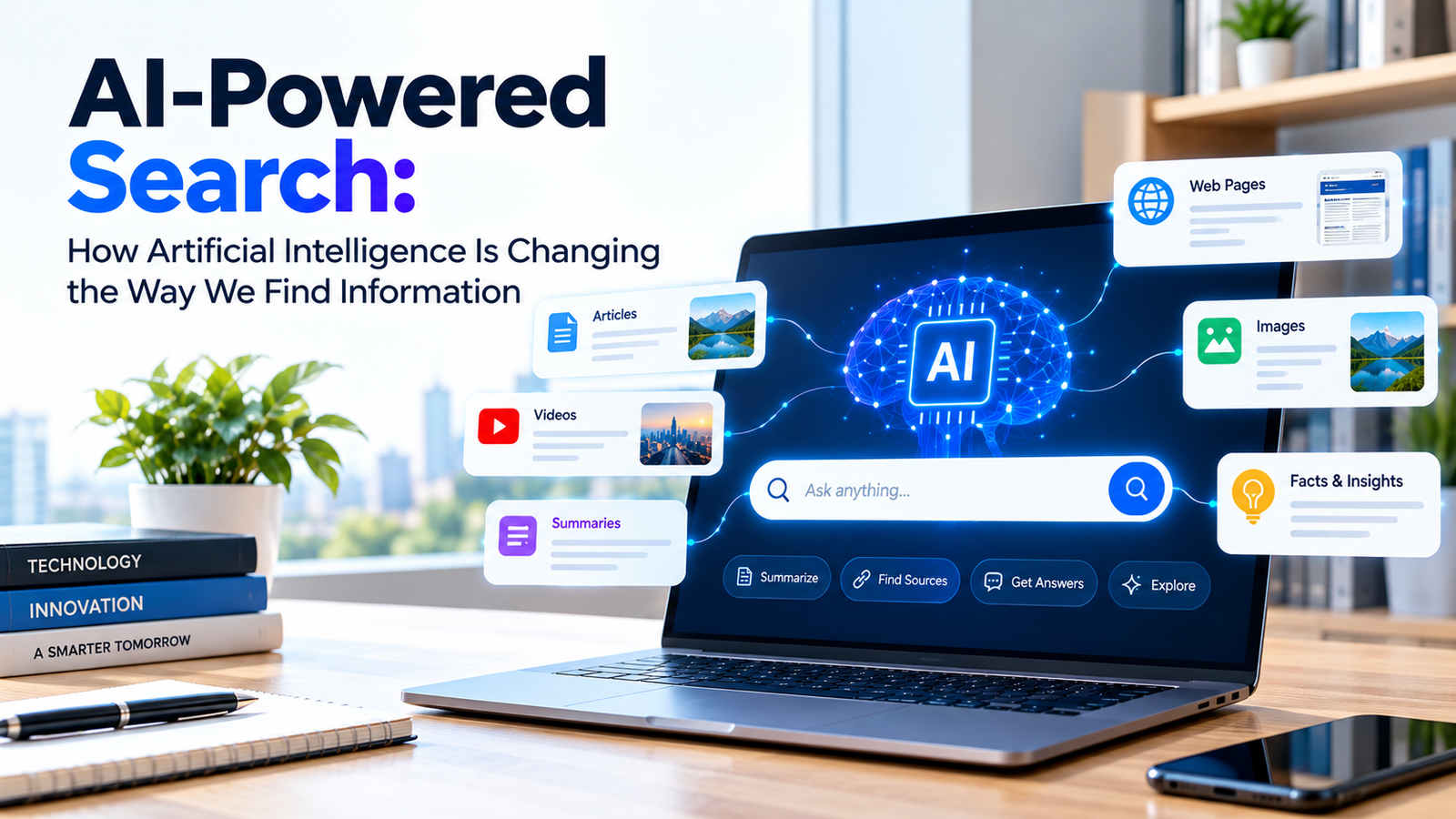
The way people find information online is changing faster than at almost any other time in the internet’s history. For years, search engines worked primarily by matching a user’s words with pages available in a search index and then presenting a list of links. That model is still important, but artificial intelligence is adding a new layer: understanding questions, interpreting context, summarizing information, handling follow-up questions, and helping users explore topics through natural conversation. Together, these changes are making search less about finding links and more about getting direct, useful help.
This shift is driving the growth of ai powered search, which combines web search technology with artificial intelligence to understand what a person is asking and generate a more useful response.
Instead of searching for several short phrases, users can increasingly ask complete questions such as, “What should I consider when choosing health insurance in the United States?” or “Compare these three laptops for programming and explain which specifications matter.” AI search systems can analyze the intent behind the question, retrieve information from multiple sources, organize the results, and present a conversational answer.
Major technology companies are already integrating AI into mainstream search. Google has expanded AI Overviews and AI Mode, while Microsoft offers Copilot Search in Bing. ChatGPT can search the web and provide answers with source citations, and Perplexity describes its product as an answer engine built around web-based research and cited responses.
The change is not simply about making search faster. It is changing how users, search engines, websites, and information interact, and that broader shift is the central story of AI-powered search.
What Is AI-Powered Search?
AI powered search refers to search systems that use artificial intelligence to interpret queries, understand context, retrieve information, summarize results, and sometimes generate a direct response instead of presenting only a traditional list of links.
Traditional search generally requires users to formulate a query and then examine multiple pages to assemble an answer. AI-powered systems, by contrast, attempt to do more of that work within the search experience.
For example, someone searching:
“best ways to reduce energy use in a home during winter”
might previously receive articles about insulation, heating systems, thermostats, windows, and energy bills. An AI search system can potentially combine relevant information from several sources and organize it into categories such as heating efficiency, insulation, smart thermostats, and household habits.
The important difference is that AI can process relationships between words and concepts rather than relying solely on exact keyword matches.
This does not mean traditional search has disappeared. Instead, modern search experiences increasingly combine conventional ranking systems with AI-generated summaries, conversational interfaces, multimodal inputs, recommendations, and links to supporting sources.
For example, Google says its AI Search experiences are designed to help people explore complex questions while still connecting them to websites and original content. Microsoft similarly describes Copilot Search as an experience that provides summarized answers, sources, and suggestions for further exploration.
AI Search vs. Traditional Search
The difference between traditional search and AI search comes down to how much interpretation the search system performs.
Traditional search often follows a relatively familiar pattern:
Query → Search index → Ranked results → User opens websites.
AI-powered search can introduce additional stages:
Question → Intent and context analysis → Search/retrieval → Information processing → Generated response → Sources and follow-up exploration
This second approach can be particularly useful when a question is complicated or requires information from multiple sources.
Consider the difference between these searches:
“New York hiking trails”
and:
“I have one day in New York City and want an easy outdoor activity that is accessible by public transportation. What options should I consider?”
The first is a conventional discovery query. The second, by contrast, contains preferences, constraints, location information, and an implied decision-making task. AI systems are designed to process these additional details.
Google reported in 2026 that people using its AI Mode in the United States were asking longer questions, with the average AI Mode search reported as roughly three times the length of a traditional Search query. Google also reported that more than one in six searches in the U.S. were using voice or images in its analysis of AI Mode usage. These are Google’s own measurements and should be understood as platform-specific data, not a measure of every search engine.
The result is an evolving search behavior in which users can communicate more naturally with search technology, and in which search increasingly serves interpretation as much as retrieval.
How AI-Powered Search Works
Behind an AI-powered search experience are several technologies working together. Although the exact architecture differs between providers, the overall process often includes query understanding, retrieval, ranking, language-model processing, source selection, and response generation.
1. Understanding Search Intent
The first challenge is determining what the user actually wants.
A query such as “Apple stock” could mean:
- the current stock price,
- historical performance,
- financial analysis,
- company news,
- dividend information,
- or an explanation of how to buy shares.
AI systems can use context to determine the most appropriate interpretation.
This is especially important with conversational queries because users do not always phrase them like traditional search keywords.
For example:
“How does it work?”
has little meaning without context.
But after discussing electric vehicles, the same question may clearly refer to regenerative braking or battery systems.
AI search can use previous conversational context to interpret follow-up questions more naturally.
2. Semantic Understanding
Another important technology is semantic search.
Semantic search focuses on the meaning and relationship between words rather than simply matching exact terms. As a result, a search engine can understand that related concepts may satisfy the same information need.
Someone searching “how to make my computer faster” might be interested in solutions involving storage upgrades, memory, software cleanup, startup programs, or hardware limitations, even when a web-page does not contain that exact sentence.
Semantic understanding helps search engines identify relationships between concepts and connect user intent to relevant information.
3. Retrieving Information
For questions that require current information, AI systems can search external sources instead of relying exclusively on a model’s training data.
OpenAI’s current documentation explains that its web-search tools allow models to access up-to-date internet information before generating responses and return results with citations. ChatGPT’s Help Center also advises users to review cited sources because search results can sometimes be incomplete, outdated, or incorrect.
This retrieval step matters because internet information changes constantly.
News, prices, software releases, public policies, product specifications, business details, and other time-sensitive information cannot safely be treated as permanent facts.
4. Processing Multiple Sources
Some AI search systems can analyze information from several sources and organize it into a single response.
This can be useful when research requires comparison.
For example, a user researching solar panels might want to know about:
- installation costs,
- efficiency,
- tax incentives,
- maintenance,
- warranty periods,
- and expected energy production.
Instead of visiting many pages independently, an AI search experience may gather information across sources and present a structured overview.
Google has described a technique used in AI Mode called “query fan-out,” in which a complex question can be broken into multiple related searches across different subtopics before the system combines the results.
5. Generating a Natural-Language Answer
After retrieving and processing information, a generative AI model can turn the results into readable language.
This is one of the biggest differences between conventional and generative AI search.
Instead of only asking, “Which pages are relevant?” the system can also attempt to answer, “What information from those pages helps address this person’s question?”
The response may contain a summary, explanations, tables, comparisons, follow-up questions, or links to sources.
6. Allowing Follow-Up Questions
A major advantage of conversational search is continuity.
Users can ask:
“What are the advantages?”
Then:
“What about the disadvantages?”
Then:
“Which option is better for a small business?”
The search system can retain relevant context, making the research process feel more like a conversation than a sequence of unrelated searches.
Google’s AI Mode is explicitly designed around follow-up exploration, while Microsoft’s Copilot Search supports follow-up questions and suggested topics.
The Rise of AI Search Engines
The growth of AI search engines reflects a broader shift from information retrieval toward information assistance, showing that search is becoming more conversational, more interpretive, and more centered on direct help.
Some services were built around AI-first interfaces, while established search engines are adding generative AI to existing infrastructure.
Google AI Search
Google has integrated AI into its Search experience through features including AI Overviews and AI Mode. In this view, Google says AI Mode is intended for more complex questions, follow-up conversations, and deeper exploration across the web.
In August 2026, Google stated that AI Overviews had more than 2.5 billion monthly active users, while AI Mode had surpassed one billion monthly users. These figures are Google’s own reported platform metrics.
Google is also emphasizing links and access to sources. In 2026, the company announced additional features to help users discover original content, preferred sources, and websites within AI Search experiences.
Microsoft Copilot Search
Microsoft’s Copilot Search in Bing combines web search with AI-generated summaries.
Microsoft describes the service as an AI-powered search-and-answer experience that provides summarized information, cited sources, follow-up topics, and additional links. It is designed for users who want more context than a traditional results page provides.
This approach shows how search engines can preserve the traditional web index while adding an AI interpretation layer on top.
ChatGPT Search
ChatGPT also supports web search, allowing users to ask questions and receive answers informed by current web sources.
According to OpenAI’s Help Center, ChatGPT can search the web for current information and may provide citations and links to relevant sources. OpenAI also cautions users to inspect sources when accuracy matters because search results can contain errors or outdated information.
This represents a broader change: search is no longer limited to dedicated search-engine pages. Conversational AI interfaces can also function as gateways to web information.
Perplexity
Perplexity positions itself as an AI answer engine focused on research, cited answers, and web-based information retrieval. Its platform describes an approach that combines AI with web-first research and citations.
Together, these services illustrate an increasingly competitive AI search landscape.
What Is Conversational Search?
Conversational search allows people to interact with search technology using natural language rather than repeatedly creating isolated keyword queries.
These approaches feel more like speaking with a research assistant.
A conventional search session might look like:
“best laptops for students”
followed by:
“best laptops under $800”
followed by:
“best battery life laptop”
A conversational search session might begin with:
“I need a laptop for a U.S. college student studying computer science. My budget is around $800, and battery life is important.”
The user can then continue:
“Compare the top options.”
Then:
“Which one is easiest to upgrade?”
The context makes the research process more efficient.
Conversational search is especially valuable for complicated tasks where the first query rarely contains every requirement.
What Is Generative AI Search?
Generative AI search combines information retrieval with generative models that can create a response based on retrieved information.
This distinction matters because the system is not simply displaying information that already exists in the same format.
It may synthesize several pieces of information into a new explanation.
For example, an AI system might retrieve information about cloud computing from several sources and then explain:
- what cloud computing is,
- how businesses use it,
- common deployment models,
- potential advantages,
- limitations,
- and examples.
The generated explanation is new text, but ideally it is grounded in the underlying information sources.
This is why citations are becoming increasingly important in AI search. A generated answer can sound confident, but users still need a practical way to verify important claims.
Benefits of AI-Powered Search
The growing interest in AI-powered search comes from several practical advantages.
Faster Research
AI can summarize information, so users don’t have to open numerous pages to understand the basics.
For straightforward questions, this can significantly reduce the time required to reach an initial understanding.
Better Handling of Complex Questions
Traditional keyword searches can become inefficient when a question includes many conditions.
AI systems can process multiple constraints within a single prompt.
For example:
“Find a lightweight laptop suitable for programming, with at least 16GB RAM, strong battery life, and a price below $1,000.”
This query contains several requirements that can be interpreted together.
More Natural Interaction
People generally communicate through sentences rather than keywords.
AI-powered interfaces allow users to search in a way that feels closer to normal conversation.
This can make search easier for beginners and people who do not know the correct technical terminology.
Personalized Exploration
Conversational systems can adapt their explanations according to the user’s follow-up questions.
A beginner can ask for a simple explanation, while an experienced user can ask for technical details.
Multimodal Search
Modern AI systems are moving beyond text.
Users can increasingly combine text with images, files, voice, and other inputs.
This creates new search scenarios.
Someone could upload a picture of a computer component and ask:
“What is this part, and what is it used for?”
A student could upload a document and ask for key concepts.
A traveler could upload a photo and ask about a landmark.
This represents a significant expansion of what search can mean.
How AI Search Is Changing the Way People Find Information
The impact of AI search is not limited to search-engine interfaces. It changes how people formulate questions, evaluate answers, and move through the research process.
From Keywords to Questions
Traditional search taught users to think in short phrases.
AI encourages users to express the complete information need.
Instead of:
“best home office setup”
users can explain:
“I work from home eight hours a day and have limited space. What should I prioritize when building a comfortable home office?”
More contextual questions may produce a more useful starting point.
From Link Lists to Summaries
Search results pages traditionally required users to select several links and combine information themselves.
AI-generated summaries can provide an initial synthesis.
That can be helpful for discovery, although it should not eliminate source checking.
From One Search to an Interactive Session
Search is increasingly becoming iterative.
Users ask an initial question, inspect an answer, identify what they still need, and continue with follow-up queries.
This creates a more dynamic research process.
From Text-Only to Multimodal Discovery
AI systems are making search less dependent on typed words.
Voice and image-based queries can help users search using information that would be difficult to describe manually.
Google reported that image and voice usage represented more than one in six searches in its 2026 U.S. analysis of AI Mode.
AI-Powered Search and the Future of SEO
AI search growth is also changing the online publishing industry.
For years, SEO focused heavily on helping pages rank for specific keywords in traditional search results.
Keywords remain important, but website owners increasingly need to think about whether their content can be understood, trusted, cited, and surfaced within AI-generated experiences.
Content Quality Matters More
Search systems need useful information to generate useful answers.
Thin pages created mainly to target keywords may provide less value than detailed content that genuinely explains a topic.
For publishers, this creates an opportunity to focus on:
- original research,
- firsthand experience,
- accurate explanations,
- clear organization,
- useful examples,
- trustworthy references,
- and strong topical coverage.
Search Visibility Is Becoming More Complex
A website can appear in traditional search results without being directly presented in an AI-generated response.
This introduces a new layer of visibility.
A publisher may therefore care about both traditional rankings and the possibility of being cited or referenced within AI search experiences.
Google has acknowledged this changing environment and announced new Search Console resources and controls intended to help website owners understand how generative AI in Search affects their content.
Long-Form and Structured Content
AI search does not necessarily make long-form content irrelevant.
In many cases, detailed content can provide more useful information for complex questions.
However, length alone is not enough.
A 4,000-word article filled with repetition is unlikely to be more useful simply because it is longer.
Strong structure, factual accuracy, direct answers, clear headings, examples, and original insights are more valuable than unnecessary word count.
How Businesses Can Adapt to AI Search
Businesses are also adjusting their digital strategies.
To appear in search results, a company needs to think beyond basic keyword placement.
Its online presence should clearly communicate:
- what the company does,
- who it serves,
- where it operates,
- what products or services it provides,
- and why customers should trust the information.
Accurate business information becomes especially important when AI systems summarize websites.
Businesses should also keep information consistent across their website and key online profiles.
Build Content Around Real Customer Questions
One useful strategy is to create content that answers questions customers genuinely ask.
Instead of writing only:
“Cloud Computing Services”
a company could publish:
“What Is Cloud Computing and Which Cloud Model Is Right for a Small Business?”
The second approach provides significantly more context and can address a broader range of search intent.
Demonstrate Firsthand Expertise
AI systems can generate general explanations easily.
Human expertise therefore becomes a more valuable differentiator.
Case studies, original research, expert interviews, proprietary data, demonstrations, and firsthand experiences can make a website more distinctive.
Limitations and Risks of AI Search
Despite its advantages, AI-powered search has important limitations.
The most obvious is that artificial intelligence can produce inaccurate information.
An AI system may misunderstand a question, retrieve weak sources, combine conflicting information incorrectly, or generate a statement that sounds plausible but is not supported.
That is why users should not treat an AI-generated response as automatically correct.
OpenAI explicitly notes that search results and citations can sometimes be incomplete, outdated, or incorrect and recommends opening cited sources when accuracy matters.
Hallucinations
A hallucination occurs when an AI model produces unsupported or incorrect information.
This is particularly dangerous in areas where small errors can have serious consequences.
Medical, legal, financial, and safety-related questions require additional care and should be checked against authoritative sources and qualified professionals.
Source Quality
Citations do not automatically make an answer reliable.
A response could cite a web-page that is outdated, biased, poorly researched, or incorrect.
Users need to evaluate the quality of the underlying source.
Privacy
Search engines and AI services may process the information users provide.
This means users should be cautious about entering confidential business information, private documents, passwords, personal financial information, or other sensitive data into services without understanding their privacy practices.
Over-reliance on Summaries
AI-generated summaries can be convenient, but summaries remove context.
The source may contain qualifications, exceptions, methodology, or evidence that does not appear in a short AI response.
For important decisions, the summary should be treated as a starting point rather than the final authority.
How to Use AI Search More Effectively
Users can improve the quality of AI search results by writing better questions.
Be Specific
Instead of asking:
“What is cybersecurity?”
try:
“Explain cybersecurity for a beginner and give five practical examples of how small U.S. businesses can protect themselves.”
The second query provides context and a desired output.
Add Constraints
Tell the system what matters to you.
For example:
“Compare these options based on price, performance, battery life, and long-term value.”
Specific criteria can make comparisons more useful.
Ask for Sources
When researching factual topics, ask for credible sources and review them.
AI search products increasingly make source links part of the response experience. Microsoft says Copilot Search displays sources used to generate its answers, while OpenAI documents citations as part of web-search responses.
Ask Follow-Up Questions
Do not assume that your first query has to contain everything.
Start broad, then narrow the research.
For example:
“What are the major causes of climate change?”
Then:
“Which causes are primarily associated with energy production?”
Then:
“Show me credible sources for those claims.”
This creates a research conversation rather than a single search.
AI Search and Information Trust
One of the biggest questions surrounding the future of search is not simply how quickly information can be found, but how confidently it can be trusted.
The internet contains high-quality journalism, academic research, government publications, expert guidance, user-generated content, marketing pages, outdated articles, misinformation, and duplicated material.
An AI search engine must decide what information is relevant and how to represent it.
This makes source transparency increasingly important.
A good AI search experience should help users understand:
- Where the information came from.
- Whether sources agree or disagree.
- How current the information is.
- Which claims require additional verification.
- Where users can read the original material.
Google’s recent AI Search updates have emphasized connections to original content, links, and source discovery, reflecting the importance of keeping users connected to the wider web rather than treating an AI answer as the only destination.
The Future of Search
The future of search is likely to be more conversational, contextual, multimodal, and action-oriented.
Search may increasingly move from:
“Find information for me”
toward:
“Understand my goal and help me make progress.”
That does not necessarily mean traditional search results will disappear.
Instead, future search experiences may blend several interfaces:
- traditional web links,
- AI-generated summaries,
- conversational dialogue,
- visual search,
- voice interaction,
- personalized recommendations,
- maps and local information,
- shopping information,
- and direct actions.
Google’s 2026 Search updates show this direction clearly. The company has described efforts to combine AI Overviews and AI Mode into a more seamless AI Search experience while continuing to provide links to the web.
Search could also become increasingly proactive.
Imagine researching a new computer. Instead of searching individually for specifications, reviews, compatibility, prices, accessories, and setup instructions, an AI assistant could organize the entire research journey around your requirements.
The search interface would become less like a box where you type keywords and more like an intelligent research workspace.
Will AI Replace Traditional Search Engines?
AI is transforming traditional search, but “replacement” is more complicated than it sounds.
Search engines do more than generate answers. They index enormous amounts of web content, rank pages, provide navigation, support local discovery, surface images and videos, connect users with businesses, and provide specialized results.
AI adds reasoning, summarization, and conversation to this infrastructure.
The most likely direction is therefore not a simple choice between search engines and AI.
Instead, the two technologies are becoming increasingly integrated.
Traditional search remains useful when a user wants to browse websites, find a particular page, compare sources independently, or explore many results.
AI search becomes especially useful when users want an explanation, synthesis, comparison, or conversational exploration.
The best search experience may ultimately combine both approaches.
What AI-Powered Search Means for the Web
The growth of AI-powered search creates both opportunities and challenges for website publishers.
On one side, AI search can introduce users to content more efficiently and potentially send qualified visitors to highly relevant sources.
Google has said it is developing AI Search features that continue to connect users with websites, original reporting, creators, and other online sources.
On the other side, publishers need to understand how a world of generated summaries affects website traffic, brand visibility, and content strategy.
This makes original information increasingly important.
If dozens of websites repeat the same generic explanation, an AI system or a reader has little reason to prefer one over another.
A publisher can stand out by contributing something difficult to reproduce: expertise, experiments, data, firsthand experience, expert commentary, original reporting, or a particularly clear explanation.
AI Search for Students, Professionals, and Everyday Users
AI search applies to almost every information-intensive activity.
Students can use it to understand difficult concepts, explore research topics, generate study questions, and identify useful sources.
Professionals can use it for market research, technical investigation, competitive research, software documentation, and idea generation.
Consumers can use it to compare products, understand specifications, plan trips, research services, and learn about unfamiliar topics.
Researchers can use AI search to accelerate discovery, although important claims still require examination of original papers, official documents, and authoritative references.
For everyday users, the biggest advantage may be reducing the friction between having a question and knowing where to begin.
AI-Powered Search: What Comes Next?
AI-powered search is still developing.
Models are becoming better at reasoning across multiple sources, understanding images and files, interpreting longer prompts, and maintaining conversational context.
Search interfaces are also becoming more multimodal.
The result is a broader definition of search.
A user may no longer need to decide whether something should be called a “search query.”
They might upload a document, show an image, describe a situation through voice, or explain a goal in ordinary language.
The AI system can then determine what information is needed and how to retrieve it.
Google has reported substantial growth in AI Mode usage and has described AI Search as changing not only how people search but also the types of questions they are comfortable asking.
That may ultimately be the most important development.
The future of search is not only about machines becoming better at finding information. It is about making information discovery more aligned with how people naturally think, ask questions, compare ideas, and solve problems.
Frequently Asked Questions About AI-Powered Search
What is AI-powered search?
AI-powered search uses artificial intelligence to understand user intent, retrieve relevant information, analyze sources, summarize content, and generate responses. Depending on the service, it may also support conversations, images, voice, and follow-up questions.
What is the difference between AI search and traditional search?
Traditional search generally presents ranked links and other search results. AI search can add generated summaries, contextual explanations, conversational follow-ups, and information synthesis while still providing links to sources.
What are AI search engines?
AI search engines are search products that use artificial intelligence as an important part of the search experience. Examples include Google Search’s AI features, Microsoft Copilot Search in Bing, ChatGPT with web search, and AI-focused research products such as Perplexity.
What is semantic search?
Semantic search focuses on the meaning and relationships behind a query instead of relying only on exact keyword matches. It helps systems understand related concepts and user intent.
What is generative AI search?
Generative AI search combines information retrieval with generative AI models that can produce natural-language answers based on information gathered from relevant sources.
Is AI search always accurate?
No. AI systems can generate incorrect or incomplete information, and sources can vary in quality and freshness. Important information should be checked against authoritative sources.
How does AI search affect SEO?
AI search adds another layer to search visibility. Beyond traditional rankings, publishers increasingly need content that is useful, well structured, trustworthy, original, and easy for search systems to understand and cite.
Is traditional search going away?
There is no simple indication that traditional search is disappearing. Instead, major search platforms are integrating AI into existing search systems. The two approaches increasingly work together.
Conclusion
AI powered search is changing online information discovery by making search more conversational, contextual, multimodal, and capable of synthesizing information.
Traditional search transformed the internet by making billions of web-pages easier to discover. AI is building on that foundation by helping users ask more natural questions and understand information without manually opening and comparing every result.
The rise of AI search engines, AI-powered search engines, artificial intelligence search, generative AI search, conversational search, and semantic search represents a broader shift in how humans interact with digital information.
For users, the benefits include faster research, more natural questions, better handling of complex topics, and easier follow-up exploration. For businesses and publishers, the transition creates new opportunities while also demanding greater attention to quality, originality, expertise, and source credibility.
AI will not make the need for reliable information disappear. In many ways, it makes information quality even more important.
The next generation of search will likely combine the strengths of traditional web discovery with the reasoning and conversational capabilities of artificial intelligence. The search box may still exist, but the experience around it is becoming far more intelligent.
As AI continues to reshape how people discover, understand, and use information, one thing is becoming clear: the future of search is moving from simply finding pages toward helping people make sense of the information behind them.





Leave a Reply