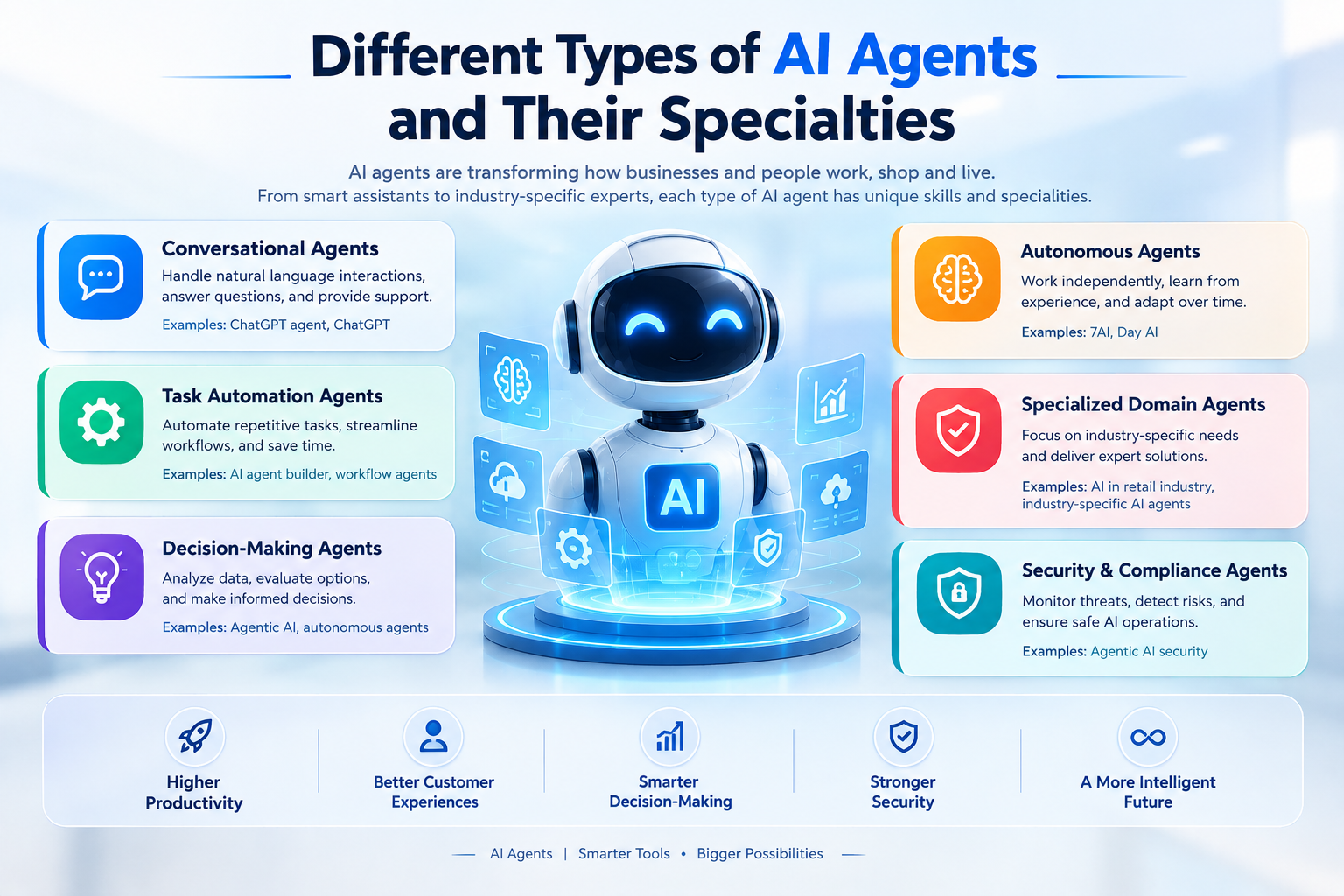
Artificial intelligence is moving beyond simple question-and-answer chat-bots. In 2026, AI systems are increasingly being designed to understand goals, plan multiple steps, use digital tools, access information, and complete actions with less human intervention. This shift has made AI agents one of the most important developments in modern technology.
For individuals and businesses in the United States, AI agents can support everything from research and software development to cybersecurity, customer service, sales, shopping, and retail operations. Instead of simply generating a response, an AI agent can often decide what to do next, select the right tools, and work through a task.
However, not every AI model is an AI agent. A chat-bot, an image-generation model, an AI assistant, and a fully autonomous agent can have very different capabilities.
This guide explains the types of AI agents, how they work, what makes them different, and where each type is useful. It also explores popular agent systems and platforms, including ChatGPT agent, Claude, Day AI, 7AI, Microsoft Copilot Studio, and Amazon Bedrock. It then looks at how to create an AI agent, AI agent development services, and the growing importance of agentic AI security.
What Is an AI Agent?
An AI agent is a software system that can pursue a defined objective by interpreting information, reasoning about what to do, using available tools, and taking actions. Modern agents commonly use large language models as their reasoning engine, but an agent is more than a language model alone.
IBM describes AI agents as systems that can autonomously perform tasks by designing workflows and using available tools. In practical terms, this means an agent can break down a larger objective into smaller steps, interact with APIs or applications, obtain additional information, and adjust its actions based on what happens during execution.
For example, a traditional chat-bot might answer:
“What are some good laptops for video editing?”
An AI agent could go further. It might research current products, compare specifications, check prices, organize the findings, and create a report according to the user’s budget and requirements.
That difference between generating information and performing a workflow is central to understanding agentic AI.
AI Model vs AI Assistant vs AI Agent
People often use the terms AI model, AI assistant, and AI agent interchangeably, but they are not identical. Each serves a different role.
An AI model is the underlying technology that processes information and generates outputs. Examples include large language models and multi-modal models.
An AI assistant usually interacts with a person through a conversational interface. It may answer questions, summarize information, write content, or help with everyday tasks, but it does not always pursue a multi-step objective.
An AI agent is generally designed to pursue a goal through multiple actions. It may use tools, maintain state or memory, call external systems, and determine the next step without requiring the user to direct every action manually.
The boundaries are becoming less clear because modern AI assistants increasingly include agentic features. A single product may provide standard chat in one situation and agent-style execution in another, but the roles remain distinct.
Understanding the Main Types of AI Agents
Several ways to classify AI agents exist. A classic AI framework identifies five major categories: simple reflex agents, model-based reflex agents, goal-based agents, utility-based agents, and learning agents. These categories describe how an agent makes decisions and adapts to its environment.
Modern generative AI systems add another practical layer of classification. Today, businesses often describe agents by specialty, such as research agents, coding agents, customer-service agents, cybersecurity agents, sales agents, and workflow agents.
Both perspectives are useful, and this section begins with classic decision-making categories.
1. Simple Reflex Agents
Simple reflex agents operate according to predefined rules. They examine the current situation and respond with a corresponding action.
A basic example is an automated system that follows a rule such as:
“If inventory falls below a certain level, create a replenishment alert.”
These agents typically don’t need sophisticated planning. They are valuable because they are predictable, fast, and relatively easy to manage.
Simple reflex systems remain useful for highly structured environments where the rules are clear, and the number of possible situations is limited.
Examples include:
- Basic automation systems
- Temperature controls
- Simple customer-routing systems
- Rule-based alerts
- Industrial automation
They are less suitable when a task requires open-ended reasoning or changing objectives.
2. Model-Based Reflex Agents
Model-based agents maintain an internal representation of their environment. Instead of reacting only to what is happening right now, they use information about previous states.
This allows them to function in environments where not everything is directly visible.
For example, an automated logistics system might track:
- Current inventory
- Previously shipped orders
- Supplier information
- Delivery status
- Warehouse conditions
The agent can use this information to decide what action makes sense next.
The major advantage is context. The agent does not treat every event as completely separate from what came before.
3. Goal-Based Agents
Goal-based agents are designed around a desired outcome.
Instead of simply reacting to a condition, the agent asks:
“What actions will help me achieve the goal?”
Suppose a user asks an AI system to prepare a market research report. A goal-based agent may determine that it needs to:
- Understand the requested market.
- Find relevant sources.
- Collect current information.
- Compare companies or products.
- Organize the results.
- Prepare the final report.
The agent is not just responding to individual prompts. It is working toward an objective.
This approach is particularly useful for research, planning, scheduling, customer support, and business automation.
4. Utility-Based Agents
Utility-based agents go a step further. They do not simply ask whether an action achieves the goal. They consider which available outcome provides the greatest overall value according to defined criteria.
For instance, an e-commerce agent might need to select a shipping method. Several options could reach the customer, but the agent may consider:
- Cost
- Delivery time
- Customer priority
- Inventory location
- Service availability
A utility-based system can evaluate the trade-offs instead of selecting any solution that technically works.
This type of reasoning becomes particularly useful when businesses have multiple objectives.
5. Learning Agents
Learning agents improve their behavior from experience, feedback, or additional data.
A learning agent may observe which actions worked successfully, which produced errors, and which outcomes users preferred. It can then use that information to improve future decisions.
Learning capabilities can be important in environments where conditions change frequently.
Examples include:
- Recommendation systems
- Adaptive customer-service systems
- Robotics
- Fraud detection
- Personalized digital assistants
IBM notes that learning agents are distinctive because they can incorporate new experiences into their knowledge and improve their operation over time.
Modern Types of AI Agents by Specialty
The traditional five categories explain how agents make decisions. For today’s businesses, another question matters: What is the agent designed to do? This shift leads to the practical types of AI agents people encounter in modern software.
This practical view leads to the types of AI agents people encounter in modern software.
Research and Web-Browsing Agents
Research agents gather, analyze, organize, and synthesize information.
A conventional chat-bot may answer from its existing knowledge or from information the user supplies. A research agent can potentially search multiple sources, evaluate information, collect evidence, and produce a structured result.
Research agents are useful for:
- Competitive research
- Market research
- Product comparisons
- Academic research
- Business intelligence
- News monitoring
- Industry analysis
This agent type adds value by turning a broad request into a multi-step research workflow.
Coding and Software Development Agents
Coding agents focus on software engineering tasks.
A coding agent can assist with:
- Writing code
- Understanding large code-bases
- Debugging
- Creating tests
- Reviewing changes
- Refactoring
- Running development tools
- Working through multi-step engineering tasks
Anthropic has described increasingly capable computer-use and coding workflows for Claude, including systems that interact with live applications and work across complex software tasks. In February 2026, Anthropic said it was advancing Claude’s computer-use capabilities through its acquisition of Vercept.
Coding agents are therefore a major category of specialized AI agents, not simply another form of auto-complete.
Customer Service Agents
Customer service agents are designed to resolve customer questions and perform support workflows.
A basic chat-bot might answer:
“What is your return policy?”
A more capable service agent could potentially:
- Find the customer’s order.
- Identify the issue
- Check company policies
- Create a return request.
- Update the support record.
- Escalate unusual cases to a human.
This ability to interact with business systems is what makes agentic customer service different from simple conversational automation.
Sales Agents
Sales agents can support revenue teams by processing information from customer interactions and business systems.
Potential tasks include:
- Lead qualification
- Account research
- Meeting preparation
- Follow-up reminders
- CRM updates
- Proposal assistance
- Pipeline monitoring
- Sales research
This is one area where persistent context can be particularly valuable because sales decisions often depend on information spread across emails, meetings, documents, and CRM records.
Marketing Agents
Marketing agents can assist with repetitive and research-heavy work, including:
- Market research
- Content planning
- Competitive analysis
- Audience research
- Campaign preparation
- Reporting
- Lead segmentation
- SEO research
Rather than producing one piece of content, an agent may help coordinate multiple stages of a campaign.
Human review remains important for brand voice, factual accuracy, compliance, and final publishing decisions.
Cybersecurity Agents
Cybersecurity is becoming one of the most important specialized applications of AI agents.
A security agent can help monitor alerts, investigate suspicious activity, correlate information, prioritize incidents, and support response workflows.
One example is 7AI, which describes its product as an agentic security platform designed to automate repetitive security operations work. The company says its agents help security teams process and triage alerts and reduce repetitive analyst workload.
This illustrates an important principle:
A specialized agent does not need to be a general-purpose chat-bot. It can be designed for a narrowly defined, high-value operational task.
AI Agents for Retail
The retail industry is another area where agentic systems can coordinate several business processes.
Retail operations involve many connected activities:
- Inventory
- Pricing
- Demand forecasting
- Customer experience
- Product recommendations
- Fulfillment
- Merchandising
- Marketing
Agentic AI can connect these processes so that an event in one area can trigger an appropriate workflow in another.
For example, if demand for a product suddenly increases, an agentic retail system could identify the demand signal, examine inventory, evaluate replenishment options, and route an action for approval.
Info describes agentic AI in retail as a coordinated approach in which agents can work across merchandising, inventory, pricing, and fulfillment while keeping people involved in important decisions.
This is a major distinction between predictive AI and agentic AI.
Predictive AI may tell a retailer:
“Demand is likely to increase.”
Agentic AI may help answer:
“What should the organization do about that increase?”
Personal Productivity Agents
Personal productivity agents help people manage information and routine work.
Examples include:
- Scheduling
- Email organization
- Meeting preparation
- Personal research
- Document creation
- Task tracking
- Travel planning
- Reminders
These agents are increasingly moving beyond chat interfaces and into software environments where they can interact with applications.
Enterprise Workflow Agents
Enterprise workflow agents are designed to operate inside business environments.
They may connect:
- CRM systems
- ERP systems
- Databases
- Cloud services
- Internal knowledge bases
- Project management tools
- APIs
The objective is usually not simply to answer questions but to execute repeatable business processes.
Microsoft describes autonomous agents in Copilot Studio as systems that can perceive events, make decisions, and execute tasks independently using triggers, instructions, and guardrails.
Multi-Agent Systems
Some complex problems are better handled by multiple specialized agents rather than one large general-purpose agent.
Imagine a business system containing:
- A research agent
- A data-analysis agent
- A writing agent
- A compliance agent
- A project-management agent
One coordinating agent could assign sub-tasks to the specialists.
This approach resembles a digital team, with each agent having a specific role.
Amazon’s documentation describes multi-agent collaboration as a setup in which agents can break complex work into sub-tasks and delegate parts of the problem to specialized agents.
Multi-agent systems can be useful when a workflow contains several clearly separated specialties.
What Makes an AI Agent Different From a Chat-bot?
The difference usually comes down to agency.
A chat-bot primarily communicates.
An agent can communicate, reason, plan, use tools, and take action.
Consider this example.
A user asks:
“Find three software vendors that meet our requirements and prepare a comparison.”
A basic chat-bot may generate three names from its knowledge.
A research agent might:
- Identify the requirements.
- Search for suitable vendors.
- Review information from multiple sources.
- Compare features.
- Identify gaps.
- Organize the results.
- Produce a report.
The agent therefore transforms the user’s request into an executable workflow.
This does not mean an agent will always be correct. Agentic systems can still misunderstand instructions, make mistakes, encounter inaccessible information, or take an inappropriate action. Their autonomy increases usefulness, but it also increases the need for controls.
ChatGPT Agent and Agent Mode in ChatGPT
The phrase ChatGPT agent became widely associated with OpenAI’s July 2025 launch of an agentic system that combined conversational reasoning, web interaction, and computer-use capabilities. OpenAI described the system as being able to navigate websites, use tools, run code, perform research, and create deliverables such as spreadsheets and slides.
This is why users often search for phrases such as what is agent mode in ChatGPT or chat gpt agent.
However, the product landscape has continued to change.
As of September 2026, OpenAI’s current help documentation marks the original ChatGPT agent documentation as outdated and points users toward newer agentic experiences, including ChatGPT Work and Workspace agents. The same documentation still describes agent mode capabilities such as multi-step execution, browser workflows, user confirmation, and interruption controls.
For SEO purposes, the phrase “ChatGPT agent” remains useful because it reflects what people search for, but articles should avoid presenting an older product description as if nothing has changed.
Claude as an Agentic AI Tool
Claude has also become an important part of the agent ecosystem.
Anthropic’s computer-use technology allows Claude-based systems to interact with software interfaces and perform sequences of computer actions. Anthropic has also discussed agents that use tools, recover from errors, and operate across multi-step workflows.
In 2026, Anthropic continued expanding its agentic capabilities. Claude Sonnet 4.6, released in February 2026, included improvements in coding, computer use, long-context reasoning, agent planning, and knowledge work.
This makes Claude relevant to categories such as coding agents, computer-use agents, research systems, and specialized business workflows.
Day AI and Context-Aware Business Agents
Day AI represents another approach to AI agents.
Rather than positioning its system purely as a general-purpose chat-bot, Day AI describes itself as a context graph and agent control plane for customer-facing teams. Its platform connects information from tools such as email, meetings, and Slack, providing persistent context that its agents can use.
Day AI’s agents are presented as having defined jobs, skills, triggers, and organizational context. The company also describes skills that can run manually, on schedules, or in response to events.
This model demonstrates how AI agents can become specialized workers inside a business rather than simply digital chat assistants.
7AI and Cybersecurity Agent Specialization
7AI is a highly specialized AI agent platform.
It focuses on security operations rather than general productivity. According to 7AI, its platform processes security alerts and automates repetitive SOC tasks, allowing human analysts to spend more time on judgment-intensive work.
This specialization matters because different industries require different tools, data, permissions, workflows, and safety controls.
A cybersecurity agent should not be designed in the same way as a sales agent.
AI Agent Platforms
An AI agent platform provides the infrastructure to create, deploy, monitor, and manage agents.
Instead of developing everything from the ground up, organizations can use platforms that provide features such as:
- Foundation model access
- Tool calling
- Memory
- APIs
- Data connectors
- Authentication
- Workflow orchestration
- Monitoring
- Security controls
- Evaluation
Amazon is one major example. Amazon Bedrock provides services for building generative AI applications and agents connected to enterprise systems and data. AWS documentation now distinguishes the older Amazon Bedrock Agents service as “Agents Classic” and directs new development toward Amazon Bedrock AgentCore.
AWS also announced Managed Agents powered by OpenAI in limited preview in April 2026, showing how enterprise cloud environments are increasingly becoming deployment layers for agentic systems.
Microsoft Copilot Studio is another example of a platform built around creating business agents and workflows. Microsoft’s 2026 updates emphasize more complex multi-step processes and autonomous agents.
AI Agent Builder Tools
An AI agent builder allows users or developers to create an agent without building every component manually.
Depending on the platform, an agent builder may let you define:
- The agent’s objective
- Instructions
- Personality or behavior
- Available tools
- Knowledge sources
- Triggers
- Permissions
- Human approval points
- Expected outputs
Some builders are designed for developers, while others target business users with low-code or no-code interfaces.
The right choice depends on workflow complexity.
A simple customer FAQ agent may require limited customization.
A financial operations agent might require strict identity controls, audited actions, approvals, data governance, and integration with several enterprise applications.
How to Create an AI Agent
People often search for how to create an AI agent because modern platforms have made agent development much more accessible.
The basic process can be divided into several stages.
Step 1: Define the Goal
Start with a specific problem.
Instead of:
“Build an AI agent for my business.”
Define a measurable objective such as:
“Create an agent that reviews incoming customer requests, identifies their category, finds relevant information, and drafts a response.”
A clear goal reduces unnecessary complexity.
Step 2: Choose the Model
The model provides the reasoning and language capabilities.
Depending on the application, you might select a model optimized for:
- General reasoning
- Coding
- Fast responses
- Long-context tasks
- Multi-modal input
- Cost efficiency
Select the model based on the workflow, not brand popularity alone.
Step 3: Give the Agent Tools
Tools allow the agent to do more than generate text.
Examples include:
- Web search
- Databases
- APIs
- Email systems
- CRM platforms
- Code execution
- File systems
- Business applications
This is one of the most important steps in agent development.
Step 4: Give It Knowledge
An agent may need access to company information that was not included in its original training.
Organizations can connect knowledge bases, documents, databases, or retrieval systems.
Good knowledge architecture improves the likelihood that an agent can ground its actions in current organizational information.
Step 5: Establish Permissions
An agent should not automatically receive unlimited access.
Define exactly what it is allowed to:
- Read
- Write
- Change
- Send
- Delete
- Approve
- Purchase
- Publish
Permissions should correspond to the actual requirements of the workflow.
Step 6: Add Human Approval
High-impact actions should often include human checkpoints.
For example, an agent may draft an email automatically but require approval before sending.
Similarly, a retail agent could recommend a price adjustment while requiring approval for major changes.
Human oversight can create a useful balance between automation and accountability.
Step 7: Test the Agent
Testing should include normal requests, unexpected inputs, incorrect information, incomplete data, malicious instructions, and tool failures.
AI agents can produce errors in unusual situations, so evaluation should happen before deployment and continue after launch.
Anthropic’s 2026 guidance on evaluating agents emphasizes that agent systems are more difficult to evaluate than simple single-response systems because agents operate across multiple turns, tools, state changes, and intermediate actions.
Step 8: Monitor and Improve
After deployment, collect information about:
- Errors
- Successful task completion
- User feedback
- Tool failures
- Security events
- Unexpected actions
- Response quality
- Escalation frequency
Treat an agent as a continuously managed software system rather than a one-time prompt.
AI Agent Development Company vs DIY Development
Companies have two broad options.
They can build an agent internally or hire an AI agent development company.
An experienced development partner may provide:
- AI architecture
- Model selection
- Agent workflow design
- API integration
- Database integration
- Security
- Testing
- Deployment
- Monitoring
- Maintenance
This may be useful for organizations with a clear business process but not enough internal AI engineering expertise.
AI Agent Development Services
AI agent development services can vary greatly in scope.
A provider may offer a simple chat-bot conversion into an agentic workflow, while another may design a complete multi-agent enterprise platform.
Typical services include:
Custom AI Agent Development
A specialized agent is designed for a particular business process.
Multi-Agent Development
Several agents collaborate on a larger workflow.
Enterprise Integration
Agents connect to CRM, ERP, cloud services, databases, and APIs.
AI Automation
Routine processes are redesigned to allow agents to perform approved actions.
Agent Monitoring
Systems track agent behavior, errors, latency, costs, and outcomes.
AI Security and Governance
Controls are implemented to reduce the risk created by autonomous actions.
Agentic AI Security: Why It Matters
As AI agents become more capable, security becomes more complicated.
A normal chat-bot may produce a bad answer.
An agent with system access could potentially perform a bad action.
This creates a significant difference in risk.
Agentic AI security focuses on securing agents that can reason, access data, use tools, and act across digital environments.
Microsoft identifies several security challenges created by agentic systems, including the need for clear identity, strong policies, monitoring, and governance.
Important security controls include:
Least-Privilege Access
Give an agent only the permissions it actually needs.
Identity Management
Every agent should have an understandable identity and access policy.
Audit Logs
Organizations should record important actions so they can determine what happened and why.
Approval Workflows
Sensitive actions should require explicit authorization.
Prompt-Injection Protection
Agents that access external websites and documents can encounter malicious instructions designed to manipulate their behavior.
Anthropic has highlighted prompt injection as an important concern for computer-using AI systems.
Continuous Monitoring
Security teams should monitor agent behavior rather than assuming that an approved agent will always behave as expected.
Recent 2026 research and incidents have reinforced these concerns. Nature Machine Intelligence discussed growing cybersecurity issues surrounding increasingly capable agents, including evaluations where unusual data transfers and other risky behaviors emerged during testing.
Why AI Agents News 2026 Is Focusing on Security
Much of the AI agents news 2026 landscape is moving beyond the question:
“What can AI generate?”
The discussion increasingly involves:
“What can AI safely do?”
Recent developments include stronger computer-use capabilities, more autonomous enterprise workflows, specialized security agents, multi-agent collaboration, cloud deployment, and improved evaluation techniques.
OpenAI’s recent documentation changes, Anthropic’s agent development work, Microsoft’s autonomous Copilot Studio capabilities, Google’s agentic browser features, and AWS’s AgentCore direction all illustrate the same broader trend: AI is increasingly being connected to real software environments rather than remaining limited to text generation.
Are Gemini, Nano Banana, and Other AI Tools AI Agents?
This is an important distinction.
A product may contain both AI models and agentic capabilities.
For example, Google’s Nano Banana is a family of image-generation and editing models built on Gemini. Google describes Nano Banana 2 as a Gemini image model designed for image generation and editing. That means Nano Banana itself should not automatically be categorized as an autonomous AI agent.
At the same time, Google is adding agentic capabilities to products around Gemini. In August 2026, Google described agentic capabilities in Gemini in Chrome that can assist with tasks such as booking parking, updating recurring orders, and organizing travel, with confirmation controls for certain sensitive actions.
This illustrates why an AI article should distinguish between:
AI model → AI assistant → AI tool → AI agent → multi-agent system.
They can overlap, but they are not identical.
What Are the Best AI Agents?
The phrase “best AI agents” is useful for search, but no single agent is ideal for every task.
The appropriate system depends on the job.
For general-purpose work, users may look for agents that can research, reason, browse, and work with documents.
For software development, coding and computer-use capabilities may matter more.
For cybersecurity, specialized SOC automation may matter more.
For enterprise automation, integration’s, permissions, monitoring, and governance may matter more than conversational quality.
For retail, agents that understand inventory, pricing, merchandising, and fulfillment workflows may provide more relevant capabilities.
For sales teams, persistent customer context and CRM integration can be critical.
Therefore, a useful way to evaluate AI agents is by specialty rather than popularity.
How to Choose an AI Agent for a Business
Before selecting an agent, businesses should consider five questions.
What task should the agent perform?
A narrow and measurable task is easier to automate reliably.
What systems must it access?
An agent that cannot access the necessary data or applications may not be useful.
How much autonomy is appropriate?
Some tasks can be fully automated. Others should require human approval.
How will performance be measured?
Define metrics before deployment.
Examples include:
- Completion rate
- Response time
- Error rate
- Cost per task
- Human escalation rate
- Customer satisfaction
What happens when the agent makes a mistake?
A responsible design should include stopping conditions, escalation mechanisms, audit-ability, and recovery procedures.
Benefits of AI Agents
AI agents can provide several potential benefits.
Automation of Repetitive Work
Agents can handle routine processes that otherwise consume employee time.
Faster Workflows
Multi-step tasks can sometimes be completed faster when software automatically handles intermediate steps.
24/7 Availability
Software agents can operate outside normal business hours, subject to system design and monitoring.
Better Access to Information
Agents can connect multiple data sources and present relevant information within a workflow.
Personalized Experiences
Agents can adapt responses and actions to individual users or business situations when appropriate data is available.
Scalable Operations
An organization can potentially deploy many specialized agents across departments without requiring every task to be handled manually.
Limitations of AI Agents
AI agents should not be treated as perfect digital employees.
They have limitations.
They Can Make Incorrect Decisions
Agentic reasoning is not the same as guaranteed accuracy.
They Can Misinterpret Goals
Unclear instructions can produce an incorrect workflow.
They Depend on Tools
A broken API or unavailable website can stop a task.
They Can Encounter Security Threats
External information may contain malicious instructions or unexpected content.
They May Increase Costs
Long-running agent workflows can consume significant computing resources depending on architecture and usage.
They Require Monitoring
The more autonomy an agent receives, the more important monitoring becomes.
The Future of AI Agents in the United States
The United States is likely to remain an important environment for AI agent development because it concentrates technology companies, cloud platforms, software businesses, startups, and enterprise customers.
The major change will not simply be the creation of more chat-bots.
The larger shift is toward software that can understand a goal, decide what needs to happen, use tools, execute actions, and report the result.
Businesses may increasingly use specialized agents for customer service, sales, software development, cybersecurity, finance, operations, research, and retail.
At the same time, organizations will need stronger governance.
As AI agents gain access to more systems, security cannot be treated as an optional feature added at the end. Organizations must consider identity, permissions, audit-ability, evaluation, monitoring, human approval, and recovery mechanisms from the beginning.
Frequently Asked Questions About AI Agents
What are the types of AI agents?
The classic types of AI agents are simple reflex agents, model-based reflex agents, goal-based agents, utility-based agents, and learning agents. In modern business applications, agents are also classified by specialty, including research agents, coding agents, customer service agents, sales agents, cybersecurity agents, retail agents, and workflow agents.
What is agent mode in ChatGPT?
Agent mode refers to an agentic style of ChatGPT use in which the system can plan and execute multi-step tasks using tools and, in relevant environments, computer interaction. OpenAI’s original 2025 ChatGPT agent launch described these capabilities, while current OpenAI documentation points to newer agentic experiences and marks the original launch documentation as outdated.
Is ChatGPT an AI agent?
ChatGPT can provide both standard conversational AI functionality and agentic capabilities, depending on the product experience you use. So it is more accurate to distinguish the ChatGPT assistant from specific agentic modes or products than to treat every ChatGPT interaction as an autonomous agent.
How do I create an AI agent?
To create an AI agent, define a clear goal, choose an appropriate model, give the agent necessary tools and knowledge, configure permissions, add safety controls, test it, and monitor its performance after deployment.
What is an AI agent platform?
An AI agent platform provides tools and infrastructure to build, deploy, integrate, secure, and monitor agents. Examples include Microsoft Copilot Studio and AWS services for agent development and deployment.
What is agentic AI security?
Agentic AI security is the set of security, governance, identity, access control, monitoring, and risk-management practices used to protect autonomous or semi-autonomous AI agents. Microsoft highlights identity, policies, and continuous monitoring as important components of an agentic security approach.
What is 7AI?
7AI is a cybersecurity company that provides an agentic security platform focused on automating security operations tasks such as alert processing and triage.
What is Day AI?
Day AI describes itself as a context graph and agent control plane for customer-facing teams. Its system combines customer context from connected business tools with agents that can perform defined jobs and skills.
Is Nano Banana an AI agent?
Nano Banana is primarily an AI image generation and editing model family from Google, rather than a standalone autonomous agent. Google’s broader Gemini ecosystem can provide agentic capabilities in certain products and environments.
Will AI agents replace human workers?
AI agents are designed to automate tasks and workflows, but their impact will vary by role and industry. In many applications, agents are being developed to augment people by handling repetitive or multi-step work while humans retain responsibility for decisions, approvals, exceptions, and oversight.
Final Thoughts
The evolution from chat-bots to AI agents represents a major change in how people interact with software.
Traditional software waits for instructions.
A chat-bot responds to a question.
An AI agent can potentially take a goal and work through a sequence of actions to achieve it.
That ability makes agents valuable across research, coding, cybersecurity, customer service, sales, marketing, retail, and enterprise operations. Platforms such as Microsoft Copilot Studio and AWS’s evolving agent infrastructure are making it easier for organizations to build and deploy specialized systems. In contrast, products from companies such as OpenAI, Anthropic, Google, Day AI, and 7AI demonstrate different approaches to agentic computing.
The key lesson is that no single definition of an AI agent explains every modern system. Some agents are simple and rule-based. Others can reason, learn, use tools, interact with computers, coordinate with other agents, or operate within complex business environments.
As these systems become more capable, the question will not only be what an agent can do. It will also be what an agent should be allowed to do, what information it can access, how its actions are monitored, and where a human must remain in control.
For businesses and technology users in the United States, understanding these distinctions will make it easier to choose the right AI system for the right job—and to deploy it responsibly as agentic AI continues to evolve.





Leave a Reply