Artificial intelligence has entered a new stage of development.
For years, the biggest AI breakthroughs were tied to increasingly large models trained on enormous amounts of general-purpose data. These systems became capable of writing, coding, answering questions, analyzing information, generating images, and supporting a wide range of tasks from a single platform.
That flexibility changed how people think about artificial intelligence.
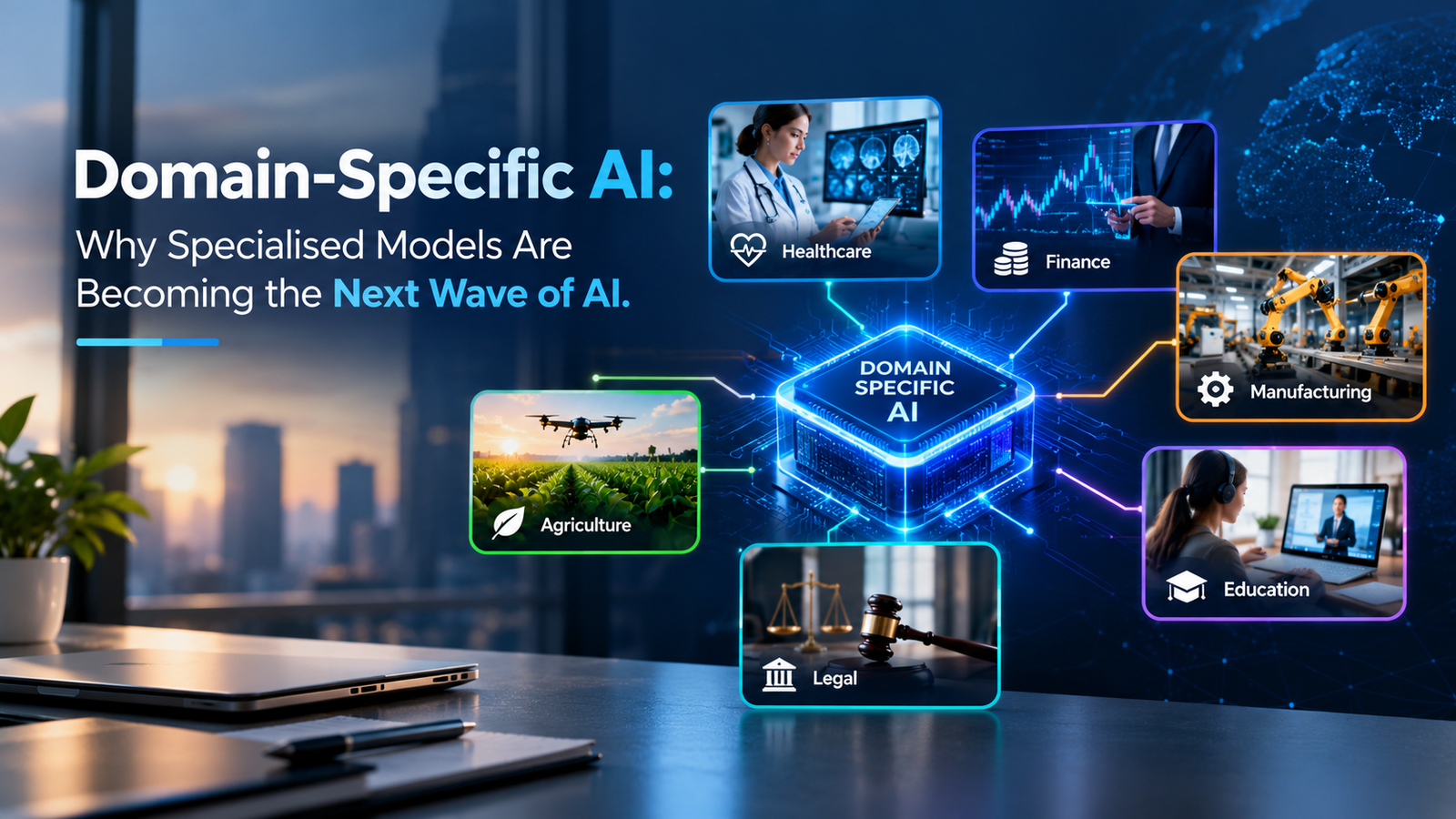
But as businesses move from experimenting with AI to deploying it in real-world environments, another trend is becoming increasingly important: domain-specific AI.
Instead of building one AI system that tries to understand everything, organizations are increasingly interested in models designed for a particular industry, profession, workflow, or business problem.
This approach is creating a new generation of specialized AI models that can focus on a specific domain’s vocabulary, rules, data, workflows, and requirements.
A legal AI system does not need to understand every possible topic with equal depth. It needs to understand contracts, case documents, legal terminology, regulations, and legal workflows.
A healthcare AI system may need a deep understanding of clinical terminology, medical documentation, imaging data, and healthcare processes.
A financial AI system may need to interpret financial reports, market information, risk indicators, and compliance requirements.
This is the basic idea behind domain-specific AI: build AI around the problem rather than forcing every problem into the same general-purpose model.
The shift does not mean that general-purpose models are becoming irrelevant. In fact, general AI systems remain extremely valuable. However, businesses are discovering that specialization can provide better accuracy, stronger relevance, greater control, and more efficient performance for certain tasks.
This article explores how AI models are evolving toward specialization, what domain-specific AI means, how specialized models differ from general-purpose systems, why industries are adopting them, and what this trend could mean for the future of business and technology in the United States.
What Is Domain-Specific AI?
Domain-specific AI is artificial intelligence designed to operate within a particular industry, field, organization, or specialized area of knowledge.
Rather than trying to be equally useful for every possible task, a domain-specific system is optimized for the requirements of a narrower environment.
The “domain” could be an industry such as:
- Healthcare
- Banking
- Insurance
- Manufacturing
- Retail
- Education
- Law
- Logistics
- Energy
- Telecommunications
- Real estate
- Cybersecurity
It could also be a professional function such as accounting, software testing, sales operations, supply-chain planning, or customer support.
The defining characteristic is specialization.
A domain-specific system is developed or adapted using relevant data, terminology, workflows, and requirements so that it can perform tasks within its target environment more effectively.
For example, a general-purpose AI model might know what a “mortgage” is.
A specialized financial model may understand how mortgage applications are structured, what financial terms mean in context, which documents are relevant, and how to handle a particular workflow.
That extra contextual understanding can make a significant difference in business applications.
Why Specialized AI Is Becoming Important
The early excitement around AI focused heavily on a simple idea: bigger models can do more.
That remains true in many cases.
However, organizations quickly discovered that intelligence alone does not guarantee a successful business application.
Companies also care about accuracy, consistency, privacy, cost, compliance, speed, and integration with existing workflows.
A general-purpose AI model may be highly capable but still produce responses that are too generic for a specialized business environment.
Imagine a law firm using AI to analyze a complex contract.
A general-purpose model might understand the document reasonably well.
A domain-specific AI model can potentially go further by being optimized for legal language, contract structures, legal terminology, relevant document patterns, and the firm’s specific workflows.
This specialization can make AI more practical.
Instead of asking:
“How intelligent is this model?”
Businesses can begin asking:
“How well does this model understand our world?”
That is a much more useful question for enterprise AI.
AI Models Are Becoming More Specialized
The AI landscape is no longer dominated by a single model category.
Today, different types of AI models serve different purposes.
Some focus on general language understanding.
Others specialize in images, speech, coding, robotics, forecasting, recommendation systems, or scientific analysis.
Within those categories, another layer of specialization is emerging.
A general language model might be adapted into a healthcare language model.
A healthcare model might then be customized for radiology, clinical documentation, pharmaceutical research, or patient communication.
This creates a hierarchy of specialization.
General AI provides broad capabilities.
Industry-specific AI adds domain knowledge.
Organization-specific AI adds company data and workflow context.
The result is more targeted intelligence.
What Are Domain-Specific AI Models?
Domain-specific AI models are AI systems designed or fine-tuned for a particular area of knowledge or business activity.
They may be trained from scratch for a specific purpose, adapted from existing foundation models, or enhanced through fine-tuning, retrieval systems, instruction tuning, and specialized datasets.
Their advantage comes from focus.
A model doesn’t need to spend all its capacity trying to understand unrelated topics.
Instead, it can concentrate on patterns that matter most for the target domain.
For example, an insurance-focused model might be optimized for:
- Claims documents
- Policy language
- Coverage terms
- Risk assessment
- Fraud indicators
- Customer communication
- Regulatory requirements
A manufacturing model could focus on:
- Equipment data
- Production processes
- Quality standards
- Maintenance records
- Supply-chain information
- Factory workflows
- Sensor data
The more relevant the data and workflow, the more useful specialization can become.
General-Purpose AI vs Domain-Specific AI
The debate between general-purpose and specialized AI is often presented as a competition.
In reality, both have important roles.
General-purpose systems are useful when a business needs broad flexibility.
They excel at open-ended tasks, creative work, general research, brainstorming, coding assistance, and many everyday productivity tasks.
Domain-specific systems become more attractive when accuracy, specialized knowledge, and predictable performance matter most.
Consider a simple example.
A general AI model can write a business email.
A domain-specific legal model could help review a contract.
The first task benefits from broad language ability.
The second benefits from deep domain knowledge.
Neither model is inherently “better.”
They are optimized for different jobs.
General-Purpose AI
General-purpose AI tends to offer:
- Broad knowledge
- Flexible language understanding
- Multiple use cases
- Strong creative capabilities
- General reasoning
- Wide user applicability
Domain-Specific AI
Domain-specific systems tend to emphasize:
- Specialized knowledge
- Industry terminology
- Narrower workflows
- Higher relevance
- More controlled outputs
- Industry-specific data
- Business-process integration
This distinction is becoming increasingly important as companies move beyond experimentation.
What Is Vertical AI?
The term vertical AI is closely related to domain-specific AI.
Vertical AI generally refers to AI products and systems built specifically for a particular industry or vertical market.
Instead of creating one AI application for every type of customer, a vertical AI company develops technology around one sector.
For example, a company might build an AI platform specifically for:
- Healthcare providers
- Law firms
- Mortgage lenders
- Insurance companies
- Manufacturers
- Property managers
- Retailers
The platform can then be designed around that industry’s needs, workflows, terminology, data structures, and challenges.
This creates a major advantage over generic software.
A generic system provides tools.
A vertical AI system provides tools already shaped around the user’s environment.
That can reduce the customization required before a business can get value.
Domain-Specific Language Models
One of the most important developments in this space is the emergence of domain-specific language models.
These systems use language-model technology but focus on a particular area of knowledge.
A domain-specific language model may understand industry terminology more deeply, recognize domain-specific document structures, and produce responses that are more relevant to professional users.
For example, a healthcare-oriented language model can be exposed to medical literature, clinical documents, medical terminology, and healthcare communication patterns.
A financial language model can focus on financial reports, economic terminology, corporate disclosures, and investment-related information.
The model’s value comes not simply from knowing more words.
It comes from understanding how those words are used within a professional context.
What Are Domain-Specific LLMs?
Domain-specific LLMs are large language models adapted or developed to perform better within a particular domain.
They can be especially valuable where language is highly specialized.
Consider the difference between ordinary English and professional language.
A financial analyst might use terms such as:
“EBITDA”
“yield curve”
“liquidity risk”
“credit spread”
“capital structure”
A physician may work with specialized clinical terminology.
A lawyer may use highly specific legal language.
An engineer may rely on technical specifications and industry standards.
A general-purpose language model can learn many of these concepts.
But a domain-specific LLM can be optimized to work with them repeatedly and accurately within the target environment.
This makes it easier to build AI applications that are deeply integrated into professional workflows.
Why Industry-Specific AI Is Growing
Several factors are driving the growth of industry-specific AI.
Businesses Want More Accuracy
In professional environments, a generic answer may not be good enough.
A marketing assistant can generate an approximate idea.
A financial compliance system may need much stricter standards.
Specialization improves relevance and reduces unnecessary outputs.
Enterprises Have Specialized Data
Large companies possess enormous amounts of internal information.
This may include:
- Procedures
- Contracts
- Product documentation
- Customer records
- Technical manuals
- Internal knowledge bases
- Transaction histories
- Support conversations
General AI systems cannot automatically understand all of this information in the right business context.
Specialized AI can be designed around it.
Workflows Are Different Across Industries
A healthcare organization does not operate like a bank.
A factory does not operate like a law firm.
Industry-specific systems can be built around the actual sequence of tasks employees perform.
Regulation Matters
Certain industries have stronger privacy, compliance, documentation, and accountability requirements.
Specialized AI can be designed with these constraints in mind.
That does not automatically guarantee compliance, but it can make the system easier to align with industry-specific requirements.
AI Models for Specific Industries
The market for industry-specific AI models is likely to expand as businesses seek more targeted solutions.
Let’s examine several major areas.
Healthcare
Healthcare may be one of the clearest examples of why specialization matters.
Medical language is complex.
Healthcare organizations also generate enormous amounts of specialized data, including clinical notes, medical imaging, lab reports, patient histories, research papers, and administrative records.
Healthcare-oriented AI can support tasks such as:
- Clinical documentation
- Medical information retrieval
- Patient communication
- Medical coding assistance
- Research support
- Image analysis
- Drug discovery
- Administrative automation
The important point is that healthcare AI needs more than general intelligence.
It needs context.
A system must understand medical terminology and operate within workflows where accuracy and safety matter most.
Finance
Financial institutions handle complex data and highly specialized language.
Domain-specific financial AI can support:
- Financial document analysis
- Risk assessment
- Fraud detection
- Customer support
- Research
- Compliance workflows
- Financial forecasting
- Transaction analysis
A banking system may need to interpret information differently from a general-purpose assistant.
Specialized financial models can be optimized for these requirements.
Legal Services
Legal work involves huge amounts of documentation and precise terminology.
Law firms and legal departments can use specialized AI for:
- Contract analysis
- Document review
- Legal research support
- Case organization
- Clause comparison
- Compliance workflows
- Document summarization
A domain-specific legal system can be trained or adapted to understand legal language and document structures more effectively.
Manufacturing
Manufacturing creates an entirely different AI environment.
Factories generate data through machines, sensors, cameras, production systems, and quality-control processes.
Specialized industrial AI can support:
- Predictive maintenance
- Quality inspection
- Production optimization
- Inventory planning
- Supply-chain forecasting
- Equipment monitoring
- Process control
Here, AI may combine language understanding with computer vision, time-series analysis, and sensor data.
That requires more specialization than a general chat-bot.
Retail
Retail companies have access to detailed customer and product data.
AI can help with:
- Product recommendations
- Inventory optimization
- Demand forecasting
- Customer service
- Pricing analysis
- Marketing personalization
- Product discovery
Retail-focused systems can use industry-specific patterns to improve the customer and operational experience.
Insurance
Insurance is another industry where specialized AI can deliver major value.
Insurance organizations process:
- Claims
- Policy documents
- Customer histories
- Risk information
- Property information
- Fraud indicators
AI systems can analyze these datasets to assist with claims processing, underwriting, customer communication, document review, and fraud detection.
Education
Education has unique workflows involving students, teachers, institutions, assessments, curriculum, and learning outcomes.
Specialized educational AI can support:
- Personalized learning
- Tutoring
- Curriculum assistance
- Student support
- Educational content generation
- Administrative tasks
The key is that educational AI must understand the learning context, not just generate information.
Custom AI Models for Businesses
The rise of specialization is also creating interest in custom AI models.
A custom AI model is developed or adapted to address the specific needs of an organization or use case.
A company might want an AI system that understands its own:
- Product catalog
- Internal procedures
- Customer-support history
- Technical documentation
- Brand guidelines
- Business terminology
- Operational data
This creates a more personalized AI experience.
However, “custom” does not always mean building a new model entirely from scratch.
That can be extremely expensive and technically demanding.
Companies can often achieve useful specialization by combining an existing foundation model with:
- Fine-tuning
- Retrieval-augmented generation
- Proprietary knowledge bases
- Structured business data
- Carefully designed prompts
- Workflow integration
- Domain-specific evaluation
This approach can deliver many of the benefits of specialization without requiring a company to build a foundation model independently.
Why Data Is the Foundation of Specialized AI
The quality of specialized AI depends heavily on the data used to develop and operate it.
A company may have thousands of documents, but that does not automatically mean it has useful training data.
Data must be:
Accurate.
Relevant.
Current.
Well organized.
Appropriately labeled.
Accessible.
Secure.
This matters especially because specialization magnifies the importance of domain-specific information.
A general-purpose AI system can rely on broad world knowledge.
A specialized system depends much more heavily on the quality of information surrounding the target domain.
If the source data is poor, the AI may become specialized in the wrong information.
Fine-Tuning vs Retrieval
Several ways can make AI more domain-aware.
Fine-tuning changes the model’s behaviour by training it on additional examples.
Retrieval-based systems provide relevant information to the model when you ask a question.
These approaches solve different problems.
Fine-tuning can improve style, behaviour, terminology, and task performance.
Retrieval can help the model access current or company-specific information without retraining the entire model every time data changes.
In many enterprise applications, the best architecture may combine both techniques.
The Business Benefits of Domain-Specific AI
Organizations do not adopt specialized AI simply because it is technically interesting.
They adopt it because specialization can create measurable business value.
Better Relevance
The model understands the target domain better.
Improved Workflow Integration
The system can be designed around the way employees actually work.
Greater Consistency
Specialized models can be optimized for repeatable business tasks.
Lower Noise
A domain-focused system may have less irrelevant information influencing an output.
Stronger User Experience
Professional users often prefer systems that understand their terminology and workflow.
Competitive Advantage
A company with high-quality proprietary AI capabilities may be able to create services competitors cannot easily replicate.
Domain-Specific AI Can Reduce AI Waste
Another interesting advantage is efficiency.
A company does not always need the largest AI model available.
Suppose a business only needs to classify documents, identify customer intent, or extract specific information from contracts.
Using a giant model for every request may be unnecessarily expensive.
A specialized model can potentially handle the workload with fewer computing resources.
This is one reason specialization is closely connected to the broader movement toward efficient AI.
The future of AI may involve more models, but not necessarily bigger models for every task.
The Rise of AI Model Specialization
The AI industry is moving from a “one model for everything” mindset toward a more layered ecosystem.
A modern enterprise could have:
A general-purpose model for broad tasks.
A financial model for finance workflows.
A support model for customer service.
A coding model for software development.
A document model for information extraction.
A vision model for quality control.
These systems can work together.
This creates a modular AI architecture.
Instead of replacing every business system with one giant intelligence layer, organizations can use multiple specialized models connected through software.
That approach can make AI more efficient and manageable.
Specialized Models and AI Agents
AI agents are another reason domain-specific systems are becoming important.
An AI agent may need to perform tasks inside a specific business environment.
A banking agent must understand banking workflows.
A logistics agent needs to understand transportation and inventory.
A customer-service agent needs access to company policies and customer data.
A specialized model can provide the intelligence these workflows need.
The agent can then interact with databases, software systems, APIs, documents, and other tools.
This combination of specialized AI models and AI agents could transform enterprise automation.
Instead of a chat-bot simply answering questions, an AI agent could perform a multi-step workflow.
It could read information, make a recommendation, update records, prepare documents, and request human approval when necessary.
Security and Privacy Considerations
Specialized AI can improve security and privacy, but it also introduces new risks.
The more an AI system is connected to company data, the more important access controls become.
Organizations need to think carefully about:
- Who can access the model?
- What data the model can retrieve
- Which employees can use specific functions?
- How information is stored
- How prompts and outputs are logged.
- How sensitive data is protected
- What happens when an AI makes a mistake
Specialized AI should therefore be treated as part of the company’s technology infrastructure, not just another software feature.
The Challenge of Bias in Domain-Specific AI
Specialization has another side effect.
If a model learns primarily from one organization’s historical data, it can inherit the assumptions, mistakes, and biases contained in that data.
This matters most in fields involving people, financial decisions, employment, education, healthcare, and public services.
Businesses need evaluation processes that test whether the model behaves appropriately across different scenarios and groups.
More data does not automatically solve bias.
Better data and stronger evaluation matter more.
The Challenge of Keeping Models Current
Industries change.
Regulations change.
Products change.
Customer behaviour changes.
Business processes change.
A specialized AI system therefore cannot simply be built once and forgotten.
Organizations need mechanisms to update their knowledge and evaluate their behaviour over time.
This is particularly important when the model works with information that changes frequently.
A model that was highly useful two years ago may become less reliable if the surrounding domain evolves significantly.
The Role of Human Experts
Specialized AI should not eliminate domain professionals.
In many cases, domain experts are more important than ever.
Doctors, lawyers, engineers, financial professionals, analysts, and other specialists understand the real-world context AI may not fully capture.
They can help define workflows, validate outputs, identify risks, and improve the model over time.
The strongest systems will often combine machine intelligence with human expertise.
AI processes information quickly.
Experts understand consequences.
Together, they can create better outcomes than either working independently.
Domain-Specific AI and Small Models
Domain specialization is closely tied to smaller AI systems.
A model does not always need to be enormous when its task is narrow.
A specialized model trained for one type of workflow may achieve strong performance without needing the scale of a universal model.
This creates an important opportunity.
A company may be able to build a smaller, cheaper, and faster AI system that performs extremely well for its target application.
This can be particularly valuable for businesses that need predictable costs or local deployment.
Why the U.S. Market Is Well Positioned for Vertical AI
The United States has a large and diverse technology market with major industries that generate enormous volumes of specialized data.
Healthcare, financial services, manufacturing, logistics, software, retail, energy, insurance, and professional services all have complex workflows that can benefit from tailored AI systems.
This creates a strong market opportunity for companies developing vertical AI products.
Instead of competing only to build the world’s most powerful general model, AI companies can build products that solve specific problems better than broad platforms.
That can create defensible businesses.
An AI company that deeply understands one industry may offer more value to customers than a generic platform with thousands of unrelated features.
How Businesses Should Decide Between General and Specialized AI
The right choice depends on the task.
Businesses should consider several questions.
Is the task highly specialized?
If it involves industry-specific language or workflows, specialization may help.
Is accuracy especially important?
If mistakes are costly, a domain-focused approach may be useful.
Does the organization have proprietary data?
If the business has large amounts of valuable internal information, custom AI may provide meaningful advantages.
Does the workflow repeat frequently?
High-volume tasks can benefit significantly from specialized automation.
Is the domain regulated?
Industries with strong regulatory requirements may need more controlled AI systems.
Is broad creativity more important than domain precision?
If so, a general-purpose model may remain the better option.
How to Build a Domain-Specific AI Strategy
A successful strategy should begin with the business problem.
Start by identifying a process where AI could create measurable value.
Then determine what knowledge the system needs.
Next, assess the available data.
After that, decide whether an existing model can be adapted or whether a more specialized architecture is necessary.
The organization should then create a pilot.
The pilot should be evaluated based on measurable factors such as:
- Accuracy
- Speed
- Cost
- User satisfaction
- Error rate
- Productivity
- Security
- Business impact
If the system produces positive results, it can be expanded gradually.
This is generally more effective than trying to transform an entire company overnight.
Examples of Practical Domain-Specific AI Applications
To understand the potential of specialized AI, consider several realistic examples.
A Bank
A bank could use domain-specific AI to summarize customer interactions, analyze financial documents, detect suspicious transactions, and assist employees with internal policy questions.
A Hospital
A hospital could use specialized AI to organize clinical documentation, retrieve information from medical records, assist with administrative tasks, and support research workflows.
A Manufacturer
A manufacturer could combine sensor data, computer vision, and specialized AI to monitor equipment and identify potential quality problems.
A Law Firm
A legal organization could use specialized AI to compare contracts, identify clauses, summarize case files, and organize documents.
A Retail Company
A retailer could use AI to predict product demand, personalize recommendations, optimize inventory, and improve customer support.
In every example, the value comes from understanding the specific environment.
The Future of Domain-Specific AI
The next phase of artificial intelligence may be defined by specialization.
The industry has already demonstrated that general-purpose AI can perform an enormous variety of tasks.
Now the focus is increasingly shifting toward making AI genuinely useful inside specific environments.
That means understanding the terminology, processes, data, constraints, and goals of individual industries.
This could lead to a much more fragmented but powerful AI ecosystem.
Instead of one AI model dominating every task, thousands of specialized systems may work across different fields.
Some models will be general.
Some will be industry-specific.
Some will be company-specific.
Some will be task-specific.
And many will work together.
AI Models Will Become More Like Digital Specialists
One useful way to think about this trend is to imagine AI models as digital specialists.
Instead of expecting one model to behave like an expert in everything, organizations can deploy different systems for different roles.
A legal AI could act like a legal research assistant.
A financial AI could act like a financial operations assistant.
A manufacturing AI could monitor production systems.
A customer-service AI could support agents.
A coding AI could assist developers.
These systems may be connected, but each has a clear area of expertise.
That division of intelligence could make enterprise AI more practical.
The Importance of Trust
As AI becomes more specialized, trust matters more.
Users need to know:
Why did the model produce this answer?
What data influenced it?
Can the information be verified?
What happens when the model is uncertain?
Who is responsible for the final decision?
Businesses may therefore need stronger transparency and auditing processes.
In critical environments, simply saying “the AI said so” will not be enough.
Organizations will increasingly need ways to evaluate, monitor, and govern AI behaviour.
Will Domain-Specific AI Replace General AI?
No.
General-purpose AI remains essential because flexibility has enormous value.
Businesses want systems that can handle unexpected questions, creative tasks, broad research, and rapidly changing requirements.
The future will likely combine both.
General-purpose models can provide broad intelligence.
Domain-specific models can provide deep expertise.
A system may use both depending on the situation.
This is similar to how organizations already work with people.
A general employee may handle a wide range of tasks.
Organizations bring in a specialist when they need deeper expertise.
AI systems can follow a similar structure.
The Next Wave of AI
The next wave of artificial intelligence is not necessarily about creating a single model that can do everything.
It is about making AI more useful.
That means improving its understanding of context, reducing errors, integrating it into workflows, and aligning it with specific industry requirements.
This is why domain-specific AI is becoming such an important direction.
The market is moving from:
“Can AI perform this task?”
toward:
“Can AI perform this task accurately, securely, efficiently, and within our actual business environment?”
That is a much higher standard.
And it is the standard that will shape the next generation of AI products.
Frequently Asked Questions About Domain-Specific AI
What is domain-specific AI?
Domain-specific AI is artificial intelligence designed or adapted to operate within a particular industry, profession, organization, or specialized area of knowledge.
What are domain-specific AI models?
Domain-specific AI models are models optimized for a particular domain. They may be trained or adapted using specialized data, terminology, workflows, and instructions.
What is the difference between general AI and domain-specific AI?
General AI is designed for broad use across many topics and tasks. Domain-specific AI focuses on a narrower area and aims to provide deeper expertise and greater relevance within that domain.
What are domain-specific language models?
Domain-specific language models are language models optimized for a particular field, such as healthcare, finance, law, manufacturing, or education.
What are domain-specific LLMs?
Domain-specific LLMs are large language models adapted or developed to better understand and perform tasks within a specific industry or area of expertise.
What is vertical AI?
Vertical AI refers to AI products and systems built specifically for a particular industry or market, rather than for broad general-purpose use.
What are specialized AI models used for?
Specialized AI models can support document analysis, forecasting, customer service, fraud detection, medical support, contract review, manufacturing operations, recommendations, compliance, and many other industry-specific tasks.
Why are companies interested in custom AI models?
Companies may use custom AI models to leverage proprietary data, improve relevance, integrate AI into internal workflows, and create specialized capabilities that general-purpose systems may not provide.
Are domain-specific AI models better than general-purpose models?
Not universally. Specialized models can be better for focused professional tasks, while general-purpose models may be better for broad, flexible, and unpredictable workloads.
Will every industry have its own AI model?
Many industries are likely to develop specialized AI systems, but they may not all require completely independent foundation models. Some will be built by adapting larger general-purpose models.
Conclusion
Artificial intelligence is moving into a new phase.
The first major wave proved what increasingly powerful AI models could accomplish. The next wave is about making those capabilities deeply useful in the environments where people actually work.
That is why domain-specific AI models are gaining momentum.
Healthcare needs AI that understands healthcare.
Finance needs AI that understands financial workflows.
Law needs AI that understands legal language.
Manufacturing needs AI that understands machines and production.
Retail needs AI that understands products and customer behaviour.
You can’t always meet these requirements effectively by treating every problem as a general-purpose AI problem.
Specialized AI models, industry-specific AI, vertical AI, domain-specific language models, and domain-specific LLMs are different expressions of the same broader trend: moving toward AI that is more focused, contextual, and useful.
At the same time, custom AI models are giving businesses opportunities to combine general foundation models with proprietary information and specialized workflows.
The future is unlikely to be controlled by one type of model.
Instead, AI will probably become an ecosystem of systems working together.
General-purpose models will provide broad intelligence.
Specialized models will provide deep expertise.
Smaller models will handle efficient tasks.
Larger models will tackle complex reasoning.
AI agents will connect these systems to real-world workflows.
For companies in the United States and around the world, this creates an important opportunity.
AI’s competitive advantage may not come from simply having access to the most powerful model.
It may come from knowing which model to use, what information to give it, how to connect it to business processes, and how deeply it understands the industry it serves.
That is the real promise of domain-specific AI.
Artificial intelligence is becoming less about one model that knows everything and more about the right model knowing exactly what it needs to know.
And that could make specialized AI one of the defining developments of the next era of intelligent technology.





Leave a Reply