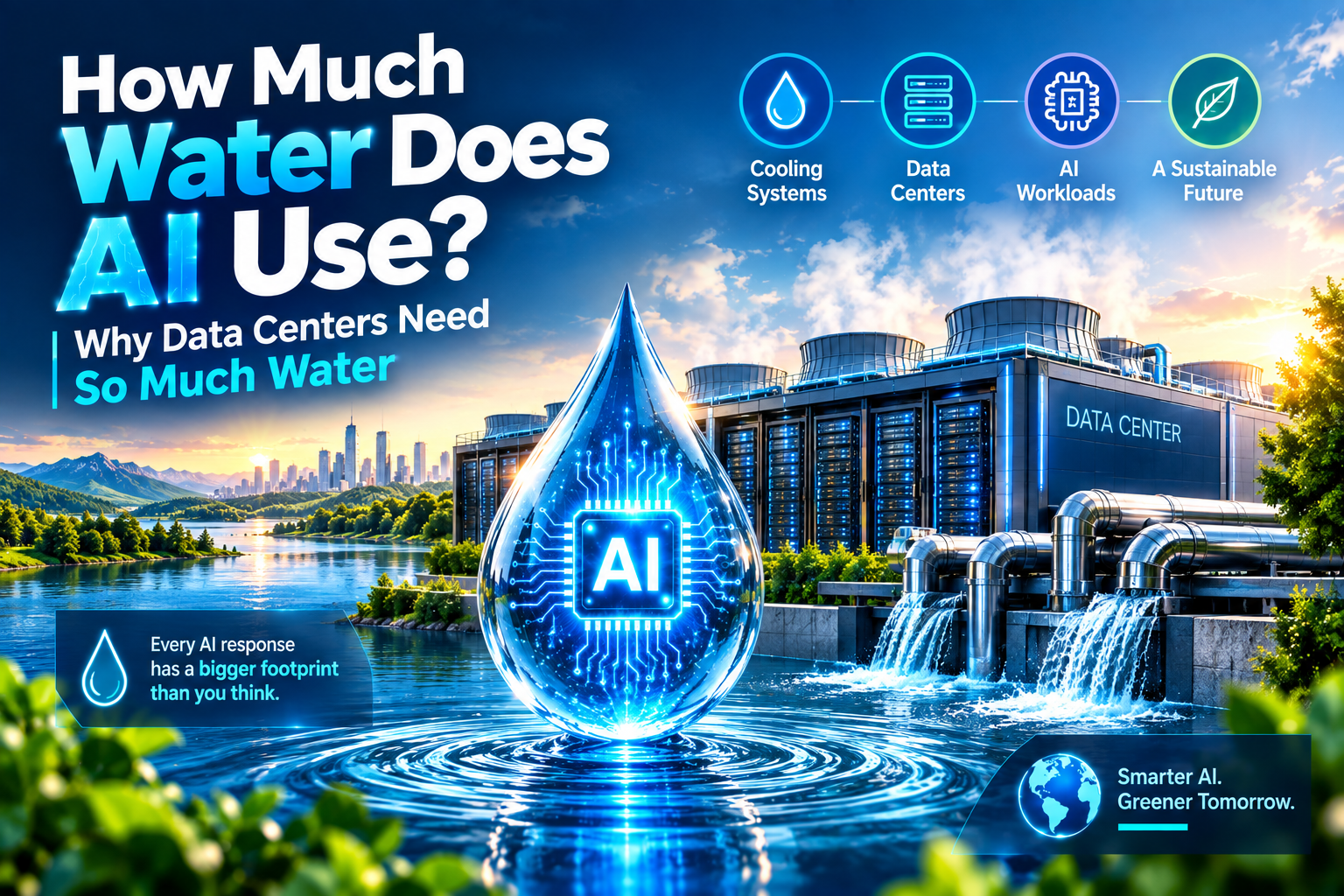
Artificial intelligence is one of the most important technologies in the modern digital economy. Millions of people use it every day, from chat-bots and image generators to recommendation systems, autonomous software, and AI-powered business tools.
But behind every AI response is a large physical infrastructure of servers, processors, cooling systems, and data centers. These facilities require enormous amounts of electricity, and many also require water to remove the heat generated by computer hardware.
That leads to an important question: how much water does artificial intelligence use?
The answer is more complicated than a single number. AI does not consume water directly in the way a person or an agricultural field does. Instead, data centers that run AI systems consume water and, indirectly, the power plants that generate the electricity they need.
Recent research and industry disclosures show that water consumption can vary dramatically by AI model, workload, location, weather, hardware, electricity source, and cooling technology. For example, Google estimated in 2025 that a median Gemini Apps text prompt consumed about 0.26 milliliters of water under its comprehensive measurement methodology. Older academic research produced much larger estimates for some AI workloads because it used different assumptions, data centers, and accounting methods.
This article explains how much water AI uses, how much water data centers use, why data centers need water, what happens to that water, and whether AI’s water footprint is an environmental concern in the United States. Together, these sections show how the pieces fit.
How Much Water Does Artificial Intelligence Use?
There is no universal answer to how much water does artificial intelligence use because different AI systems operate under very different conditions.
A simple AI text request might require relatively little water in a highly efficient data center. A large AI model performing a complex reasoning task, generating an image, or processing a long context may require considerably more computing resources. The cooling system and electricity supply also affect the final water footprint.
One of the most useful recent measurements comes from Google. In an August 2025 analysis, Google estimated that the median Gemini Apps text-generation prompt consumed about 0.26 milliliters of water, or roughly five drops, using its more comprehensive methodology. The estimate included data-center overhead rather than considering only the electricity consumed by the AI accelerators themselves.
Google also reported a narrower calculation of approximately 0.12 milliliters per prompt when looking only at active TPU and GPU consumption. The company described this narrower approach as an optimistic scenario because it leaves out other parts of the operational system. Here, “prompt” means a single user request to the model.
This distinction matters because it helps explain why water estimates can differ so much.
A commonly repeated statement online may suggest that every AI prompt consumes a glass or bottle of water. That is not a reliable universal rule. Per-prompt estimates depend on what you measure and where the computation occurs.
An earlier academic study by researchers from the University of California, Riverside and other institutions estimated a substantially different water footprint for AI, including an estimate that training GPT-3 could directly evaporate around 700,000 liters of freshwater in Microsoft’s U.S. data centers. The study also modeled future global AI water withdrawal under certain assumptions. In this context, “water footprint” includes the water tied to the system being studied.
The difference between these figures does not necessarily mean one estimate is simply “correct” and the other is “wrong.” They measure different systems, workloads, infrastructure, and time periods.
So, How Much Water Does AI Use Per Prompt?
The most accurate answer is:
It depends.
For one recent real-world example, Google estimated about 0.26 mL of water for a median Gemini Apps text prompt in May 2025 using its comprehensive methodology. That number does not represent every Gemini prompt, every AI model, or every data center. Google specifically noted that prompt-level performance changes as models, hardware, and user behavior evolve.
This means readers should be cautious with headlines claiming that “one AI prompt uses X amount of water” as though the figure were fixed, since the context can change the result.
Several factors can change the result:
- The size and type of AI model
- The complexity of the request
- The number of tokens processed
- Whether the AI generates text, images, audio, or video
- The efficiency of the processors
- Data-center cooling technology
- Outdoor temperature and humidity
- The geographic location of the facility
- The source of electricity
- Whether water is counted directly, indirectly, or both
A short text question and a large AI-generated video are not equivalent workloads.
Why Does AI Use Water?
The easiest way to understand why AI uses so much water is to look at the hardware behind it.
AI models run on computers containing high-performance processors, especially GPUs and specialized AI accelerators. These processors perform enormous numbers of calculations. The electricity used by that equipment ultimately becomes heat.
If too much heat builds up, the equipment can become less efficient or be damaged. Data centers therefore need sophisticated cooling systems to keep servers operating within safe temperature ranges.
One way to remove that heat is through water.
Water can be used in cooling towers, chillers, heat exchange’s, and other systems. In evaporative cooling systems, some of the water changes from liquid to vapor and carries heat away from the facility.
This is why the water footprint associated with AI is largely an infrastructure issue.
AI software does not directly drink water. The computers running AI may require cooling, and the electricity powering them can also have a water footprint.
This distinction is important when discussing environmental impacts.
Why Do Data Centers Need Water?
Data centers need water primarily for heat management.
Modern data centers contain thousands or potentially tens of thousands of servers and accelerators. When those machines operate continuously, they produce heat. Cooling systems prevent overheating and maintain reliable performance.
Some facilities use air-based cooling, while others use water-based or hybrid systems.
Evaporative Cooling
Evaporative cooling is a major reason data centers can consume large quantities of water.
In a simplified example, warm water can transfer heat from servers or cooling equipment and eventually reach a cooling tower. Some of the water evaporates, removing heat from the system. Additional water may be needed to replace losses from evaporation, blow-down, and other processes.
This approach can be energy-efficient in suitable climates, but its water requirements can be significant.
Chilled-Water Systems
Some data centers use chilled-water loops to transfer heat. Refrigeration equipment lowers the water temperature, which then circulates through the facility.
The water may remain in a closed loop, but the overall cooling system may still require water, depending on how it rejects heat.
Direct-to-Chip Liquid Cooling
AI hardware is becoming increasingly powerful and dense, making conventional air cooling more difficult in some high-performance environments.
Liquid cooling can bring coolant directly to the areas producing the most heat.
This can improve thermal management and reduce energy requirements. Newer systems can also use closed-loop designs that dramatically reduce or eliminate ongoing water consumption.
For example, Microsoft announced a data-center design in 2024 optimized for AI workloads that uses closed-loop, chip-level cooling and consumes zero water for cooling during operations. Microsoft said the design could avoid more than 125 million liters of water annually per data center compared with its previous evaporative approach.
That example shows why the phrase “AI uses water” needs context. Engineering decisions strongly influence water consumption.
How Much Water Do Data Centers Use?
The answer to how much water data centers use also varies significantly.
According to the U.S. Department of Energy’s Lawrence Berkeley National Laboratory, U.S. data centers consumed approximately 66 billion liters of water directly in 2023. The report noted that hyper-scale and co-location facilities accounted for approximately 84% of this total.
To put that in perspective, 66 billion liters is about 17.4 billion gallons.
However, direct water consumption is only part of the story.
Data centers also have an indirect water footprint associated with electricity generation. Some electricity production methods require water for cooling or other processes. The amount depends heavily on the power plant’s technology and the local electricity mix.
Lawrence Berkeley National Laboratory has emphasized that water consumption associated with electricity generation can vary substantially by primary energy source, power-plant efficiency, and location.
Consequently, two data centers using the same amount of electricity can have different overall water footprints.
Do Data Centers Use a Lot of Water?
Yes, some data centers can consume large quantities of water, particularly facilities using evaporative cooling in hot environments or areas where water demand is already high.
But saying that all data centers use enormous amounts of water would be misleading, because cooling technology makes a major difference.
Cooling technology makes a major difference.
The 2024 U.S. Data Center Energy Usage Report showed that direct water consumption by U.S. data centers reached around 66 billion liters in 2023, compared with approximately 21.2 billion liters in 2014. The report also projected further growth as data-center capacity expands.
At the same time, technology companies are increasingly developing air-cooling, reclaimed-water systems, rainwater collection, and closed-loop liquid-cooling solutions.
Microsoft, for example, reported in 2026 that approximately 90% of its owned data-center fleet operated with highly efficient low- to zero-water cooling systems in 2025.
The broader lesson is that data-center water consumption is not a fixed characteristic of computing. It is affected by infrastructure design.
How Is AI Using Water?
The question of how AI uses water can be broken down into several stages.
1. Training AI Models
Before a large AI model can answer questions, it must first be trained.
Training involves processing enormous datasets and performing huge numbers of calculations. Training can run across many processors in data centers for extended periods.
Those processors use electricity and generate heat, so the data-center cooling system must continuously remove that heat.
Academic research has estimated significant water use for training large AI models. One widely cited 2023 study estimated that training GPT-3 could directly evaporate approximately 700,000 liters of freshwater in Microsoft’s U.S. data centers under the researcher’s assumptions.
However, this figure should not be interpreted as the amount of water required to train every modern AI model. AI hardware and data-center efficiency have changed substantially, and companies increasingly use more efficient cooling technologies.
2. Running AI Models
After training, AI models still need computing resources every time someone uses them.
This stage is called inference.
When a user asks an AI chat-bot a question, servers process the request and generate a response. The associated hardware consumes electricity and creates heat.
At large scale, billions of AI interactions can turn even very small per-request resource requirements into substantial aggregate demand.
3. Generating Images, Audio and Video
Text generation is only one AI workload.
Image-generation systems can require considerably more computation than a short text response. Video generation can require even more computational processing.
Therefore, AI’s water footprint shouldn’t be represented by a single text-prompt number.
A simple text request and a complex video-generation task can place very different demands on a data center.
Does AI Waste Water?
The question of whether AI wastes water deserves a nuanced answer.
Water used in an evaporative cooling system is not necessarily “wasted” in the ordinary sense. It performs a useful cooling function, and some of the water eventually returns to the atmosphere as vapor.
However, from a local water-resource perspective, consumed water is still important.
If a facility withdraws freshwater from a river, municipal system, or groundwater source and a significant portion is evaporated, that water is no longer immediately available to the same local system—the timing and location of that consumption matter.
This is why the same amount of water can have very different environmental significance in different places.
A data center located in a region with abundant water resources may present a different local concern from an identical facility operating in an area experiencing drought or water stress.
Microsoft has explicitly recognized this issue in its data-center strategy, including using reclaimed and recycled water in some regions and developing cooling systems that reduce or eliminate water evaporation.
The better question is therefore not simply “Does AI waste water?” but:
Where does the water come from, how much is consumed, what happens to it, and how much stress is already present in that watershed?
Are Data Centers Bad for the Environment?
The question of whether data centers are bad for the environment cannot be answered with a simple yes or no.
Data centers have several environmental impacts, including:
- Electricity consumption
- Greenhouse-gas emissions depending on the electricity source
- Water consumption
- Construction materials
- Land use
- Hardware manufacturing
- Electronic waste
- Local infrastructure requirements
AI can intensify some of these impacts because advanced AI workloads require large amounts of computing capacity.
The U.S. Department of Energy reported in December 2024 that data-center electricity consumption was expected to double or triple by 2028, with growth partly tied to the expansion of AI applications.
At the same time, data centers are becoming more efficient.
For example, Google reported a fleet-wide average Power Usage Effectiveness of 1.09 in its 2025 AI environmental analysis and said it was working to reduce water use through cooling optimization and water replenishment efforts.
Microsoft has also introduced next-generation cooling systems specifically designed around the needs of AI workloads while reducing water consumption.
This creates an important trade-off.
A cooling system that uses less water might require more electricity. A system that uses evaporative cooling may reduce electricity requirements while consuming more water. The best engineering solution can therefore depend on local conditions.
Why Does AI Use So Much Water?
The question of why AI uses so much water can make AI sound inherently water-intensive, but the real explanation is more precise.
AI workloads can drive high water demand because they require substantial computing power, and high-performance computing generates heat.
Three major factors are especially important.
High-Powered AI Chips
Modern AI models rely heavily on GPUs and specialized accelerators. These processors can consume substantial electrical power when operating at high utilization.
More power generally means more heat to manage.
Large-Scale Data Centers
AI services often run in large facilities designed to support enormous amounts of computing equipment.
The bigger the facility and the more intensively it operates, the greater the potential cooling requirement.
Cooling System Design
The cooling method directly affects water consumption.
Traditional evaporative systems can consume large amounts of water.
Air cooling may use little or no cooling water but can have different energy requirements.
Direct-to-chip systems and closed-loop cooling can provide another approach, particularly for dense AI hardware.
Microsoft’s newer AI-optimized facilities demonstrate how engineering changes can reduce operational water use. The company says its latest design recirculates water through a closed loop rather than continuously evaporating fresh water for cooling.
Water Consumption vs. Water Withdrawal
One reason AI water statistics can appear contradictory is that researchers and companies may use different water terms.
Water withdrawal refers to water taken from a source for use.
Water consumption generally refers to water that is not immediately returned to the original water system, such as water lost through evaporation.
These are not interchangeable.
A data center could withdraw a large volume of water but return a considerable portion after use. Another facility could withdraw less water while consuming a larger percentage through evaporation.
For this reason, readers should always check whether a statistic refers to withdrawal, consumption, direct water use, or indirect water use.
Direct vs. Indirect Water Use
There are two major categories of data-center water use.
Direct Water Use
Direct water use happens at the data center itself.
Examples include:
- Evaporative cooling
- Cooling towers
- Humidification
- Other facility operations
The 66-billion-liter figure reported by Lawrence Berkeley National Laboratory for U.S. data centers in 2023 refers to direct water consumption.
Indirect Water Use
Indirect water use is associated with generating electricity.
Some power plants require water for cooling and other processes. Therefore, a data center powered by electricity from a water-intensive generation system can have an additional water footprint outside the data-center property.
This is one reason location and energy source matter so much when calculating AI’s overall environmental impact.
Does Every AI Data Center Use Freshwater?
No.
Companies are increasingly experimenting with alternatives.
Depending on local conditions, facilities may use:
- Reclaimed wastewater
- Recycled water
- Rainwater
- Air cooling
- Closed-loop liquid cooling
- Direct-to-chip cooling
Microsoft has reported using reclaimed and recycled water in several locations and rainwater harvesting in parts of its data-center operations.
This matters because freshwater is a particularly important resource in water-stressed regions.
Reducing freshwater consumption can ease pressure on municipal supplies and local watersheds, even as facilities continue to operate at scale.
How Much Water Could AI Use in the Future?
AI adoption is expanding rapidly, but projecting future water use is challenging because efficiency is improving at the same time.
On one side, AI demand is increasing.
More users, larger models, more advanced reasoning, image generation, video generation, and enterprise applications can all increase computing requirements.
On the other side, researchers and technology companies are improving:
- Processor efficiency
- Model efficiency
- Cooling efficiency
- Data-center design
- Renewable and low-carbon electricity
- Water recycling
- Closed-loop cooling
- Workload scheduling
Google reported that the energy use of its median Gemini Apps text prompt declined dramatically between May 2024 and May 2025, reflecting advances across hardware, software and AI serving infrastructure.
Meanwhile, Microsoft has said that its newest AI-focused data-center designs can eliminate operational water consumption for cooling.
Therefore, future AI water consumption will depend not only on how much AI people use, but also on how efficiently the infrastructure can deliver it.
Why Location Matters
Water use is fundamentally a local environmental issue.
Consider two hypothetical AI data centers that each consume 100 million gallons of water annually.
The first may operate in a location with plentiful water resources and access to reclaimed water.
The second may operate in a region where communities, agriculture, and ecosystems are already competing for limited supplies.
The same volume can have very different consequences.
This is why water-stress assessments are increasingly important when companies decide where to build data centers.
Google said in its 2025 environmental analysis that it considered local watershed conditions when selecting cooling approaches and expected new facilities in high-water-stress locations to rely increasingly on air-cooled technology during normal operations.
In the United States, this issue is particularly relevant because data centers are expanding across regions with very different climates and water conditions.
Is AI Water Use Larger Than Its Energy Use?
Water and energy are connected but should not be treated as the same environmental impact.
A data center can reduce water consumption by switching from evaporative cooling to a largely air-based system, but the alternative may require more electricity.
Likewise, an energy source may have a different water footprint depending on how it generates electricity.
This creates what researchers and engineers sometimes describe as a water-energy trade-off.
The most sustainable option depends on multiple factors, not a single universal technology.
Google’s analysis illustrates this complexity by including both AI serving energy and water consumption and emphasizing improvements across the entire infrastructure stack.
What Can Technology Companies Do to Reduce AI Water Use?
Reducing AI’s environmental footprint does not necessarily require reducing AI adoption. A major opportunity is improving the efficiency of the infrastructure that enables AI.
Build More Efficient Cooling Systems
Direct-to-chip liquid cooling and other advanced technologies can remove heat precisely where it is generated.
Microsoft says its newer AI data centers use closed-loop chip-level cooling and do not consume water for cooling during operations.
Use Reclaimed Water
When appropriate, reclaimed wastewater can reduce pressure on potable water supplies.
Microsoft has reported expanded use of reclaimed and recycled water in locations including Texas, Washington, and California.
Improve AI Model Efficiency
AI models can sometimes be optimized to produce the same useful result with less computation.
More efficient algorithms, hardware accelerators, model architectures, and software can lower both energy and associated cooling requirements.
Build According to Local Conditions
A data center should not necessarily use the same cooling system everywhere.
Hot, dry areas, cool climates and water-stressed regions may require different engineering strategies.
Measure Water More Transparently
Companies can improve public understanding by reporting water withdrawal, consumption, cooling methods, and geographic information consistently.
Better measurement can help regulators, communities and businesses understand where the biggest impacts actually occur.
What Can AI Users Do?
Individual users should not assume that one ordinary text prompt has a massive water footprint.
Recent measurements suggest that the water consumption of a median text prompt can be very small at an efficient AI provider. Google’s 2025 estimate of about 0.26 milliliters per median Gemini Apps text prompt shows how different modern AI efficiency can be from older estimates.
However, individual behavior can still matter at scale.
Users can avoid unnecessary computation, particularly for resource-intensive tasks such as repeated image or video generation. At the same time, AI can provide benefits that potentially reduce resource use elsewhere—for example, optimizing logistics, detecting leaks, improving industrial efficiency, or helping organizations analyze complex systems.
The most meaningful environmental impact is therefore often found at the infrastructure and system level rather than in one isolated text request.
AI Water Use: The Bigger Picture
It is easy to become focused on a single statistic such as “milliliters per prompt.” But that number only tells part of the story.
AI has a physical footprint that includes:
Computing: Powerful servers and accelerators perform the calculations.
Electricity: Those machines require energy.
Heat: Electricity use produces heat that must be removed.
Cooling: Cooling systems may use air, water, or liquid-based technologies.
Water: Some cooling systems consume water, while electricity generation can also have an indirect water footprint.
Infrastructure: Data centers require buildings, networking equipment, backup systems, and other physical resources.
The complete environmental picture is therefore much larger than the water used by an individual prompt.
Frequently Asked Questions About AI and Water
How much water does artificial intelligence use?
No single number applies to all artificial intelligence systems. A 2025 Google analysis estimated approximately 0.26 milliliters of water for the median Gemini Apps text prompt under its comprehensive methodology. Other studies have produced different estimates based on different models, workloads, and infrastructure.
How much water does AI use per prompt?
It varies by AI model, prompt complexity, hardware, data-center location, and cooling system. Google estimated around 0.26 mL for a median Gemini Apps text prompt in May 2025, but that figure should not be treated as a universal value for every AI system.
Do data centers use a lot of water?
Some do, particularly facilities using evaporative cooling. U.S. data centers consumed approximately 66 billion liters of water directly in 2023, according to Lawrence Berkeley National Laboratory.
Why do data centers use so much water?
Primarily because water can effectively transfer and remove heat from high-powered computer equipment, evaporative cooling systems use water to carry heat away from data-center facilities.
Why does AI use so much water?
AI workloads require powerful computers that consume electricity and generate heat. The cooling infrastructure that removes that heat can consume water, while electricity generation can create an additional indirect water footprint.
Does AI waste water?
Whether water is considered “wasted” depends on the context and accounting method. Water consumed through evaporation is not available for immediate reuse in the same local water system, so it can matter environmentally, especially in water-stressed regions.
Are data centers bad for the environment?
Data centers have environmental impacts involving electricity, water, emissions, construction, and hardware. However, the scale of those impacts depends on the facility’s design, location, energy supply, and cooling technology. Increasingly, companies are developing lower-water and more energy-efficient systems.
How is AI using water?
AI uses water indirectly through the data centers that train and operate AI models. Water can be used to cool computing equipment, and electricity production can also have an indirect water footprint.
Final Thoughts: How Much Water Does AI Really Use?
So, how much water does artificial intelligence use?
The honest answer is: there is no single number.
AI’s water footprint depends on the model, workload, hardware, data center, cooling system, climate, electricity source, and how you measure water consumption.
Recent data shows why the subject needs context. Google estimated approximately 0.26 milliliters of water for a median Gemini Apps text prompt in its 2025 comprehensive analysis, while earlier academic research produced much larger estimates for specific AI training scenarios.
At the infrastructure level, Lawrence Berkeley National Laboratory estimated that U.S. data centers directly consumed approximately 66 billion liters of water in 2023.
These figures point to two realities.
First, AI has a real physical and environmental footprint. It should not be treated as purely digital.
Second, that footprint is not fixed. Advances in chips, models, cooling systems, water recycling and data-center engineering can significantly change how much water is required to deliver AI services.
The future of sustainable AI will therefore depend not only on how powerful artificial intelligence becomes, but also on how efficiently the technology behind it uses the world’s energy and water resources.
For U.S. communities, businesses and policymakers, the most useful question is not simply whether AI uses water. It is how much water a particular AI infrastructure consumes, where that water comes from, how efficiently it is used, and whether the local environment can support that demand.
As AI continues to expand, those measurements will become increasingly important for building a digital economy that is both technologically advanced and more responsible with natural resources.





Leave a Reply