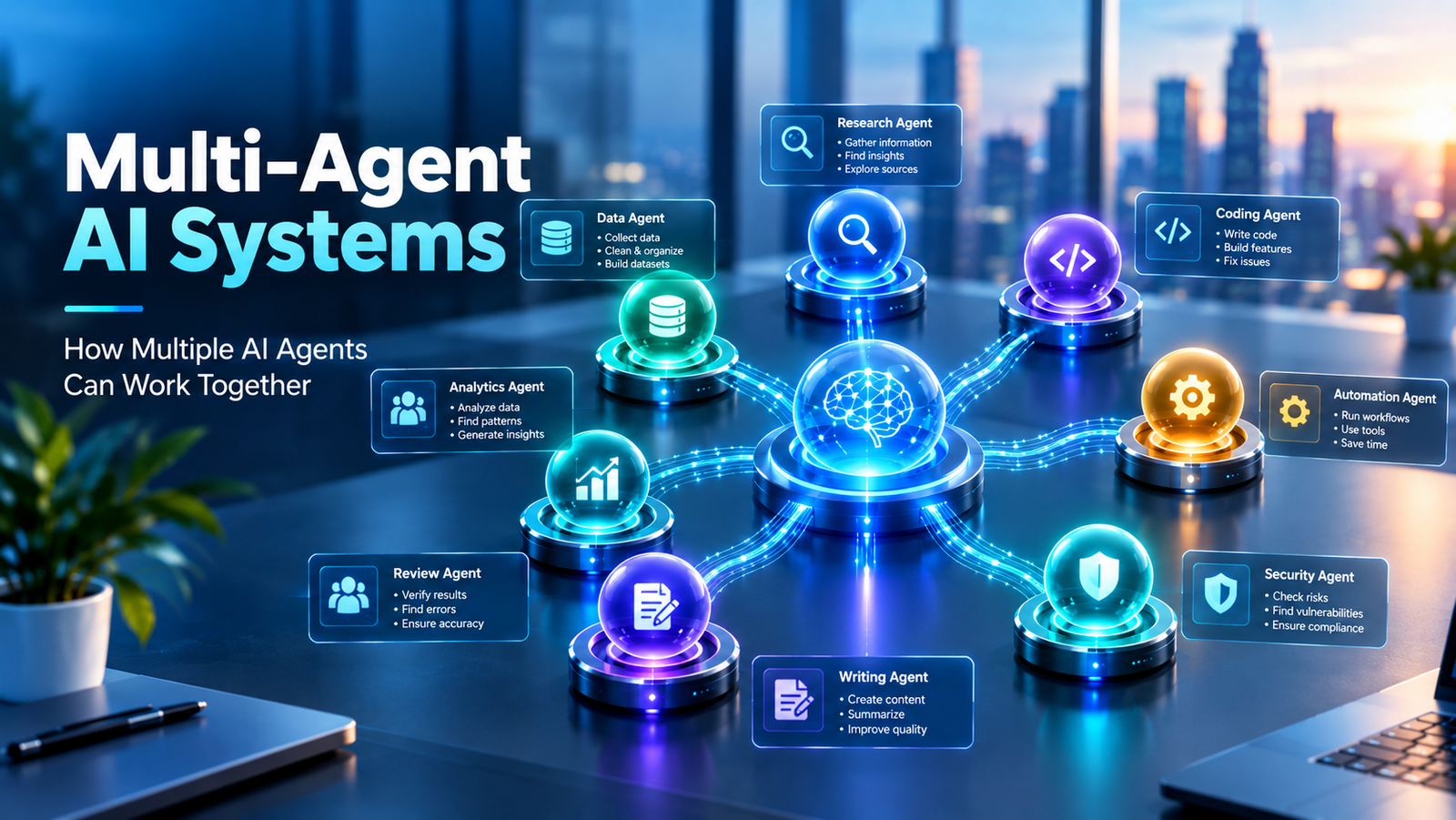
Artificial intelligence is moving beyond the idea of a single chat-bot answering questions or completing one task at a time. Today, AI systems are becoming better at planning, using tools, making decisions, and coordinating complex workflows. One of the most important developments in this shift is the rise of multi-agent systems, where multiple specialized AI agents work together to solve problems that may be too broad or complicated for one agent to handle efficiently.
Instead of asking one AI agent to research information, analyze data, write a report, review the result, and take action, a multi-agent approach can divide the work among several agents. One agent might act as a researcher, another as an analyst, another as a writer, and another as a reviewer. A coordinating agent can then bring their work together into a final result.
This approach is becoming increasingly important as businesses explore multi-agent AI, agentic AI, automation, software development, customer service, research, cybersecurity, and other applications. Modern AI platforms are also introducing tools and frameworks for coordinating sub-agents and specialized workflows. For example, OpenAI documents multi-agent approaches in which a root agent can delegate independent tasks to sub-agents. Microsoft’s AutoGen, for example, is designed for building applications in which multiple agents cooperate.
Meanwhile, the industry is working on ways for agents built by different systems to communicate. Google’s Agent2Agent, or A2A, is one example of an open protocol intended to help agents discover capabilities, exchange information, and collaborate across different applications and frameworks.
So, what exactly are multi-agent systems, how do they work, and why could they become an important part of AI’s future?
Let’s explore it step by step.
What Are Multi-Agent Systems?
Multi-agent systems are AI environments in which two or more autonomous or semi-autonomous agents work together to complete a task or achieve a shared goal.
An AI agent is more than a simple text-generation model. Depending on the system, an agent may interpret information, plan a task, use tools, access data, make decisions, communicate with other agents, and perform actions.
In a multi-agent environment, these capabilities are distributed across different agents.
For example, imagine an online business that wants to analyze why its sales declined last month. Rather than giving one agent every responsibility, the company could create several specialized agents: a research agent studies market conditions and competitor activity.
- An analytics agent identifies patterns in the company’s data.
- A strategy agent develops possible explanations and recommendations.
- A review agent checks the findings for errors or unsupported conclusions.
- A manager agent coordinates the overall process and prepares the final report.
The agents are not necessarily independent programs with completely different AI models. They can share a common platform while having different instructions, tools, responsibilities, and access to information.
This is the central idea behind AI agent collaboration. Instead of expecting one general-purpose agent to do everything, organizations can build a team of specialized agents that split the work clearly and focus on the right jobs.
Multi-Agent AI vs a Single AI Agent
A single AI agent can be extremely useful. For many tasks, it is the better choice.
Suppose someone asks an AI system to summarize a document. Creating five separate agents for that simple request would introduce unnecessary complexity.
Multi-agent AI adds value when you can divide a problem into distinct responsibilities.
Consider software development.
A single agent could potentially:
- Understand a feature request.
- Explore the existing code.
- Design a solution.
- Write code.
- Run tests.
- Review its own work.
- Produce documentation.
A multi-agent system could instead assign these responsibilities to specialized agents.
The architecture could include a planning agent, coding agent, testing agent, security-review agent, and documentation agent. A coordinator would decide which agent works next and how to combine the results.
OpenAI’s current multi-agent guidance similarly emphasizes delegation for independent, bounded tasks and notes that multi-agent designs can be useful when work can be performed in parallel or when separate contexts improve focus.
The important lesson is that more agents do not automatically mean a better AI system.
The goal is not to create as many agents as possible.
The goal is to create the right agents for the right jobs.
How Multi-Agent AI Systems Work
A typical multi-agent system contains several important components.
1. User or Business Request
Everything starts with a goal.
The request could be something simple, such as:
“Analyze our customer complaints and identify the top reasons for dissatisfaction.”
Or it could be much more complex:
“Research our competitors, analyze our sales trends, identify growth opportunities, and prepare a strategy report.”
The system must first understand the overall objective. Then the planning or manager agent takes over.
2. Planning or Manager Agent
A planning agent, coordinator, or manager decides how to break down the task.
For example, it might determine: which agents are best suited to each part?
- Which tasks can happen at the same time?
- Which tasks depend on other results?
- What should happen if an agent fails?
- Who should produce the final output?
This is an important part of AI agent orchestration.
Instead of every agent acting independently, the orchestration layer establishes a workflow.
3. Specialized Agents
Each agent receives a focused responsibility.
A research agent may search approved information sources.
An analytics agent may work with datasets.
A coding agent may create or modify software.
A compliance agent may check a result against organizational policies.
A writing agent may turn technical findings into a readable report.
Specialization can make prompts, tools, and responsibilities easier to manage.
4. Communication
Agents need a way to exchange information.
Communication can happen through messages, shared state, structured outputs, databases, APIs, or dedicated agent protocols.
For example:
Research Agent → sends market findings → Strategy Agent.
Then:
Strategy Agent → sends recommendations → Review Agent.
Finally:
Review Agent → sends approved findings → Manager Agent.
Emerging interoperability standards are attempting to make this communication easier across different systems. For example, Google’s A2A protocol lets agents communicate and collaborate even when they are built with different technologies.
5. Shared or Controlled Context
Agents may need access to common information.
However, sharing everything with every agent is usually poor design.
A financial-analysis agent may need access to financial data.
A customer-service agent may need customer records.
A marketing agent may need campaign information.
A security agent may need logs and security policies.
Giving each agent only the context it requires can reduce unnecessary exposure and make the system easier to control. As a result, the workflow stays more focused.
6. Final Synthesis
Once individual agents finish their work, another agent or orchestration layer combines their results. The final response might be a report, recommendation, software change, customer response, business decision, or automated action.
The final response might be a report, recommendation, software change, customer response, business decision, or automated action.
This creates a system that behaves more like an AI-powered team than a traditional chat-bot.
Common Multi-Agent Architecture Patterns
No single architecture works for every application. Different tasks require different coordination strategies.
Manager-Worker Architecture
The manager-worker approach uses one central agent to coordinate multiple specialized agents.
For example:
Manager Agent
↓
Research Agent
Data Agent
Writing Agent
Review Agent
The manager assigns tasks and combines results.
This model is easy to understand and works well when the workflow has a clear central decision-maker.
It also closely resembles orchestration patterns documented by modern AI platforms, where a primary agent can delegate work to specialists while retaining control over the larger workflow.
Sequential Architecture
In a sequential system, one agent completes its work before another agent starts.
For example:
Research → Analysis → Writing → Review
This works well when each step depends on the previous one.
A writing agent should not create the final report before the research and analysis are complete.
Parallel Architecture
Some tasks can happen at the same time.
Suppose a company wants to evaluate a new product.
Three agents could independently analyze:
- Customer demand
- Competitor activity
- Pricing conditions
They could then send their results to a strategy agent.
Parallel execution can make complex workflows more efficient when tasks are independent. OpenAI’s multi-agent documentation specifically highlights independent work-streams as a strong use case for multi-agent coordination. Handoff Architecture
In a handoff architecture, one agent transfers control to another specialist.
For example:
Customer-service agent → billing specialist → technical-support specialist
The next specialist effectively owns the next stage of the conversation or workflow.
This can be useful when a specialized agent needs to take over rather than provide information to a manager. Hierarchical Architecture
Large systems can have multiple levels.
For example:
Executive Agent
↓
Marketing Manager
→ Research Agent
→ Content Agent
→ SEO Agent
Sales Manager
→ Lead Agent
→ Outreach Agent
→ CRM Agent
This resembles a company structure in which managers coordinate specialized teams.
Hierarchical systems can be powerful, but they also introduce more complexity. Each additional layer creates more opportunities for communication errors, delays, unexpected behaviour, and higher costs.
Why Use Multi-Agent Systems?
The strongest argument for multi-agent systems is specialization.
A single agent may have access to dozens of tools and hundreds of instructions. That can make its environment difficult to manage.
A specialized agent can have a narrower role.
For example:
“You are a cybersecurity review agent. Your job is to identify potential security risks in the supplied software changes. Do not modify the code. Return findings using the required format.”
That is easier to control than a single agent responsible for coding, testing, deployment, security, documentation, and customer communication.
Better Task Decomposition
Complex problems are easier to manage when they are divided into smaller responsibilities.
Instead of one massive workflow, businesses can create a collection of smaller components.
Greater Specialization
An agent can be optimized for one specific purpose.
A research agent can focus on research.
A financial agent can focus on financial calculations.
A coding agent can focus on software.
A review agent can focus on quality control.
This specialization can improve consistency and make system behaviour easier to understand.
Parallel Processing
Independent tasks can be performed simultaneously.
Imagine a market research project requiring information from five different categories.
Five research agents could investigate five areas concurrently, after which a synthesis agent combines their findings.
The benefit isn’t just speed. Parallelization also lets you explore several approaches at once.
Separation of Context
Large AI tasks can involve enormous amounts of information.
Splitting work into agents can keep individual contexts more focused.
An agent analyzing financial transactions does not necessarily need the complete conversation history from a marketing specialist.
This separation can help reduce unnecessary information overload.
Easier Maintenance
When responsibilities are separated, developers can improve one component without redesigning the entire system.
For example, a company could replace its document-review agent while leaving its research and reporting agents unchanged.
This modular structure is one reason multi-agent frameworks such as Microsoft’s AutoGen are focused on cooperation between agents and agentic workflows.
Real-World Applications of Multi-Agent AI
The potential applications of multi-agent systems are broad.
Customer Service
A customer-service environment could include:
- A triage agent
- A billing agent
- A technical-support agent
- A returns agent
- A customer-history agent
- A quality-review agent
When a customer sends a request, the system identifies the issue and routes it to the appropriate specialist.
A more advanced system could let a manager agent coordinate several specialists to solve complicated cases.
For example, a customer could report an incorrect charge and a technical problem at the same time.
The billing agent handles the payment issue while the technical agent investigates the product problem.
Software Development
Software development is especially well-suited to agentic workflows.
A multi-agent engineering system could include:
- Product planning agent
- Code exploration agent
- Programming agent
- Testing agent
- Security agent
- Documentation agent
The planner could turn a feature request into smaller tasks.
The coding agent implements a solution.
The testing agent checks it.
The security agent looks for vulnerabilities.
The documentation agent explains the changes.
The result is a more structured software-development pipeline.
Marketing
Marketing teams could use multi-agent AI to coordinate research, content, analytics, and optimization.
For example:
A research agent studies customer trends.
A content agent creates draft material.
An SEO agent reviews search intent and keyword placement.
An analytics agent studies performance data.
A strategy agent combines these insights into recommendations.
This is a practical example of AI automation where multiple intelligent components cooperate rather than relying on a single assistant.
E-Commerce
An online retailer could use agents for product discovery, customer support, inventory analysis, pricing research, and marketing.
A customer might ask:
“I need a laptop for video editing under $1,500.”
One agent could understand the requirements.
Another could search a product catalogue.
Another could evaluate technical specifications.
Another could compare price and value.
A recommendation agent could then prepare the final shortlist.
Cybersecurity
Cybersecurity is another area where multiple agents can be useful.
A monitoring agent might identify unusual activity.
A threat-analysis agent could investigate the event.
A vulnerability agent could examine the affected system.
A response agent could recommend containment actions.
A human security professional could review important decisions before any high-impact action is taken.
For security applications, strong permissions and human oversight are especially important.
Research and Knowledge Work
Research projects often involve several different kinds of work.
One agent can collect information.
Another can compare sources.
Another can organize data.
Another can identify patterns.
Another can challenge the initial conclusions.
Another can prepare a report.
This can create an AI research team capable of exploring multiple lines of investigation.
Multi-Agent AI in Business
For American businesses, the attraction of multi-agent AI is not simply novelty.
Businesses already operate through specialized departments.
Sales, marketing, finance, human resources, IT, operations, customer support, and legal teams all have different responsibilities.
Multi-agent systems can mirror this specialization digitally.
Imagine an enterprise receiving a new customer order.
An order agent processes the request.
An inventory agent checks stock.
A pricing agent verifies discounts.
A fraud agent evaluates risk.
A fulfilment agent prepares shipping information.
A customer-service agent prepares communication.
A finance agent records the transaction.
The agents could operate within a structured workflow instead of requiring employees to move information between systems manually.
This is where agentic workflows become especially interesting.
An agentic workflow is not just an AI conversation. It is a process in which AI systems can determine what happens next, use tools, interact with other components, and keep working toward an objective.
AI Agent Collaboration and Interoperability
One of the most important challenges in the AI agent ecosystem is communication between different agents.
Organizations will not necessarily build every AI capability using the same framework.
One department may use one platform.
Another may use a different model or programming language.
A third-party company may provide another specialized agent.
This creates a problem:
How can these agents work together?
Open protocols are one potential answer.
Google’s A2A initiative is designed around agent interoperability, aiming to let agents communicate across different frameworks, vendors, and enterprise environments. Google describes A2A as a protocol for agents to discover one another, communicate, and coordinate tasks.
In 2026, Google’s documentation also describes cross-language multi-agent examples in which agents implemented in different languages can collaborate through A2A.
This direction could become important as organizations move from isolated AI assistants toward broader agent ecosystems.
The long-term idea is powerful: an agent does not need to know everything. It needs to know how to find and work with the right specialist.
Challenges of Multi-Agent Systems
Despite their potential, multi-agent architectures are not automatically better.
They introduce significant technical and operational challenges.
Higher Cost
Every additional agent can require model calls, tokens, infrastructure, monitoring, and tool usage.
A workflow that requires six agents may cost significantly more than one that requires one agent.
Organizations should therefore measure whether the additional complexity produces enough value.
Greater Complexity
Debugging a single AI workflow can already be difficult.
Debugging ten agents communicating with each other is much harder.
When something goes wrong, developers may need to determine:
- Which agent made the mistake?
- Was the original task misunderstood?
- Was the wrong agent selected?
- Did one agent provide incorrect information?
- Did another agent interpret it incorrectly?
- Did the orchestration logic fail?
- Was context lost during handoff?
Tracing becomes extremely important.
Communication Failures
Agents may misunderstand each other’s outputs.
For example, one agent might say:
“Risk level: high.”
Another agent might interpret “high” differently because the systems use different definitions.
Structured outputs and explicit schema can reduce these problems.
Cascading Errors
A mistake from one agent can move through the rest of the workflow.
Consider:
Research Agent makes an incorrect assumption.
↓
Analysis Agent trusts the assumption.
↓
Strategy Agent builds a recommendation around it.
↓
Report Agent presents the recommendation confidently.
This creates a chain of errors.
Adding independent verification or review agents can help, but it also increases complexity.
Security and Permissions
An autonomous AI agent may have access to sensitive data or powerful tools.
This creates security risks.
Agents should not automatically receive unlimited permissions.
A customer-service agent probably does not need access to every internal database.
A content agent does not need permission to modify production infrastructure.
A coding agent should not automatically be allowed to deploy software.
The principle should be simple:
Give each agent the minimum access required to perform its role.
Unpredictable Behavior
Agentic systems can make decisions dynamically.
That flexibility is useful, but it can also make behaviour harder to predict compared with traditional deterministic software.
Businesses must think carefully about what actions agents may take automatically and which actions require human approval.
How to Build a Multi-Agent AI System
Building a successful multi-agent system starts with the problem, not the technology.
Step 1: Identify the Business Goal
Start by defining the exact problem.
Do not begin with:
“We need ten AI agents.”
Begin with:
“We need to reduce the time required to review customer support cases.”
Then determine where AI can actually help.
Step 2: Decide Whether You Need Multiple Agents
This step is often overlooked.
A single well-designed agent may be enough.
OpenAI now recommends starting with one agent and adding specialists when they materially improve capability isolation, policy isolation, prompt clarity, or workflow visibility.
Multi-agent architecture makes more sense when:
- The task has clearly different responsibilities.
- Independent tasks can run in parallel.
- Different agents require different tools.
- Separate contexts are beneficial.
- Different parts of the workflow need different permissions.
- Specialized review or validation is valuable.
Step 3: Define Agent Roles
Each agent should have a clear purpose.
A useful agent definition answers:
What is this agent responsible for?
What is it not responsible for?
What information can it access?
What tools can it use?
What output should it produce?
When should it escalate?
Clear boundaries reduce confusion.
Step 4: Create the Orchestration Logic
The orchestration layer determines how agents interact.
It may decide:
- Which agent starts.
- Which tasks run in parallel.
- When a handoff occurs.
- What information is passed between agents.
- When a task is considered complete.
- What happens after failure.
Some systems use fixed workflows.
Others allow an AI manager to determine the next step dynamically.
There is no universally correct choice.
Fixed orchestration can be easier to test.
Dynamic orchestration can provide more flexibility.
Step 5: Use Structured Communication
Agents should exchange information in predictable formats.
Instead of returning an unstructured paragraph, a research agent could return:
Finding:
Competitor demand increased.
Evidence:
Relevant source and supporting data.
Confidence:
Medium.
Recommended next action:
Send the finding to the strategy agent.
Structured information makes downstream processing easier.
Step 6: Add Evaluation and Monitoring
A multi-agent system should be measured continuously.
Useful metrics can include:
- Task success rate
- Error rate
- Cost per workflow
- Average execution time
- Tool failure rate
- Human escalation rate
- Agent-to-agent communication failures
- Accuracy of final results
Tracing helps developers understand what happens inside complex workflows.
Without monitoring, organizations may not know whether their AI system is actually improving productivity.
Step 7: Add Human Oversight
Not every task should be fully autonomous.
Humans should remain part of workflows involving sensitive or high-impact decisions.
A system might allow agents to prepare recommendations while requiring a human to approve the final action.
This creates a practical balance between automation and control.
Multi-Agent Architecture vs Traditional Automation
Traditional automation usually follows predefined rules.
For example:
If an order is received → check inventory → create shipping record.
There is little ambiguity.
Agentic systems are different.
An agent can interpret a more complex situation and decide what information it needs or which tool to use.
Multi-agent systems take this further by allowing multiple decision-making components to cooperate.
Traditional automation is often better when processes are predictable.
AI agents become more valuable when workflows involve:
- Unstructured information
- Natural language
- Changing conditions
- Complex reasoning
- Multiple possible paths
- Human-like interpretation
The most useful business systems may ultimately combine both approaches.
A company does not have to replace reliable traditional automation with AI.
Instead, AI agents can sit on top of existing software and handle the parts of a process that previously required human judgment.
The Future of Multi-Agent AI
The long-term potential of multi-agent AI goes beyond creating better chat-bots.
The broader vision is an ecosystem of specialized digital workers that can collaborate across applications.
Imagine telling an AI system:
“Prepare everything needed for our new U.S. product launch.”
A multi-agent environment could potentially divide this broad objective into many responsibilities.
A research agent investigates the market.
A strategy agent analyses opportunities.
A content agent develops messaging.
A design agent prepares creative concepts.
A data agent studies customer segments.
A logistics agent evaluates operational requirements.
A compliance agent checks relevant company policies.
A project manager agent coordinates the entire process.
A human executive reviews the final recommendations.
This is much closer to an AI-powered organization than a traditional chat-bot.
Interoperability could be especially important in this future. Rather than one company building every capability internally, different specialized agents could potentially communicate across organizational and technical boundaries. Google’s A2A initiative reflects this push toward agent interoperability.
The result could be an AI ecosystem in which specialized agents become reusable services.
Will Multi-Agent AI Replace Human Workers?
The more realistic question is not whether multiple AI agents will simply replace people.
The bigger question is how they will change the way people work.
Many jobs contain repetitive information-processing tasks.
People spend time searching for information, moving data between applications, drafting documents, checking records, preparing reports, and coordinating workflows.
AI agents may increasingly automate parts of these activities.
That could allow human workers to spend more time on responsibilities that require judgment, creativity, relationships, leadership, and accountability.
At the same time, businesses will need employees who can manage AI systems effectively.
Future roles may involve designing agent workflows, evaluating AI outputs, setting permissions, monitoring performance, improving prompts and tools, and deciding where human oversight is needed.
The most valuable skill may not be knowing how to use one AI model.
It may be knowing how to design an effective team of AI agents and humans.
Multi-Agent AI and AI Automation
Automation has traditionally been strongest when a process can be described with exact rules.
AI automation expands that idea.
An AI agent can handle tasks involving language, documents, decisions, and loosely structured information.
Multi-agent AI adds specialization and coordination.
For example, imagine an insurance company receiving a customer claim.
A document agent extracts information.
A verification agent checks the submitted details.
A fraud-detection agent analyses risk indicators.
A policy agent compares the claim against coverage information.
A communication agent drafts a response.
A human reviewer approves the final decision.
Rather than replacing the entire process with one intelligent system, the organization uses several focused AI components.
This can make automation more modular and potentially easier to govern.
Best Practices for Multi-Agent Systems
Companies considering multi-agent AI should follow a few basic principles.
Keep Agent Responsibilities Narrow
An agent should have a clear reason for existing.
Do not create separate agents merely to make a diagram look sophisticated.
Start Small
Begin with one workflow and a small number of agents.
Measure the result.
Then expand.
Prefer Clear Interfaces
Agents should communicate through clear inputs and outputs.
Ambiguous communication leads to unpredictable workflows.
Limit Permissions
Give every agent only the access it needs.
Monitor Everything Important
Track actions, errors, costs, latency, and important decisions.
Build Human Escalation
Give the system a clear path to request human assistance when uncertainty or risk is too high.
Evaluate the Entire System
Don’t judge a multi-agent system only by individual agent performance.
The final workflow matters.
A research agent might be excellent, but the overall system can still fail if the manager agent misunderstands its output.
Frequently Asked Questions
What are multi-agent systems?
Multi-agent systems are AI architectures in which multiple specialized agents communicate, coordinate, and work together to achieve a shared objective. Each agent can have a different role, tool-set, context, or responsibility.
What is the difference between AI agents and multi-agent AI?
An AI agent is an individual intelligent component capable of performing tasks or taking actions. Multi-agent AI connects multiple agents so they can collaborate on more complex workflows.
What is AI agent collaboration?
AI agent collaboration is the process through which multiple AI agents exchange information, delegate tasks, coordinate actions, or review one another’s work.
What is AI agent orchestration?
AI agent orchestration manages how multiple agents interact. It determines which agent performs a task, what information it receives, when another agent takes over, and how it combines final results.
Are multi-agent systems always better than single-agent systems?
No. Multi-agent systems introduce additional complexity and cost. They are most useful when a problem can be divided into meaningful, independent, or specialized tasks.
Can AI agents work together without using the same AI model?
Yes. Agents can use different models, frameworks, programming languages, or services, as long as the overall architecture gives them a way to communicate. Emerging protocols such as Google’s A2A are designed specifically to support interoperability between agents.
What is a multi-agent architecture?
A multi-agent architecture is the overall technical design that defines how agents are organized, how they communicate, how tasks are delegated, and how results are combined.
Are autonomous AI agents completely independent?
Not necessarily. An autonomous AI agent can operate with limited human intervention, but its level of autonomy depends on system design, permissions, safeguards, and business requirements.
Conclusion
Multi-agent systems represent an important evolution in AI application development.
Instead of asking one AI system to solve every part of a complicated problem, organizations can create teams of specialized agents that research, analyze, plan, execute, verify, and communicate with one another.
The real power of multi-agent AI is not simply having more AI models. It is the ability to divide complex work into meaningful responsibilities and coordinate those responsibilities intelligently.
This approach can support customer service, software development, research, marketing, cybersecurity, e-commerce, business operations, and AI automation. Modern platforms and frameworks are already providing mechanisms for delegation, orchestration, hand-offs, and agent collaboration, while interoperability projects are working toward broader communication between agents built by different organizations and technologies.
However, successful multi-agent systems will require more than powerful models.
They will need thoughtful architecture, clear responsibilities, strong security, reliable communication, monitoring, evaluation, and human oversight.
The future of AI may therefore not be one giant intelligent system that does everything.
It may be a connected ecosystem of specialized AI agents, each designed to do one thing well and able to work with others when problems become more complex.
In that sense, the next stage of AI is not just about making individual agents smarter.
It is about teaching intelligent systems how to work together.





Leave a Reply