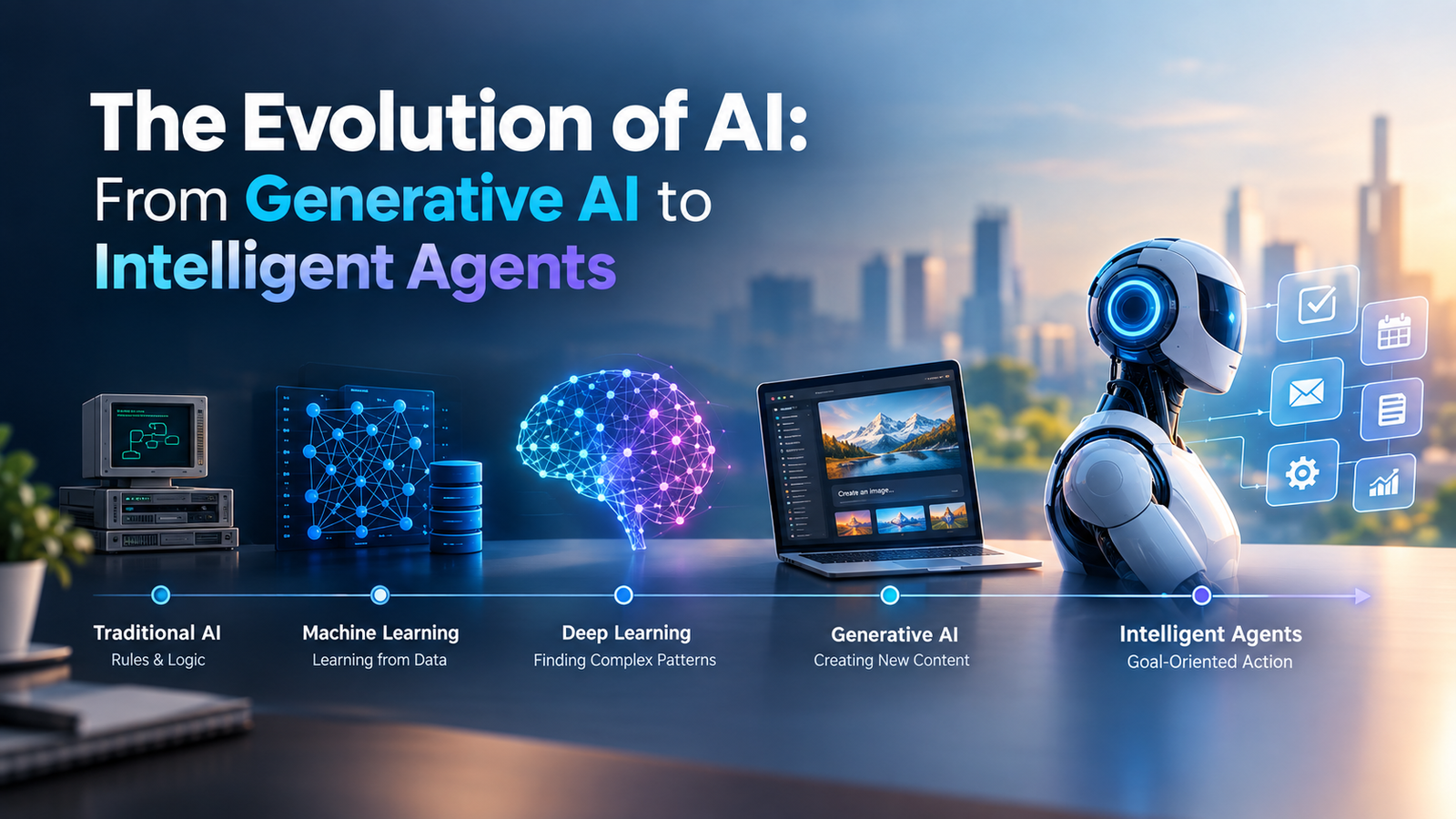
Artificial intelligence has evolved from rule-based software and experimental computer programs to systems that learn from data, generate content, interpret natural language, and interact with digital environments.
This evolution of AI has occurred through several major technological developments. Early systems relied heavily on explicit rules. Later, machine learning let computers identify patterns in data. Deep learning improved performance in areas such as computer vision and speech recognition, and large language models further expanded computers’ ability to work with human language.
Generative AI was another important milestone. Instead of simply classifying or predicting information, generative systems can create text, images, audio, video, and software code.
Now, the industry is increasingly exploring AI agents and agentic AI. These systems are designed to go beyond producing a single response by planning tasks, using tools, interacting with software, and working toward defined objectives.
The change can be summarized:
Rules → Learning → Deep Learning → Generation → Goal-Oriented Action
Understanding this progression helps explain why AI agents are attracting attention across U.S. businesses, technology companies, developers, and consumers.
The Early Evolution of AI
From Rules to Machine Intelligence
The foundations of AI emerged from efforts to understand whether machines could perform tasks associated with human reasoning.
Early systems were primarily symbolic and rule-based. Developers represented knowledge using explicit instructions and logical relationships.
For example:
IF an invoice is overdue
THEN send a reminder.
This method worked well when conditions were predictable. However, real-world situations contain exceptions, uncertainty, incomplete information, and changing circumstances, which made the approach less flexible.
A system based entirely on manually written rules can become complicated as the number of possible situations grows.
This limitation helped drive interest in machine learning, which offered a more flexible approach.
Machine Learning Changes the Model
How Machine Learning Expanded AI
Machine learning introduced a different approach.
Instead of telling software every rule it needs, developers can provide data and train models to identify patterns associated with particular outcomes.
Machine learning has become central to applications such as:
- Fraud detection
- Recommendations
- Search ranking
- Forecasting
- Image recognition
- Speech processing
- Customer analytics
This approach lets systems adapt to patterns that are difficult to describe manually, making it a major step beyond fixed rules.
The transition was significant:
Traditional programming: humans define the rules.
Machine learning: humans provide data, objectives, and algorithms while the model learns useful statistical patterns.
Machine learning became a foundation for the later growth of deep learning and modern AI.
Deep Learning and a New Wave of AI
Why Deep Learning Matters
Deep learning is a branch of machine learning based on multi-layer neural networks.
Its success helped accelerate progress in computer vision, speech recognition, natural language processing, and other demanding applications.
A major turning point came during the 2010s, when advances in neural-network architectures, large datasets, graphics processors, and distributed computing improved machine-learning performance.
Deep learning became particularly effective at extracting complex patterns from large amounts of information.
As a result, this created the foundation for today’s more advanced AI systems and set the stage for large language models.
The Rise of Large Language Models
Language Becomes a Major AI Interface
One of the biggest developments in recent AI history has been the rapid advancement of large language models.
LLMs are trained on large datasets and learn statistical relationships within language and other forms of information. They can generate and transform text, assist with coding, summarize documents, answer questions, and support many other tasks.
The Transformer architecture, introduced in the 2017 paper Attention Is All You Need, played an important role in modern language-model development.
The practical impact was enormous.
As a result, users could increasingly communicate with AI using ordinary language instead of complicated commands.
For example:
“Summarize this report and identify the most important risks.”
The simplicity of this interaction helped make AI accessible to people without specialized technical knowledge.
That development led directly to the expansion of generative AI, which turned language capabilities into content creation.
What Is Generative AI?
Creating New Content
Generative AI refers to systems that create new content from patterns learned during training.
Depending on the model, that content may include:
- Text
- Images
- Audio
- Video
- Code
- Structured information
A traditional image classifier might identify an object in a picture. A generative model can create a new picture based on a description.
Similarly, a classification system can identify whether customer feedback is positive or negative, while a generative model can draft a response.
This ability changed how people use AI.
Students can ask for explanations. Developers can generate code. Businesses can draft documents. Designers can create visual concepts. Researchers can summarize complex information.
Generative AI made AI a practical creative and productivity tool for a much broader audience, setting up the move toward agent-based systems.
Why Generative AI Is Not the Same as an AI Agent
Generation vs. Action
The distinction between generative AI and AI agents is important.
A generative model can produce an answer, document, image, or piece of code.
An agent can use that capability as one part of a larger workflow, moving from generation to action.
Consider this request:
“Research three competitors, compare their pricing, and prepare a report.”
A standard generative AI interaction might explain how to do the research or create a report from information the user already supplied.
An agent could potentially:
- Search for information.
- Retrieve relevant sources.
- Extract pricing details.
- Compare findings.
- Identify missing information.
- Organize the results.
- Produce the report.
The difference, then, is not simply intelligence.
It is the ability to operate through a sequence of actions toward a goal, which is what sets agents apart.
What Are AI Agents?
Understanding Intelligent Agents
AI agents are systems designed to accomplish objectives by combining an AI model with instructions, tools, context, and an environment where actions can take place.
The exact definition varies, but modern agent systems commonly involve some combination of:
- Goal interpretation
- Planning
- Tool selection
- Information retrieval
- Action
- Observation
- Adjustment
A simplified process looks like this:
Goal → Plan → Act → Observe → Adjust → Complete
This structure allows an AI system to handle tasks that require more than a single response and move from one step to the next.
The term intelligent agents is broader than the current LLM-based use of the word “agent.” In computer science, intelligent agents have long been associated with systems that perceive an environment and act toward objectives, and today’s systems build on that idea.
Today’s agentic systems build on that idea using modern foundation models and software tools.
What Is Agentic AI?
Moving Toward Goal-Oriented Systems
Agentic AI generally describes AI systems that can make goal-oriented decisions.
Traditional software follows predefined logic.
A more agentic system may determine which permitted action should happen next based on the current state of a task, rather than following a fixed path.
For example, a support system might receive:
“Resolve this customer’s delivery issue.”
An agent may need to:
- Retrieve the order
- Check shipping information
- Review company policies
- Determine available options
- Communicate with the customer.
- Escalate the issue when necessary.
The agent is still constrained by the tools, policies, permissions, and environment its developers provide, so each action remains bounded by context.
Agentic does not automatically mean unrestricted autonomy.
AI Agents Examples in the Real World
1. Customer Service Agents
Customer-support systems can combine language models with company databases, order-management software, CRM platforms, and knowledge bases.
Instead of simply answering a question, an agent could potentially locate an order, check its status, explain a problem, and initiate an approved support process.
This can reduce the number of manual steps required for routine cases.
2. Coding and Software Development Agents
Software engineering is one of the strongest areas for agent-based workflows.
A coding agent can potentially:
- Inspect a repository
- Locate relevant files
- Modify code
- Run tests
- Read error messages
- Debug problems
- Repeat the process when needed.
This is different from asking an AI to generate a single function. Instead, the system is working through a broader development task, step by step.
3. Research Agents
Research agents can help gather and organize information from multiple sources.
A typical workflow may involve:
Question → Search → Retrieve → Compare → Verify → Summarize
Possible applications include:
- Market research
- Competitive analysis
- Academic research
- Industry monitoring
- Product research
Human verification remains important because automated systems can misinterpret evidence or produce unsupported claims.
4. Marketing Agents
Marketing teams can use AI systems to support multi-step activities such as:
- Campaign analysis
- Audience research
- Content preparation
- Performance reporting
- Experiment planning
An agent might examine campaign information, identify under-performing areas, gather relevant data, and prepare materials for human approval.
5. Sales Agents
AI can support sales teams by helping with:
- Lead research
- Account summaries
- CRM updates
- Meeting preparation
- Follow-up drafts
- Opportunity analysis
The value comes from reducing administrative work and letting sales professionals focus on customer relationships and decisions.
6. Finance and Accounting Agents
Finance departments handle large volumes of structured documents and repetitive processes.
Potential agent applications include:
- Invoice processing
- Expense review
- Document extraction
- Transaction categorization
- Report preparation
- Anomaly investigation
Because financial mistakes can have significant consequences, these systems typically require strong controls and human review.
7. Healthcare Administration Agents
In healthcare, many potential applications are administrative rather than clinical.
Examples include:
- Appointment scheduling
- Document organization
- Information extraction
- Insurance workflow support
- Patient communication assistance
More sensitive healthcare applications require additional safeguards because errors can directly affect patients.
8. Personal Productivity Agents
Consumer-facing agents can assist with tasks involving digital information.
Examples include:
- Organizing documents
- Preparing summaries
- Managing recurring tasks
- Searching for information
- Coordinating calendars
- Drafting communications
The long-term appeal is delegating routine digital work, not just asking questions.
9. E-Commerce Agents
Shopping agents can combine product search, filtering, comparison, and decision support.
A user might specify:
“Find a laptop under $1,000 with 16GB of RAM and long battery life.”
An agent could potentially search multiple sources, compare specifications, eliminate unsuitable products, and present the remaining options.
An actual purchase should generally require clear user authorization.
How AI Agent Technology Works
Core Components of an Agent
Modern AI agent technology usually combines several parts.
Foundation Model
A large language model or multi-modal model provides capabilities such as language understanding, reasoning, image interpretation, or code generation.
Instructions
The system needs clear rules and objectives.
For example:
“Monitor incoming support requests and escalate cases that meet these criteria.”
Tools
Tools let an agent interact with external systems.
These may include:
- Search engines
- APIs
- Databases
- Calculators
- File systems
- Browsers
- Business applications
Context and Memory
Agents need relevant information about the current task. Depending on the system, this may include prior actions, retrieved documents, task history, or user-provided information.
Planning
Complex goals often need to be broken into smaller steps.
For example:
Goal: Build a market report.
Process: Gather data → compare competitors → identify trends → prepare report.
Environment
The environment is the digital or physical setting in which actions occur.
It could be a browser, a software repository, an enterprise application, or a robotic system.
AI Automation vs. AI Agents
Understanding the Difference
AI automation and agentic systems overlap, but they are not identical.
Traditional automation usually follows a predetermined path.
For example:
Form submitted → record created → email sent.
The process is fixed.
An agentic workflow can be more flexible:
Read request → interpret situation → choose available tool → take action → evaluate result.
This flexibility is useful when the task cannot easily be reduced to a fixed sequence.
However, deterministic automation remains valuable.
A company would not necessarily replace a simple, reliable workflow with a probabilistic AI system simply because an agent is available.
The best architecture depends on the problem.
In many cases, the practical solution is a combination of:
Automation + AI + Human Oversight
How AI Agents Differ From Traditional Chat-bots
From Conversation to Task Completion
The difference becomes clearer through examples.
Traditional chat-bot
User: “Why did my website traffic decline?”
The chat-bot explains possible causes.
Generative AI assistant
User: “Analyze this traffic report.”
The system reviews the supplied data and identifies patterns.
Agentic system
User: “Investigate the traffic decline and prepare a report.”
The agent may inspect analytics, compare time periods, examine related information, organize evidence, and create a report.
Each stage adds more interaction with data and tools.
The progression is:
Answer → Analyze → Act
The Role of Large Language Models in AI Agents
Why LLMs Are Useful for Agents
Large language models are particularly useful in agent systems because they can interpret natural-language goals and translate them into potential actions.
Suppose a user says:
“Find the latest sales report and summarize the major changes.”
The model can help determine:
- Where the report may be located.
- Which tool should be used.
- What information needs to be extracted.
- How the final response should be organized.
The model does not necessarily perform every operation itself. Tools handle many external actions.
This makes the LLM a kind of reasoning and orchestration layer within the broader system.
Multi-modal AI Expands Agent Capabilities
Beyond Text
The next generation of agents will increasingly work with multiple forms of information.
These may include:
- Text
- Images
- Audio
- Video
- Code
- Structured data
Real-world tasks often require several of these at once.
A customer-support agent might need to read a complaint and inspect an uploaded image.
A software agent may need to interpret source code and a visual error.
A manufacturing system could combine camera images with sensor information.
Multi-modal capabilities therefore make agents more practical for complex environments.
AI Agents in U.S. Businesses
Why Organizations Are Experimenting With Agents
U.S. companies are increasingly adopting AI for a range of business activities, while broader deployment of highly autonomous agents remains a developing area.
Businesses are particularly interested in workflows involving:
- Repetitive research
- Document processing
- Customer support
- Coding
- Data analysis
- Administrative coordination
Consider procurement.
A typical process may include:
Request → Supplier Search → Price Comparison → Policy Check → Approval → Documentation
An agent could assist with several stages while keeping important approvals under human control.
The business value comes from reducing manual effort without sacrificing accountability.
Benefits of Agentic AI
Why Organizations See Potential
Agent systems offer several practical advantages for suitable tasks.
Multi-Step Task Handling
They can coordinate several actions instead of stopping after one response.
Productivity
Employees can delegate routine research, documentation, and administrative work.
Tool Integration
Agents can bring together information from multiple software systems.
Adaptability
They may respond differently depending on a task’s current state rather than following the same path every time.
Continuous Assistance
Some systems can monitor workflows or information sources and respond when predefined conditions occur.
These benefits are strongest when the process is repetitive but not completely predictable.
Limitations and Risks
Why AI Agents Still Need Controls
Agents’ capabilities should not be confused with perfect reliability.
Incorrect Decisions
A mistake at one stage can affect every later step.
Hallucinations
A model may produce information that sounds convincing but is not supported by evidence.
Tool Errors
An agent may choose the wrong tool, supply incorrect parameters, or misunderstand a response.
Security Problems
Connecting AI to business systems creates risks involving unauthorized access, data exposure, and malicious inputs.
Privacy
Agents may handle sensitive company or personal information, making data governance important.
Cost
A long task involving multiple model calls and tools can cost more than a simple interaction.
Latency
Multi-step processing may also take longer than traditional software workflows.
These limitations are why evaluation and monitoring are essential.
Human Oversight in Agentic Systems
Keeping People in Control
A practical approach is to assign different levels of autonomy to different tasks.
An agent may automatically perform low-risk activities while requiring human approval for actions with greater consequences.
For example:
Agent: Research suppliers and compare prices.
Human: Approve supplier.
Agent: Prepare purchase order.
Human: Confirm purchase.
Agent: Submit approved order.
This approach combines automation with accountability.
For financial transactions, healthcare processes, legal matters, employment decisions, and sensitive data, organizations may require additional review and stronger safeguards.
Security and AI Agent Technology
New Risks From Tool Access
Giving AI access to external tools creates security considerations that are less important in a simple chat-bot.
Potential risks include:
- Prompt injection
- Data leakage
- Excessive permissions
- Unauthorized actions
- Malicious files
- Unsafe browser interactions
- Incorrect API usage
For this reason, agent systems should be designed around least-privilege access, clear permission boundaries, logging, testing, and confirmation for sensitive actions.
An agent should generally receive only the access required to complete its assigned work.
Multi-Agent Systems
When Several Agents Work Together
Some complex applications use multiple specialized agents rather than a single general-purpose agent.
For example:
Research Agent → gathers information
Analysis Agent → evaluates findings
Writer Agent → produces a report
Reviewer Agent → checks the result
A human can remain responsible for final approval.
The advantage is specialization.
The disadvantage is increased complexity.
Each additional agent introduces another possible point of failure, communication overhead, and cost. Multi-agent architecture therefore makes sense only when specialization clearly benefits the system.
AI Agents and Robotics
Bringing AI Into the Physical World
AI’s evolution isn’t limited to software.
Robotic systems can combine intelligent decision-making with physical machines.
A digital agent can interact with a browser or database.
A robotic agent has to interact with an unpredictable physical environment.
That environment introduces additional challenges such as:
- Sensor uncertainty
- Moving objects
- Physical constraints
- Different lighting
- Mechanical limitations
- Safety requirements
Digital autonomy is therefore generally easier to scale than physical autonomy.
Nevertheless, advances in computer vision, robotics, multi-modal AI, and hardware are bringing these fields closer together.
AI Innovation Is Shifting From Generation to Action
A Major Change in the AI Landscape
The defining change in recent AI innovation is not simply that models have become larger.
The more important development is that AI systems are increasingly being connected to tools and environments.
The progression can be expressed as:
Generate → Understand → Plan → Act → Verify
Generative AI made machines capable of producing useful content.
Agentic systems aim to use those capabilities within larger workflows.
This changes how we evaluate AI.
A model that writes a good paragraph may be useful.
A system that can reliably complete a complex business task is useful in a different way.
The challenge is ensuring that the added autonomy does not introduce unacceptable errors or security risks.
AI Agents Examples for the Future
Where Agentic Systems Could Expand
The range of potential applications is broad.
Personal Knowledge Management
Agents may organize documents, notes, schedules, and digital information into a more usable personal system.
Enterprise Operations
Businesses may use agents to coordinate workflows across departments.
Software Engineering
Coding agents could increasingly handle larger portions of development, testing, and maintenance.
Scientific Research
AI systems may assist with literature review, data analysis, computational experiments, and research planning.
Education
AI tutors could provide more adaptive lessons and personalized practice.
Robotics
Autonomous systems may become better at performing tasks in warehouses, factories, healthcare facilities, and other controlled environments.
The pace of adoption will depend on accuracy, cost, security, regulation, and the economic value of each application.
The Future of AI
What Comes Next?
The future of AI will likely be shaped by multiple technologies working together.
Important areas include:
- More capable foundation models
- Multi-modal systems
- Agentic AI
- Robotics
- Specialized models
- Better AI hardware
- Improved security
- Stronger evaluation methods
- Human-AI collaboration
Future progress will not depend solely on making models larger.
Developers also need better ways to measure reliability, control behavior, protect information, and understand how systems perform over long tasks.
That means the next stage of AI development is as much about engineering and governance as it is about model capability.
How Businesses Can Prepare for AI Agents
A Practical Adoption Strategy
Organizations considering agents should begin with the business problem rather than the technology.
1. Find Suitable Workflows
Identify repetitive processes involving research, documentation, analysis, or coordination.
2. Measure Current Performance
Track time, cost, errors, and business outcomes before introducing AI.
3. Start Small
A narrowly defined task is easier to test than a system given access to an entire organization.
4. Define Permissions
Specify exactly what the agent can read, modify, send, or approve.
5. Establish Human Review
Set clear rules for when a person must intervene.
6. Evaluate Continuously
Measure completion rate, accuracy, cost, latency, and failure patterns.
7. Expand Carefully
Increase the scope of automation only after the system demonstrates reliable performance.
This approach reduces the risk of adopting agentic technology simply because it is new.
Skills for the Agentic AI Era
What Professionals Should Understand
The growth of intelligent systems is increasing demand for both technical and practical AI skills.
Technical roles may benefit from knowledge of:
- Machine learning
- Deep learning
- Large language models
- APIs
- Software engineering
- Data engineering
- Cloud computing
- AI evaluation
- Cybersecurity
- Automation
Non-technical professionals can also benefit from understanding:
- AI capabilities
- AI limitations
- Data quality
- Workflow design
- Verification
- Privacy
- Responsible AI
An important skill is knowing when a task should remain automated through conventional software instead of being delegated to an AI agent.
The strongest AI strategy is not maximum autonomy.
It is appropriate automation for the right problem.
Generative AI vs. AI Agents
Key Differences
| Feature | Generative AI | AI Agents |
| Primary purpose | Generate content | Accomplish goals |
| Typical interaction | Prompt and response | Goal and task execution |
| Planning | Often limited | Frequently important |
| Tool use | Optional | Common |
| External systems | May not be required | Often connected |
| Task length | Usually shorter | Often multi-step |
| Autonomy | Generally lower | Can be higher |
| Verification | Usually user-driven | May be built into workflow |
| Example | Write a report | Research, analyze, and prepare a report |
These categories can overlap. An agent may rely heavily on generative AI for writing, summarization, coding, or communication.
Key AI Agents Examples to Remember
For readers researching AI Agents Examples, the major categories include:
Customer Service Agents — support customer interactions and retrieve account information.
Coding Agents — inspect repositories, modify software, test changes, and assist with debugging.
Research Agents — gather, compare, and organize information.
Marketing Agents — support campaign analysis and content workflows.
Sales Agents — help with lead research, CRM activities, and follow-ups.
Finance Agents — assist with document and transaction workflows.
Productivity Agents — manage recurring digital tasks and information.
Shopping Agents — search, compare, and organize product choices.
Enterprise Knowledge Agents — work with internal information and company applications.
Robotic Agents — combine AI decision-making with physical machines.
The common feature is not the industry.
It is the system’s ability to work toward an objective through multiple steps.
Frequently Asked Questions
What are AI agents?
AI agents are systems designed to work toward goals by interpreting instructions, using information and tools, taking actions, and adapting as a task progresses.
What is the difference between generative AI and AI agents?
Generative AI focuses on producing content such as text, images, audio, video, or code. AI agents use AI capabilities within broader workflows that may involve planning, tools, and actions.
What are AI agent examples?
Common examples include customer-service agents, coding agents, research agents, sales agents, marketing agents, productivity assistants, enterprise knowledge systems, shopping agents, and robotic systems.
What is agentic AI?
Agentic AI generally refers to systems that can pursue goals using planning, decision-making, tools, and actions instead of simply generating a single response.
Are AI agents fully autonomous?
No. Agent autonomy varies widely. Some systems operate within tightly defined workflows, while others can make more dynamic decisions. Even advanced systems can make mistakes and therefore require appropriate oversight.
Can AI agents replace traditional automation?
Not necessarily. Traditional automation is often preferable for predictable, deterministic processes. Agents are more useful when tasks require interpretation or flexible decision-making.
Do AI agents use large language models?
Many modern agents use large language models or multi-modal foundation models as part of their architecture, but an agent can also incorporate other AI models and conventional software.
Will AI agents change jobs?
They will likely change many workflows by automating or assisting with specific tasks. The impact will differ across industries, occupations, and individual responsibilities.
Conclusion
AI has evolved through several major stages.
Rule-based systems introduced machine reasoning. Machine learning enabled systems to learn patterns from data. Deep learning expanded performance in areas such as vision and language. Large language models made natural-language interaction far more powerful, while generative AI transformed machines into tools for creating content.
The next major development is the increasing use of AI agents and agentic AI.
Rather than simply generating an answer, an agent can be designed to work toward an objective by combining reasoning, tools, information, and actions. This opens possibilities across customer service, software development, research, business operations, education, finance, and robotics.
Yet autonomy introduces new challenges.
Reliability, security, privacy, cost, and human oversight remain central considerations. A successful agent is therefore not simply one that can perform many actions. It performs the right actions consistently within clearly defined boundaries.
For U.S. businesses and consumers, the significance of this transition is becoming clearer.
The future of AI is moving from systems that primarily respond and generate toward systems that can increasingly plan, execute, and collaborate.
That shift may define the next chapter of artificial intelligence: not machines that merely produce information, but intelligent systems designed to help people accomplish meaningful work.





Leave a Reply