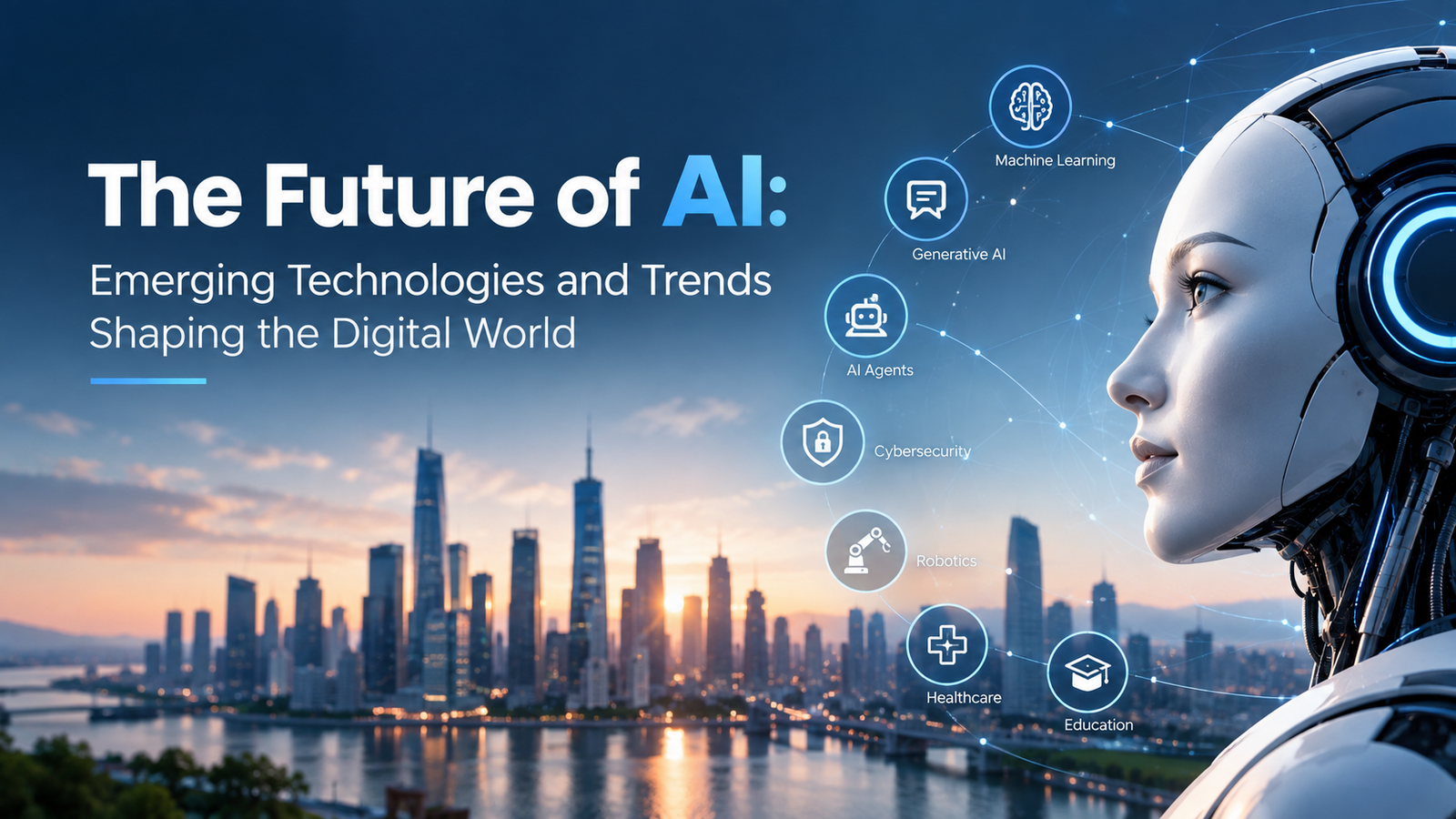
Artificial intelligence has rapidly become part of modern digital life. It now supports search, content creation, software development, data analysis, customer service, cybersecurity, and many other activities once handled entirely by people.
But what is the future of AI? The key takeaway is that it is moving beyond larger or more powerful models. The next stage is likely to focus on practical usefulness: making AI more useful in real-world workflows, better at handling different types of information, and more capable of taking action through software and connected systems. These changes set up the major trends that follow.
The future of artificial intelligence will be shaped by technologies such as generative AI, AI agents, agentic AI, machine learning, robotics, multi-modal systems, and AI automation. At the same time, privacy, security, reliability, energy consumption, regulation, and AI’s impact on society will influence how quickly these technologies can be adopted.
Stanford’s 2026 AI Index reports that organizational AI adoption reached 88% and documents major gains in language, coding, reasoning, robotics, and agentic capabilities. It also notes that some AI benchmarks are becoming outdated quickly as systems improve.
This article examines the major AI trends, emerging AI technologies, industry applications, opportunities, and challenges that will define the future of AI in the digital world.
How Artificial Intelligence Is Changing Technology
Modern AI differs from conventional software because it can learn patterns from data and use those patterns to generate outputs, predictions, classifications, and recommendations.
Machine learning provides one of the core foundations of AI. It enables systems to learn from examples instead of relying entirely on manually written rules. Deep learning, a type of machine learning based on multi-layer neural networks, has driven major advances in speech recognition, computer vision, natural language processing, and generative systems.
Another important change is the growth of multi-modal AI. Earlier systems often focused on one format, such as text or images. Newer systems can work across combinations of text, pictures, audio, video, documents, and software interfaces.
This is changing the way people use technology. Users can increasingly communicate with software in ordinary language instead of learning a complicated sequence of commands.
For example, a user could ask an AI assistant to analyze a report, identify important trends, create a summary, and prepare a presentation outline. The system becomes an interface between the user and several digital capabilities.
That shift is central to how artificial intelligence is changing technology. AI is becoming part of the infrastructure of digital services rather than a standalone feature. This evolution reinforces the article’s core thesis about practical usefulness over technical scale.
Major AI Trends to Watch
The coming years are likely to be influenced by several interconnected artificial intelligence trends. The first major area is generative AI.
1. Generative AI Will Become More Specialized
Generative AI has already transformed digital content creation. It can produce text, images, code, audio, video, summaries, and other outputs.
The next phase is likely to focus on specialization.
Instead of relying only on general-purpose chat-bots, organizations can build AI systems around particular business functions, internal documents, industry knowledge, and operational requirements.
A marketing department could use AI for campaign concepts and drafts. A software team could use it for code assistance and testing. A customer support operation could connect AI to approved company knowledge so employees can find answers faster.
Generative AI is also becoming more multi-modal, allowing systems to combine different types of information in one interaction.
This makes the technology more useful because the value comes from applying generation to specific problems rather than from generation itself. That specialization also points toward the next trend: AI agents and task completion.
2. AI Agents Will Focus on Completing Tasks
One of the most significant emerging artificial intelligence technologies is the AI agent.
A basic chat-bot normally responds to an individual request. An agent can be designed to pursue a goal through a sequence of steps, retrieving information, using software tools, analyzing results, and performing authorized actions.
This is closely associated with agentic AI. In this context, the distinction is important because the term highlights goal-driven behavior across multiple steps.
For instance, an AI agent could be given a business research task. Instead of only answering a question, it could gather information from approved sources, organize findings, compare data, and prepare a report for review.
Stanford’s 2026 AI Index reports substantial progress on computer-use benchmarks, with performance on OSWorld rising to 66.3%, while also showing that agents still fail many tasks.
That distinction matters. The key takeaway is that agents are becoming more capable, but dependable autonomy remains an engineering challenge, which makes supervised use the most practical near-term approach.
The most practical near-term use may be supervised agents that handle defined workflows while people retain control over important decisions. This focus on guided task completion connects directly to broader automation.
3. AI Automation Will Become More Intelligent
Automation traditionally depends heavily on predefined rules. AI can extend automation into activities involving language, classification, prediction, and interpretation.
This allows businesses to automate parts of workflows that previously required manual review.
Examples include:
- sorting and summarizing customer requests;
- extracting information from documents;
- identifying unusual transactions;
- preparing routine reports;
- assisting with scheduling and administration;
- supporting internal knowledge searches.
The combination of AI and automation can reduce repetitive work, but successful implementation depends on selecting tasks that are predictable enough to automate and important enough to justify deployment. For that reason, many organizations will automate selected activities within existing roles rather than entire jobs, and that approach leads into how AI is moving through business workflows.
Many organizations are likely to automate selected activities within existing roles rather than entire jobs. That approach also shapes how AI is moving through business workflows.
AI in Business: From Experimentation to Workflow Integration
AI in business is moving from isolated experimentation toward integration with existing software and processes. As this shift continues, companies are applying AI to customer service, sales, marketing, finance, analytics, operations, and software development.
Companies are applying AI to customer service, sales, marketing, finance, analytics, operations, and software development. These systems often create value by connecting AI with company data and business tools.
For example, a customer service system could use AI to summarize conversations and suggest responses while a human employee makes the final decision. A sales team could use AI to identify trends in customer interactions. An operations department could apply machine learning to forecasting and demand planning.
McKinsey’s research has found growing experimentation with AI agents and continued challenges in moving from individual pilots to organization-wide value.
This suggests that future adoption will depend on implementation rather than enthusiasm alone. In turn, companies will need clear objectives, suitable data, secure integration’s, employee training, evaluation procedures, and governance.
These requirements are especially important in sectors such as healthcare, education, and cybersecurity.
AI in Healthcare: Improving Analysis and Support
Healthcare is among the most important areas for AI applications because medical systems generate large amounts of complex information.
AI can support medical imaging, administrative documentation, pattern recognition, clinical decision support, and other specialized tasks.
The U.S. Food and Drug Administration maintains a public list of AI-enabled medical devices authorized for marketing in the United States. The list includes devices used in areas such as radiology and other clinical applications.
As the technology develops, AI in healthcare may become more integrated with clinical workflows. In that case, systems could combine information from records, imaging, laboratory results, and other approved sources to support healthcare professionals.
However, healthcare requires a higher standard of evaluation than many low-risk applications. For this reason, accuracy, validation, privacy, cybersecurity, and accountability are essential because mistakes can affect patient care.
The FDA has also continued evaluating regulatory considerations for generative AI-enabled medical devices, showing that technical progress and oversight are developing together. A similar balance will matter in education and cybersecurity, where AI adoption also depends on careful evaluation.
AI in Education: More Personalized Learning
The education sector offers another important example of how AI can support people without replacing teachers.
AI can explain concepts, provide practice exercises, assist with language learning, summarize materials, and help educators prepare lessons.
Students may eventually receive more personalized explanations based on their level of understanding. Teachers could use AI to reduce administrative work and prepare differentiated learning resources.
The U.S. Department of Education issued guidance in 2025 discussing AI use in education and responsible implementation.
There are also clear concerns. Schools must consider academic integrity, student privacy, inaccurate information, unequal access, and the risk of over-dependence on automated systems.
For that reason, future educational AI will likely work best as a support layer around teachers and students, not a substitute for human instruction.
AI Cybersecurity: Defending Against Smarter Threats
Cybersecurity is becoming closely tied to AI because both defenders and attackers can use intelligent systems.
Security teams can apply AI to detect anomalies, analyze large volumes of alerts, identify suspicious behavior, and support incident response.
Attackers can also use AI to increase the speed or scale of certain malicious activities. In contrast, defenders must adapt quickly to keep pace.
NIST has documented several adversarial machine learning threats, including evasion, poisoning, and privacy attacks. These risks show why AI security must evolve alongside AI capabilities.
Agentic systems create another dimension of risk. An AI agent connected to email, databases, software applications, or files may have more opportunities to cause harm if access controls are weak or the system is manipulated.
As a result, AI cybersecurity must cover both traditional digital threats and risks introduced by AI itself.
Organizations will increasingly need strong identity controls, monitoring, permission systems, secure model deployment, audit logs, and methods for testing AI behavior.
AI Robotics: Intelligence in the Physical World
AI robotics extends machine intelligence beyond digital environments.
Robots can combine computer vision, sensors, planning, machine learning, and physical control to perform tasks in factories, warehouses, hospitals, agriculture, transportation, and other settings.
One challenge is that physical environments are far less predictable than software environments.
Stanford’s 2026 AI Index found that robots performed much better in controlled environments than in general household tasks. Its findings illustrate how difficult it remains to build machines that can reliably operate across varied real-world conditions.
Progress in robotics is therefore likely to come through a combination of better models, sensors, simulation, hardware, and specialized training.
Autonomous vehicles provide another example of this progression, as AI-based systems have expanded from research environments into commercial operations.
Multi-modal AI and Next-Generation Assistants
One of the clearest AI advancements is the ability to combine multiple types of information.
Multi-modal systems can work across text, images, audio, video, documents, and interfaces. This allows users to provide information in whichever format is most convenient.
A worker could upload a document and an image and ask for a comparison. A student could use a diagram and a written question in the same interaction. A technician could provide a photo of equipment and request an explanation of possible issues.
These capabilities can make AI more accessible while reducing the need to use each application separately.
The next-generation AI assistant may therefore function as an intelligent interface across several digital services.
AI Infrastructure and the Growth of Computing Demand
Behind every advanced AI system is a large infrastructure ecosystem.
AI requires computing hardware, data storage, networking, software frameworks, and data centers. As AI adoption increases, demand for this infrastructure also grows.
The International Energy Agency reported that global electricity consumption from data centers was about 485 TWh in 2025 and projects that it could roughly double to around 950 TWh by 2030 in its base case. AI-focused data center consumption is expected to grow faster than overall data center demand.
The issue matters especially in the United States, which accounts for a large share of global data center infrastructure. The U.S. Department of Energy has projected strong growth in the share of American electricity data centers consume through 2030.
These figures do not mean that every AI prompt uses the same amount of energy. Actual requirements vary according to model size, workload, hardware, utilization, cooling, and other technical factors.
Nevertheless, infrastructure is becoming central to AI strategy.
Energy Efficiency as a Future AI Priority
More powerful AI does not necessarily mean that every application needs a larger model.
Businesses often need systems that are fast, affordable, private, and reliable for a particular purpose.
That creates opportunities for smaller models, specialized models, model compression, optimized inference, efficient chips, better data pipelines, and improved software architectures.
The IEA has identified improvements in both hardware and software efficiency as important factors that could affect future data center energy demand.
This means AI innovation will increasingly involve efficiency as well as raw capability.
The AI industry may therefore compete not only around how much a model can do, but also how cheaply, quickly, and efficiently it can do it.
AI Applications in Everyday Life
The artificial intelligence applications people encounter in everyday life are likely to become more integrated and less visible.
Search systems can become more conversational. Digital assistants can handle more complex requests. Translation can become more natural. Smart devices can use AI to recognize speech, images, and environmental context.
AI can also support recommendation systems, financial services, navigation, accessibility tools, shopping platforms, entertainment, and customer support.
Many future systems may not even advertise themselves as “AI products.” AI could simply become a standard layer inside common digital services.
That would represent a major step in AI transformation, because intelligence would become part of normal computing rather than something users access separately.
How AI Will Change the Digital World
The future of AI could change the basic relationship between people and software.
Currently, users usually open an application, locate a feature, enter information, and complete a sequence of steps.
AI systems introduce another model: the user describes an objective, and the system determines how to assist.
For example, a person might ask an AI assistant to summarize a set of documents and organize the findings. Instead of manually opening each document, the user could interact with an AI system connected to authorized information sources.
Businesses could similarly use intelligent systems to coordinate actions across customer service platforms, analytics software, inventory databases, and internal knowledge systems.
This does not necessarily eliminate traditional applications. Instead, AI may become an additional layer of interaction that connects users with the digital tools they already have.
The Future of Jobs and Skills
AI’s effect on employment will depend heavily on the tasks within individual occupations.
Some repetitive activities may become automated, while other responsibilities may become more productive with AI assistance.
For example, an analyst may spend less time cleaning or summarizing information and more time interpreting results. A programmer may spend less time producing routine code and more time reviewing architecture and managing software quality.
This means that how AI is shaping the future of work is partly a skills question.
AI literacy may become useful across many professions. Workers may need to evaluate AI outputs, protect confidential information, identify errors, and incorporate AI into existing workflows.
Technical roles may also evolve as demand grows for AI system integration, data management, model evaluation, cybersecurity, governance, and infrastructure.
The likely shift is not simply from “human jobs” to “AI jobs.” It is a transformation of the tasks people perform.
The Impact of AI on Society
AI’s impact on society extends beyond employment.
Artificial intelligence may improve accessibility, research, productivity, communication, education, and access to information. It can help people process large quantities of material and interact with technology through natural language.
At the same time, AI raises concerns about privacy, misinformation, discrimination, intellectual property, surveillance, digital inequality, and concentration of technological capabilities.
Stanford’s 2026 AI Index reports continued growth in responsible-AI activity but also identifies gaps in areas such as safety and transparency.
These challenges make governance essential to the technology’s development.
AI systems will increasingly need clear rules around data use, accountability, evaluation, security, and human oversight.
AI Ethics and Responsible Development
As AI enters higher-impact applications, AI ethics becomes increasingly important.
Organizations should consider questions such as:
- How accurate is the system for its intended use?
- What information is used to train or operate it?
- How is sensitive data protected?
- What happens when the system produces a mistake?
- Who reviews high-impact outputs?
- Can the system be monitored after deployment?
- Are its limitations clearly communicated?
NIST’s AI Risk Management Framework provides a voluntary approach for organizations that want to incorporate trustworthiness into AI design, development, deployment, and evaluation.
Responsible AI is therefore not simply about creating rules before a product launches. It is also about continuously measuring performance and managing risks throughout the system’s life-cycle.
The Rise of Specialized AI
Another important direction is the growth of specialized AI.
Not every organization needs a general-purpose model that can handle every possible task. A company may gain more value from a smaller system optimized for a particular function.
Examples include:
A manufacturer using computer vision for quality inspection.
A financial organization using models for fraud detection.
A medical organization using specialized systems for imaging or documentation.
A cybersecurity company using AI to analyze threats.
A retailer using machine learning for demand forecasting.
This trend suggests that advanced AI technologies will increasingly be adapted to specific business and industry needs.
General-purpose systems will remain important, but specialization can improve performance, efficiency, control, and evaluation for defined applications.
AI and Scientific Discovery
Scientific research is another area where AI could have a long-term influence.
Researchers can use AI to analyze large datasets, search literature, model complex systems, identify patterns, generate hypotheses, and assist with experimental planning.
Stanford’s 2026 AI Index highlights growing AI activity across scientific disciplines, including biology, chemistry, physics, and astronomy.
This trend’s potential importance goes beyond productivity. Science often involves examining relationships that are difficult to identify manually because datasets can be extremely large and complex.
AI can help researchers explore those datasets more efficiently while scientists remain responsible for experimental design, interpretation, validation, and conclusions.
Emerging AI Technologies to Watch
As AI development advances, several technologies deserve particular attention.
Generative AI is expanding from content creation into business and professional workflows.
AI agents are moving toward multi-step task execution.
Agentic AI connects reasoning with tools and authorized actions.
Multi-modal AI combines text, vision, audio, video, and other inputs.
Machine learning and deep learning remain foundational to prediction and pattern recognition.
AI robotics extends intelligent behavior into physical environments.
AI automation helps organizations handle repetitive and information-heavy processes.
AI cybersecurity addresses both threats against AI systems and the use of AI for defense.
Edge AI can process information closer to the user or device, potentially improving latency, privacy, and connectivity.
These developments should not be viewed independently. They increasingly reinforce one another.
Challenges That Could Shape the Next Phase
AI development faces several practical barriers.
Reliability
AI systems can still produce incorrect or misleading results. Higher capability does not eliminate the need for verification.
Security
Connected AI systems and agents can introduce new attack surfaces and require careful controls.
Data Quality
Poor-quality, incomplete, or biased data can negatively affect model performance.
Infrastructure
Advanced systems require processors, networking, storage, electricity, cooling, and data centers.
Regulation
Governments and institutions continue developing rules and frameworks for issues such as privacy, safety, accountability, and high-impact AI use.
Skills
Companies may struggle to obtain the technical and organizational expertise required to deploy AI effectively.
Solving these problems will be just as important as improving model performance.
What Businesses Should Expect
For organizations in the United States, AI is increasingly becoming part of standard technology planning.
Instead of treating AI as a separate experiment, companies may integrate it into customer platforms, internal knowledge systems, analytics tools, software development environments, and operational processes.
The strongest implementations are likely to begin with a clear business problem.
A company might want faster customer response, better forecasting, reduced administrative work, improved fraud detection, or more efficient document processing.
The right AI solution depends on the problem, available data, security requirements, operating costs, and risk level.
This is why AI adoption is not only a technology decision. It is also a process, workforce, and governance decision.
What Is the Future of AI in the United States?
The United States remains a major center for AI research, investment, infrastructure, and commercialization.
Stanford’s 2026 AI Index reports that the United States continues to lead in private AI investment and has the most AI data centers.
The country’s AI ecosystem includes technology companies, startups, universities, chip manufacturers, cloud providers, research organizations, and government institutions.
That environment supports development across software, AI infrastructure, robotics, healthcare, cybersecurity, finance, education, and manufacturing.
For U.S. businesses and workers, AI knowledge is likely to become increasingly relevant across industries. Understanding how to deploy, evaluate, secure, and manage AI may be just as important as understanding how to build AI models.
The Long-Term Future of Artificial Intelligence
The future of artificial intelligence will not depend on one breakthrough.
Instead, progress will come from the combination of better models, improved hardware, larger and more useful datasets, stronger software systems, specialized applications, intelligent interfaces, and practical deployment.
Generative AI may continue improving how digital content is produced.
AI agents may handle more structured tasks.
Robotics may bring machine intelligence into more physical environments.
Multi-modal systems may make interactions more natural.
Specialized AI may solve industry-specific problems.
Efficiency improvements may make advanced systems more affordable.
Security and governance may determine where these technologies can safely be deployed.
Some predictions will inevitably prove wrong because technology development is difficult to forecast precisely. For that reason, it is more useful to focus on capabilities and measurable trends than on fixed predictions about exactly what AI will look like years from now.
Conclusion: The Next Era of AI
So, what is the future of AI?
The next era is likely to be defined by a transition from AI that simply responds to AI that increasingly supports workflows, interacts with multiple types of information, and performs defined tasks through connected digital systems.
Generative AI has already changed content creation. AI agents are pushing systems toward task completion. Agentic AI is connecting models with tools and workflows. Machine learning and deep learning continue to provide the technical foundation for many applications, while robotics extends AI into the physical world.
Meanwhile, AI in business, healthcare, education, cybersecurity, science, and everyday technology is creating opportunities alongside new responsibilities.
The most important question is no longer whether artificial intelligence will influence the digital world. That transformation is already underway.
The more important question is how effectively organizations and individuals can use AI while addressing reliability, security, privacy, cost, energy use, and social impact.
Both technological capability and responsible implementation will therefore shape AI’s future. As intelligent systems become more deeply embedded in software, infrastructure, workplaces, and everyday services, AI may eventually become less visible as a separate technology and more familiar as a normal part of how the digital world works.
Frequently Asked Questions About the Future of AI
What is the future of AI?
The future of AI is likely to involve more capable generative systems, AI agents, multi-modal models, automation, robotics, specialized applications, and intelligent digital services. Progress will also depend on reliability, security, efficiency, governance, and responsible implementation.
How is AI shaping the future?
AI is shaping the future by changing how people interact with software, analyze information, create content, automate tasks, and use digital services. Its applications are expanding across business, healthcare, education, cybersecurity, science, and other sectors.
What are the emerging trends in artificial intelligence?
Key emerging trends include generative AI, AI agents, agentic AI, multi-modal systems, AI automation, specialized models, AI robotics, AI cybersecurity, edge AI, and improved AI hardware and software efficiency.
How is artificial intelligence changing technology?
Artificial intelligence is changing technology by enabling systems to recognize patterns, understand language, generate content, make predictions, and assist with increasingly complex tasks. These capabilities are affecting software, cloud computing, robotics, automation, and digital services.
What are the latest AI technology trends?
Major AI technology trends include generative AI, agentic systems, computer-use capabilities, multi-modal AI, AI-assisted software development, robotics, specialized models, AI security, and more efficient computing infrastructure.
What are the future applications of artificial intelligence?
Future applications can include personalized healthcare support, educational assistance, autonomous business workflows, advanced cybersecurity, scientific research, robotics, customer service, predictive analytics, and intelligent digital assistants.
How will AI change the digital world?
AI is likely to make digital systems more conversational, connected, personalized, and automated. Users may increasingly describe objectives in natural language while AI systems help coordinate information and authorized actions across digital tools.
What is the future of AI and automation?
The future of AI and automation will likely involve intelligent systems that can interpret information, run multi-step workflows, and make decisions within defined limits. Human oversight will remain important for high-impact and complex decisions.





Leave a Reply