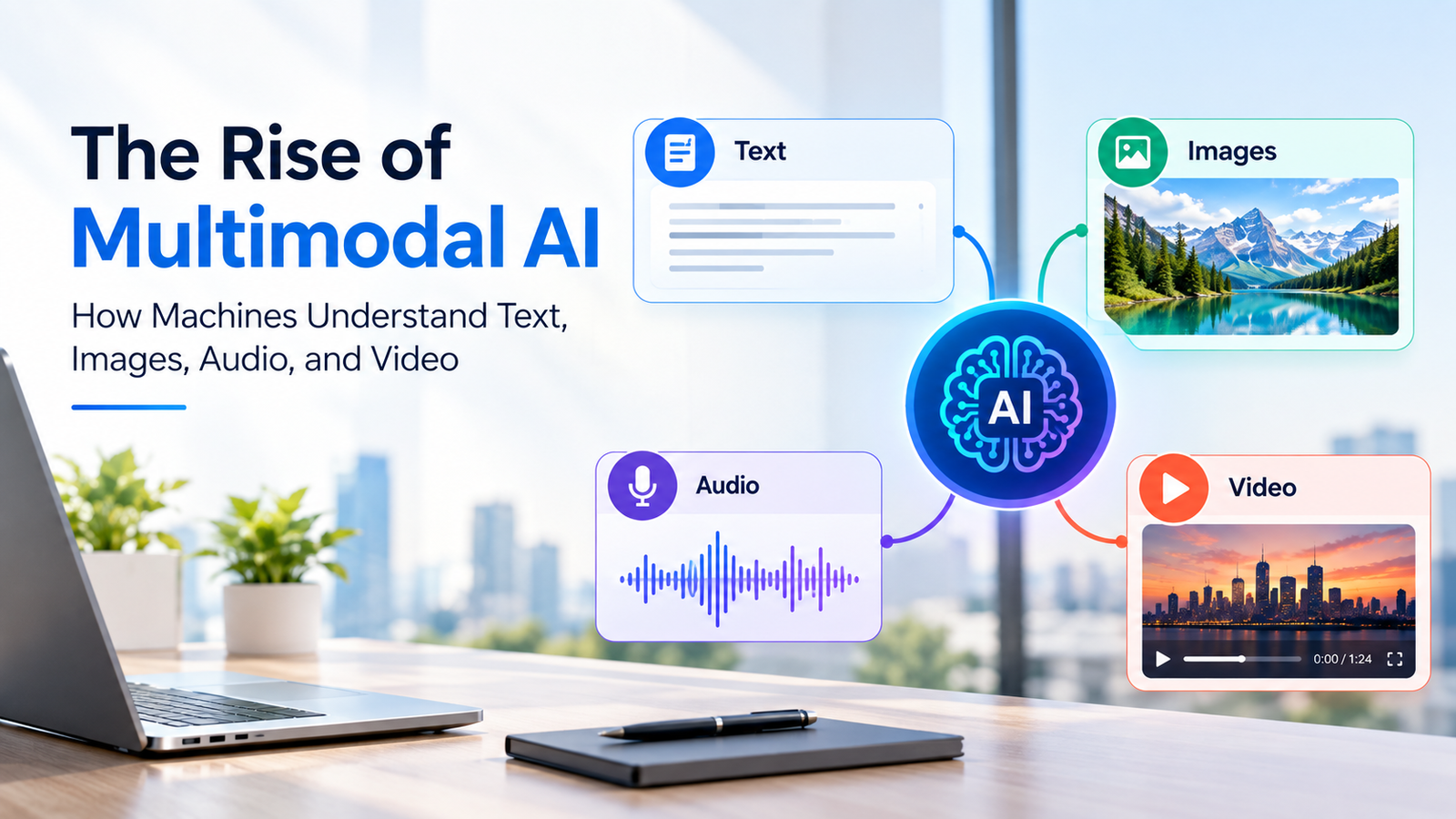
Artificial intelligence is moving beyond systems that work with only one type of information. Instead of treating text, pictures, speech, and video as separate worlds, modern AI can increasingly work across several forms of data at once. This shift is driving the rise of multimodal AI, a branch of artificial intelligence designed to process and connect information from multiple modalities.
People naturally combine what they see, hear, read, and observe over time. When someone watches a video, for example, they can understand the spoken words, identify objects on screen, recognize facial expressions, read signs, and connect those details with the surrounding context. Multi-modal systems are being developed to perform related forms of cross-modal processing with digital information.
NIST defines multi-modal models as systems that process and relate information from multiple modalities, such as vision and other human communication or sensory channels. Current developer platforms also demonstrate how far this idea has progressed. Google’s Gemini documentation describes models that can work with images, audio, video, documents, and text in the same interaction. In contrast, OpenAI describes multi-modality as understanding and generating information across formats such as text, images, audio, and video.
This technology has implications for search, education, healthcare, customer service, entertainment, software development, accessibility, business intelligence, robotics, and many other areas.
What exactly is multi-modal AI? How does it work? How is it different from traditional artificial intelligence? And why is it becoming an important part of the next generation of AI technology?
Let’s explore how systems are learning to connect text, images, audio, and video—and why that shift matters for the digital world.
What Is Multi-modal AI?
Multimodal AI refers to artificial intelligence systems that can process, understand, connect, or generate information in more than one format.
The word “multi-modal” combines two ideas: “multi,” meaning multiple, and “modal,” referring to a mode or type of information.
Common modalities include:
- Text
- Images
- Audio
- Speech
- Video
- Documents
- Structured data
- Sensor information
Traditional AI may be highly specialized. A computer vision model might analyze an image, while a natural language processing system might analyze written text. A speech-recognition system may convert spoken language into text.
Multi-modal artificial intelligence brings these capabilities together.
For example, instead of asking an AI model to analyze a photograph separately from a written description, a user might provide both and ask:
“Look at this product image and compare it with the specifications in this document.”
A multi-modal system can combine the visual information from the photograph with the textual information from the document and produce a response that considers both.
This matters because real-world information rarely exists in a single format. A customer support case might contain an email, a screenshot, a voice recording, and a screen-capture video. A doctor may work with clinical notes, medical images, test results, and patient conversations. A teacher may use textbooks, diagrams, lectures, and educational videos.
Multi-modal systems are designed for more complex environments, where different inputs must work together.
Multi-modal AI vs. Traditional AI
To understand the significance of multi-modal systems, it helps to compare them with earlier AI approaches.
Traditional AI often focused on a specific task and data type. For example, a spam filter might classify text-based emails. An image classification model might identify objects in photographs. Speech recognition could convert a recorded conversation into written words.
These technologies remain useful, but they are generally designed around particular inputs and outputs. By contrast, multi-modal AI aims to connect different kinds of information.
Multi-modal AI connects different kinds of information.
Imagine an online shopping assistant that receives a photograph of a damaged product, listens to a customer describing the problem, reads the order history, and produces a written response. That interaction requires several capabilities working together.
The system needs to interpret the image, process spoken language, understand text-based records, and combine the information into a coherent answer.
This is one reason multi-modal AI matters: it reflects how humans actually communicate with computers.
Instead of forcing users to translate everything into text, future AI interfaces can increasingly accept whatever information format is most useful in the moment.
The Four Major Modalities: Text, Images, Audio, and Video
The easiest way to understand multi-modal systems is to look at the main information types they can process.
1. Text
Text remains one of the most important forms of information for AI.
Natural language processing allows machines to work with written language for tasks such as summarization, classification, translation, question answering, information extraction, and content generation.
With multi-modal systems, text can also serve as a bridge between other forms of information.
For example, a user might upload a photograph and ask:
“What objects are visible in this image?”
The model combines the image with the user’s textual instruction to generate an answer.
Text can also be connected to audio and video. A user could provide a lecture recording and ask for a written summary, important concepts, and a list of questions based on the discussion.
This creates a more flexible relationship between language and other data types.
2. Images
Image understanding is another major part of multi-modal technology.
Computer vision helps AI systems analyze visual information, including objects, scenes, documents, diagrams, screenshots, charts, and other images.
A multi-modal system can use computer vision to identify what appears in an image and then connect that visual information with language.
For example, a business user could upload a chart and ask:
“What changed between these two periods?”
The model may analyze the chart’s visual structure and explain the apparent trends in natural language.
Likewise, someone studying a science textbook could photograph a diagram and ask for a beginner-friendly explanation.
As a result, modern multi-modal systems can make visual information easier to access for people who would otherwise need to interpret it manually.
3. Audio and Speech
Audio introduces another layer of information.
Speech recognition allows AI to convert spoken language into a machine-readable representation. From there, multi-modal systems can go beyond basic transcription by connecting spoken content with other forms of information.
For instance, an AI assistant could listen to a meeting while also processing a presentation shown during that meeting.
Instead of producing only a transcript, the system could potentially organize discussion points according to the slides being presented.
Audio can include more than words. It may contain environmental sounds, music, changes in tone, pauses, and other signals. Depending on the model and application, these signals can provide additional context.
This makes audio especially valuable for customer service, education, media analysis, accessibility, and real-time interfaces.
4. Video
Video combines several modalities at once.
A video can contain moving images, spoken language, written text, sounds, and temporal events. Understanding it therefore requires more than analyzing individual frames.
A multi-modal model may need to determine what happened, when it happened, what was said, and how different events relate to one another.
For example, someone might upload a training video and ask:
“At what point does the instructor explain how to install the software?”
A capable system needs to connect speech with the progression of visual content and identify the relevant portion of the video.
For example, Google’s current Gemini documentation explicitly describes video understanding capabilities, including analyzing video content, locating events, and describing actions.
How Does Multi-modal AI Work?
At a high level, multi-modal machine learning lets models process information from different data types and create relationships between them.
The exact technical architecture varies by system, but several concepts matter most.
Data Representation
Different modalities have different structures.
Text consists of words and tokens. Images contain pixels. Audio contains signals that change over time. Video adds a temporal dimension to visual information.
AI systems therefore need ways to convert these different inputs into representations that neural networks can process.
A system may use specialized components for different modalities, followed by mechanisms that allow those representations to interact.
The goal is not simply to recognize each input independently; it is also to connect them.
Alignment Between Modalities
Suppose a video contains a person saying, “This is a laptop,” while the camera shows a laptop.
A multi-modal system needs to understand that the spoken phrase and the visual object refer to the same thing.
This relationship is sometimes described as cross-modal alignment.
The system learns associations between information types. Words can connect to visual concepts. Spoken phrases can be linked to events. Captions can be associated with images or video segments.
This lets information from one modality help interpret another.
Fusion
Another important concept is multi-modal fusion, which broadly refers to combining information from multiple sources so the model can use them together.
Fusion broadly refers to combining information from multiple sources so the model can use them together.
Imagine an autonomous machine receiving camera images, audio signals, and sensor data. Each source offers a different view of the environment.
A multi-modal architecture may combine these signals to create a richer representation of the situation.
The fusion process can occur at different points in the model architecture. Some systems combine information early, while others first process modalities separately and combine their representations later.
Shared Representations
Some advanced systems aim to represent multiple modalities within related or shared spaces.
This lets an AI model connect different types of information through common semantic concepts.
For example, the concepts “golden retriever,” “dog barking,” and a photograph of a golden retriever are different signals, but they can all be connected to the broader concept of a dog and its characteristics.
Google has also introduced multi-modal embedding technology designed to map text, images, video, audio, and PDFs into a unified embedding space for applications such as semantic search and retrieval.
Generation Across Modalities
Multi-modal systems are not limited to analyzing information.
Some can also generate different forms of output.
For example, a system could receive an image and produce text, or receive text and generate an image. More advanced systems may connect language, vision, audio, and other formats within one workflow.
This is a major reason the technology overlaps with multi-modal generative AI.
The Role of Natural Language Processing and Computer Vision
Two established areas of AI play an important role in multi-modal systems: natural language processing and computer vision.
Natural language processing, or NLP, focuses on language. It helps AI systems interpret and generate human language.
Computer vision focuses on visual data. It allows machines to extract useful information from images and video.
Speech recognition adds another important capability by converting spoken language into information that an AI model can process.
Historically, these fields were often developed independently. Multi-modal AI increasingly seeks to connect them.
Consider a simple example.
A user uploads a photograph of a restaurant menu and asks:
“Which vegetarian dishes are under $20?”
Computer vision can help interpret the menu image. Language understanding can interpret the question. The model then combines both forms of information to generate an answer.
A purely text-based model can’t access the menu content unless the text has already been extracted.
That ability to combine modalities changes what users can ask.
Multi-modal AI Models and the Shift Toward Natural Interfaces
One of the biggest changes associated with multi-modal AI models is the move toward more natural interfaces.
Humans communicate using multiple channels. We speak, write, point, gesture, look at objects, and use visual context.
Traditional software often requires users to interact through strict interfaces such as menus, forms, buttons, and commands.
AI can reduce some of that friction.
A multi-modal assistant could potentially receive a spoken question while looking at an image uploaded by the user. It could then answer verbally or with text.
OpenAI introduced GPT-4o as an example of an AI model designed to reason across audio, vision, and text in real time, illustrating the growing emphasis on more direct interaction between users and AI.
The broader trend is toward AI systems that are less dependent on a single input method.
Why Multi-modal AI Is Growing
Several developments are contributing to the growth of multi-modal systems.
More Digital Data
The internet produces an enormous variety of information. Websites contain text, images, videos, audio clips, diagrams, PDFs, and interactive content.
Organizations also generate multi-modal data internally.
Emails may include screenshots. Customer-service records may contain voice calls. Manufacturing operations may produce images and sensor readings. Marketing departments create videos and graphics alongside written campaigns.
AI systems that can work with multiple data types can therefore address a wider range of business workflows.
Better AI Models
Advances in machine learning have made it easier to train larger and more capable models.
The development of powerful foundation models has also encouraged companies to build systems that can handle multiple input types rather than creating an independent model for every format.
Current AI developer platforms demonstrate this direction. Google’s documentation describes multi-modal input across text, image, audio, video, and documents, while OpenAI’s developer resources describe multi-modality as a model capability spanning text, images, audio, and video.
More Powerful Computing
Training and operating sophisticated AI models requires considerable computing resources.
Advances in specialized processors, cloud infrastructure, distributed training, and model optimization have helped make more advanced AI applications practical.
As infrastructure improves, multi-modal applications can become more accessible to developers and organizations.
Real-World Applications of Multi-modal AI
The potential applications of this technology are broad.
Healthcare
Healthcare is naturally multi-modal.
Medical professionals may work with notes, laboratory results, images, scans, audio, and patient conversations.
AI that can connect several information sources could support tasks such as summarizing records, organizing clinical information, assisting with medical image analysis, and helping professionals search large collections of documents.
However, healthcare applications require strong safeguards. AI-generated information should not automatically be treated as a clinical diagnosis or final medical decision. Privacy, reliability, security, validation, and human oversight remain essential.
Education
Education is another area where multi-modal systems can be useful.
A student could photograph a difficult math problem and ask for a step-by-step explanation.
A teacher could provide a lecture recording and generate a structured study guide.
A language learner might practice speaking with an AI tutor and receive feedback based on both spoken language and written responses.
Multi-modal technology can also make educational content more accessible by offering different ways to interact with the same material.
Customer Service
Customer support often combines text, screenshots, voice conversations, and product information.
A customer might send a screenshot showing an error message while describing the problem by voice.
A multi-modal customer-service system could combine these details before producing troubleshooting guidance.
This can reduce the need for customers to explain the same issue repeatedly.
Marketing and Advertising
Marketing teams work with text, images, videos, audio, product catalogs, and customer data.
Multi-modal generative AI can help transform one piece of information into several types of content.
For example, a product description might become the basis for an advertising concept, social media copy, image prompt, or video script.
Human review remains important because brand accuracy, factual claims, copyright considerations, and audience suitability cannot be delegated blindly to an AI system.
Retail and E-Commerce
Retailers can use visual search, product recognition, voice interfaces, and text-based assistance.
A shopper could photograph an item and ask:
“Find similar products in black.”
The system could combine image understanding with product data and natural language.
This type of AI text-image interaction can make online shopping more conversational.
Manufacturing
Manufacturing operations produce significant amounts of visual and sensor data.
Computer vision can help identify defects, while additional systems can combine production records and other data sources.
A multi-modal system could support technicians by analyzing a machine image, reading a maintenance document, and explaining relevant troubleshooting steps.
Media and Entertainment
Video is one of the most naturally multi-modal forms of content.
AI can help with transcription, captioning, search, summarization, content organization, and production workflows.
A media company could use AI to search a large video library for scenes based on spoken phrases, visual events, or concepts.
This can save time when organizing large archives.
Accessibility
Multi-modal AI can also improve digital accessibility.
An AI assistant could describe visual information for a user who cannot easily see an image. It could summarize spoken content as text or convert written information into speech.
The technology does not replace established accessibility practices, but it can provide additional ways for people to interact with digital content.
Multi-modal AI in U.S. Businesses
The U.S. business environment is increasingly digital, and companies often manage information across many channels.
A sales organization might have CRM records, emails, phone calls, presentations, and product demonstrations.
A software company may handle source code, screenshots, tickets, logs, documentation, and recorded support sessions.
An online retailer may have product images, descriptions, customer reviews, video demonstrations, and voice requests.
A system that connects these sources can support broader workflows than a single-format AI tool.
For businesses, one of the biggest benefits is moving from isolated AI features to integrated AI assistants.
Instead of one tool summarizing a document and another analyzing an image, organizations can increasingly experiment with systems that handle both within one workflow.
However, adoption should be tied to a specific business problem. Multi-modal technology can be impressive, but organizations still need to consider accuracy, cost, data governance, security, compliance, integration, and measurable business value.
Multi-modal Generative AI
Generative AI is commonly associated with creating content such as text, images, audio, music, or video.
Multi-modal generative AI expands this concept by allowing different input and output combinations.
For example, a user might provide:
- Text and receive an image
- An image and receive a description
- Audio and receive a summary
- Video and receive a transcript
- Text plus an image and receive an explanation
The exact capabilities depend on the model.
This flexibility makes multi-modal generative AI useful for content creation, education, design, software development, research, marketing, and many other workflows.
It also changes how we define an AI prompt. A prompt does not necessarily have to be a paragraph typed into a chat box. It may be a photograph, document, voice recording, video clip, or combination of several inputs.
What Are the Benefits of Multi-modal AI?
The main advantage is the ability to work with information in a way that more closely reflects real-world communication.
Richer Context
A single data format may not contain enough information.
Combining multiple sources can provide a more complete picture.
A photograph may show what is happening, while text explains why. Audio may reveal what someone said, while video shows what occurred.
Together, these sources can be more informative than any one of them alone.
Better User Experience
Users do not always want to type everything.
Sometimes it is faster to speak. Sometimes an image is more informative than a written description.
Multi-modal interfaces give users more flexibility.
Greater Accessibility
Different modalities can provide alternative ways to consume or communicate information.
For people with different abilities or preferences, this can make digital systems more flexible.
New Automation Opportunities
Businesses can use multi-modal systems to process workflows that previously required employees to inspect several separate data sources manually.
This could include reviewing customer submissions, analyzing documents with images, sorting media archives, or extracting information from complex files.
More Powerful Search and Retrieval
Multi-modal embeddings and retrieval technologies can enable searching across different types of information.
Instead of searching only through text, users could potentially search large collections using concepts represented in text, images, audio, or video.
Challenges and Limitations of Multi-modal AI
Despite its potential, multi-modal AI is not perfect.
Accuracy and Hallucinations
AI models can produce incorrect information.
A model might misunderstand an image, misinterpret speech, overlook important video details, or confidently generate an unsupported answer.
Multi-modal inputs can complicate the problem because the model has more information to interpret.
Human review is therefore important in high-stakes applications.
Bias
AI models learn from data.
If training data contains social, cultural, geographic, or linguistic biases, model outputs can reflect some of those patterns.
Multi-modal systems may introduce additional challenges because bias can appear in images, language, audio, or the relationships between them.
Privacy
Images, recordings, documents, and videos can contain sensitive personal information.
Organizations using multi-modal systems need appropriate data handling, access controls, retention policies, and security practices.
Copyright and Ownership
Multimedia content can be protected by copyright.
Businesses and creators need to consider whether they have the necessary rights to use, analyze, transform, or generate content.
Legal requirements can vary by circumstances and jurisdiction.
Computational Cost
Processing video, high-resolution images, long audio recordings, and large documents can require more computational resources than working with a short text prompt.
This can affect speed, infrastructure requirements, and operating costs.
Context Complexity
More information does not always guarantee a better result.
A model may focus on irrelevant details or miss the most important input.
Developers therefore need to design workflows that clearly define the task and expected output.
Is Multi-modal AI the Same as Human Understanding?
No.
The phrase “AI understands” is convenient, but it should not be interpreted as meaning that an AI model experiences the world like a human.
A multi-modal model can learn statistical relationships between different types of data and use those relationships to perform useful tasks.
For example, it can associate a visual pattern with words that frequently describe that pattern. It can connect a spoken sentence to a video event. It can relate a question to information extracted from a chart.
These capabilities can appear remarkably sophisticated, but they do not automatically imply human-like perception, consciousness, or common-sense understanding.
This distinction matters because users should evaluate AI systems by what they can reliably do, rather than assuming impressive outputs mean the model understands every situation in the human sense.
Multi-modal Machine Learning vs. Multi-modal Generative AI
These terms are closely related but are not identical.
Multi-modal machine learning is the broader technical field concerned with learning from multiple data types.
A model might use multi-modal learning for classification, search, recommendation, detection, or prediction without generating new content.
Multi-modal generative AI, by contrast, focuses on systems that create new outputs while working across multiple modalities.
For example, generating a written explanation from an image is a generative task. Producing an image based on a text instruction is also generative.
So multi-modal machine learning is a broader concept, while multi-modal generative AI represents one important application area.
What Does the Future of Multi-modal AI Look Like?
The next stage of AI development will likely focus more on systems that can work across multiple formats within a single workflow.
One emerging direction is more natural real-time interaction.
Instead of typing a prompt, users may speak, show an object to a camera, share a screen, or combine several inputs at once.
Another direction is stronger connections between multi-modal perception and AI agents.
An AI agent may need to understand a user’s written goal, inspect visual information, hear instructions, access software tools, and then perform multiple steps.
In that environment, multi-modality becomes more than a feature. It becomes part of the agent’s ability to operate in complex digital and physical environments.
Research and commercial development are also exploring ways to make multi-modal systems more efficient and useful for retrieval, document understanding, real-time communication, and visual reasoning. Current developer resources from major AI providers show continuing work across vision, audio, video, multi-modal reasoning, and real-time interaction.
The long-term direction is not necessarily one giant model doing everything. Specialized components, multi-modal foundation models, AI agents, retrieval systems, and traditional software may continue to work together.
How Businesses Can Prepare for Multi-modal AI
Companies do not need to transform their entire technology stack overnight.
A practical approach starts with identifying workflows that involve more than one type of information.
For example, a company may notice that employees spend hours reviewing customer emails and screenshots. Another organization may spend substantial time transcribing calls and connecting them to CRM data.
These are potential starting points.
Businesses should then evaluate several factors:
Data quality: Poor inputs can lead to poor results.
Security: Sensitive multimedia data requires strong controls.
Accuracy: Important decisions may require human verification.
Integration: AI tools should work with existing systems rather than creating unnecessary data silos.
Cost: The organization should understand infrastructure and usage expenses.
Governance: Clear policies should define how the organization uses and reviews AI.
Measurement: Companies should track whether the technology actually improves efficiency, customer experience, quality, or another meaningful business outcome.
The strongest use cases are generally those where multi-modal capabilities solve a real problem rather than being added simply because the technology is new.
Multi-modal AI and the Changing Search Experience
Search is another area that could be transformed.
Traditional search relies heavily on typed keywords.
Multi-modal search can expand the concept.
A shopper might upload a photograph rather than describing an item. A student could submit a diagram and ask a question about it. A researcher might search an archive for videos containing specific events.
Multi-modal embeddings are particularly relevant here because they can help represent different forms of information in a way that supports similarity and semantic retrieval. Google’s documentation, for example, describes multi-modal embeddings for text, images, video, audio, and PDFs.
This can lead to search experiences where people retrieve information using the format that best represents what they are looking for.
Multi-modal AI and the Future of Human-Computer Interaction
For decades, computers required people to learn specific interfaces.
Multi-modal AI is contributing to a different model: computers learning to respond to more natural forms of human communication.
Imagine a worker pointing a camera at a piece of equipment and asking a spoken question.
Imagine a student showing a handwritten solution and asking why the answer is incorrect.
Imagine a designer uploading a product sketch and discussing changes through voice.
These interactions feel more natural because they use multiple channels at once.
The deeper significance of multi-modal AI may therefore be less about individual features and more about how people communicate with software.
Frequently Asked Questions About Multi-modal AI
What is multi-modal AI in simple terms?
Multi-modal AI is artificial intelligence that can work with more than one type of information, such as text, images, audio, and video. It can connect information from different formats to perform tasks such as answering questions, summarizing content, analyzing images, or understanding video.
What are examples of multi-modal AI?
Examples include AI assistants that accept text and images, systems that analyze video and audio together, document tools that understand text and diagrams, and applications that combine speech recognition with visual information.
Current AI platforms support multi-modal workflows that combine text, images, audio, video, and documents.
What is the difference between AI and multi-modal AI?
Artificial intelligence is the broad field of creating systems that perform tasks associated with intelligence. Multi-modal AI is a type of AI designed to work with multiple information modalities instead of relying primarily on one.
Why is multi-modal AI important?
It can provide richer context, more natural interactions, broader automation opportunities, improved accessibility, and new ways to search and analyze information.
Can multi-modal AI understand video?
Some modern multi-modal systems can analyze video, including visual events and spoken or other associated information. Capabilities vary by model, implementation, video length, and task. Google’s current Gemini documentation, for example, describes video understanding capabilities.
Is ChatGPT multi-modal?
Multi-modality is a capability available in modern OpenAI systems and developer workflows. OpenAI’s developer resources describe multi-modality across text, images, audio, and video, while GPT-4o was introduced as a model capable of reasoning across audio, vision, and text.
What industries can use multi-modal AI?
Potential applications span healthcare, education, retail, manufacturing, financial services, customer support, marketing, software development, media, logistics, and accessibility.
What are the biggest risks of multi-modal AI?
Key risks include inaccurate outputs, bias, privacy problems, security issues, copyright concerns, over-reliance on automated decisions, and the computational cost of processing complex multimedia data.
Final Thoughts
The rise of multi-modal AI represents an important shift in the development of artificial intelligence.
For years, many AI applications were built around individual capabilities: language models for text, computer vision for images, speech recognition for audio, and specialized technologies for video. The emerging generation of AI systems increasingly connects these capabilities so that machines can work with information in multiple forms.
That matters because the real world is multi-modal.
People do not experience information only through written words. We look at images, listen to conversations, watch events unfold, read documents, interpret charts, and combine these signals to make decisions.
Multi-modal artificial intelligence is designed around a similar principle: combine different forms of information to create richer context.
The technology still has major limitations. AI can make mistakes, misunderstand visual or audio information, produce unsupported answers, and create privacy and governance challenges. For high-stakes applications, human oversight remains essential.
At the same time, the potential is significant. From more accessible education and smarter search to advanced business assistants and multi-modal generative AI, systems that can work with text, images, audio, and video are opening new possibilities for human-computer interaction.
The future of AI will likely not be defined by a single modality. Instead, the most useful systems may connect many types of information and turn them into practical, understandable, and actionable results.
As multi-modal AI models continue to develop, the relationship between humans and intelligent software may become more natural, flexible, and interactive than ever before.





Leave a Reply